Precision Rejection: The Definitive Guide to Rejection Conveyors, Vision Systems & Automated Quality
Author: David Wang, Senior Automation Engineer | 16+ years of experience in F&B packaging line integration for multinationals like Nestlé and Orion.Date: 2025Read Time: 45 Minutes
SEO Title: Precision Rejection: The Ultimate Guide to Automated Conveyor Quality ControlURL Slug: /precision-rejection-conveyor-guideMeta Description: Master the engineering of Rejection Conveyors. Learn about Pusher Conveyors, Vision System synchronization, and Dorner sanitary designs for 100% product safety.
Executive Summary
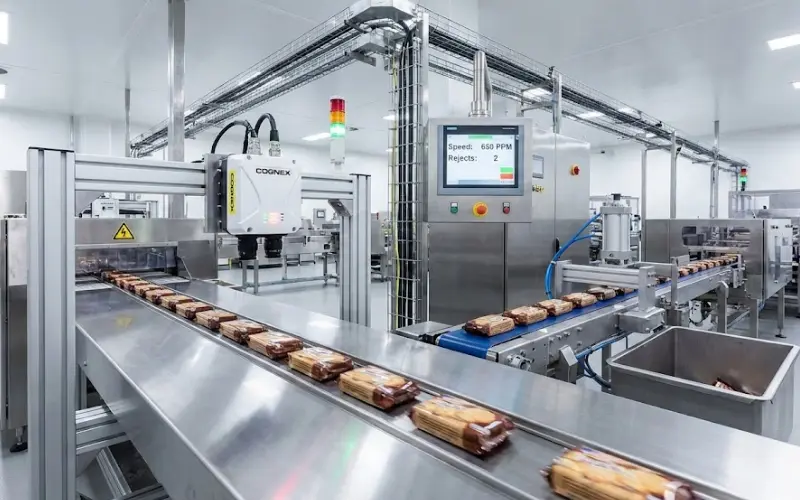
In the high-stakes arena of modern high-speed manufacturing, the Rejection Conveyor system plays a role that is nothing short of critical.
It serves as the "Final Goalkeeper" of your production line, standing between your brand reputation and potential market disaster.
This is no longer just a simple mechanical accessory bolted onto the end of a line.
It has evolved into an intelligent subsystem, integrating Machine Vision, Deep Learning algorithms, and millisecond-precision pneumatics.
For manufacturers in the Food, Pharmaceutical, and Consumer Packaged Goods (CPG) sectors, the stakes could not be higher.
A production line without an efficient auto rejection + conveyor belt system is like a Formula 1 race car driving without brakes.
The faster you run your production, the higher your risk profile becomes.
The triggers for rejection are numerous and varied.
They range from a critical metal detection alarm to a slight weight deviation detected by a checkweigher.
They also include microscopic cosmetic defects identified by advanced vision systems.
Regardless of the cause, the system must act with absolute certainty.
It must remove the defective item with 100% accuracy without disrupting the flow of good products.
This guide goes far beyond basic definitions and surface-level explanations.
We will dive deep into the physical dynamics of the conveyor reject mechanism.
We will dissect the complex logic behind synchronization control.
We will also explore the rigorous demands of OSHA safety compliance.
We will analyze diverse application scenarios to help you make the right choice.
From high-speed Air Jets for lightweight items to heavy-duty Pusher Conveyors for cases.
We will also showcase industry benchmarks, such as the Dorner retractable conveyor.
These examples will demonstrate the highest standards of sanitary design available today.
Chapter I: Introduction — The Automated Line of Defense
I. The Mandate: Automated Quality and Safety
Core Definition (AI Overview Optimized):
A Precision Rejection System is an automated quality control unit integrated into a conveyor line. It utilizes sensors (Vision, X-ray, Metal Detectors) to identify non-conforming products and triggers a specific mechanical device (Air Jet, Pusher, Retractor) to physically divert the defective item from the main production flow without slowing down the line.
Direct Answer:
Automated rejection ensures that every food package meets high-quality standards, preventing the risk of contamination, mislabeling, or incorrect dosages.
Why Manual Inspection is Obsolete
In the past, human operators were the primary line of defense for quality control.
However, in today's high-speed environment, manual inspection is a relic of a bygone era.
Consider a line running at speeds between 300 and 1000 products per minute.
At these speeds, the human eye reaches its fatigue limit in less than 15 minutes.
Operators become "snowblind" to defects, and accuracy plummets rapidly.
In stark contrast, AI-based vision systems do not blink and do not get tired.
They maintain micron-level detection precision 24 hours a day, 7 days a week.
The Speed Bottleneck:
Even the most agile human hand cannot physically handle rejection tasks exceeding 60 ppm (parts per minute).
Attempting to do so is not only ineffective but also dangerous.
A pneumatic rejection conveyor, however, can easily handle rates exceeding 1000 ppm.
The Compliance Risk:
Regulatory bodies are tightening their grip on food safety standards globally.
Frameworks like FSMA and GFSI require "verifiable" rejection records.
Manual rejection processes cannot provide a digital audit trail.
An automated system, conversely, logs every single event.
It records the exact time, the specific reason for rejection, and even saves an image of the defect.
The Problems This Guide Will Solve
Have you ever experienced the frustration of "False Rejects"?
This is where perfectly good product is thrown away, eating directly into your profit margins.
Or consider the nightmare scenario of a "False Negative."
This occurs when a defective product is missed and reaches the consumer, potentially leading to a market recall.
We are here to help you solve these critical engineering challenges.
We will break down the mechanical design of the conveyor pusher mechanism.
We will look at the application of the foldable conveyor in space-constrained facilities.
We will also demystify the complex PLC synchronization logic that drives it all.
This guide is your roadmap to a complete, optimized solution.
🔑 Key Takeaways
Match Mechanism to Product: There is no "one-size-fits-all" rejector; lightweight cookies demand Air Jets, while heavy cartons require a Pusher Conveyor.
Synchronization is the Heart: The success of a rejector depends less on brute force and more on the millisecond precision of the PLC tracking logic (Shift Register).
Verification is Mandatory: You must install a "Reject Verification Sensor"; without it, you never truly know if the defective item actually left the belt.
Hygiene as an Investment: Choosing a system designed for rapid disassembly, like the Dorner retractable conveyor, is the key to lowering your long-term cleaning costs.
Chapter II: Detection Technology — The Eyes of the Line
II. Detection Technology: The Eyes of the Line
Before a rejection conveyor can take any physical action, the system must first "see" the problem.
The detection phase is the upstream intelligence that dictates downstream action.
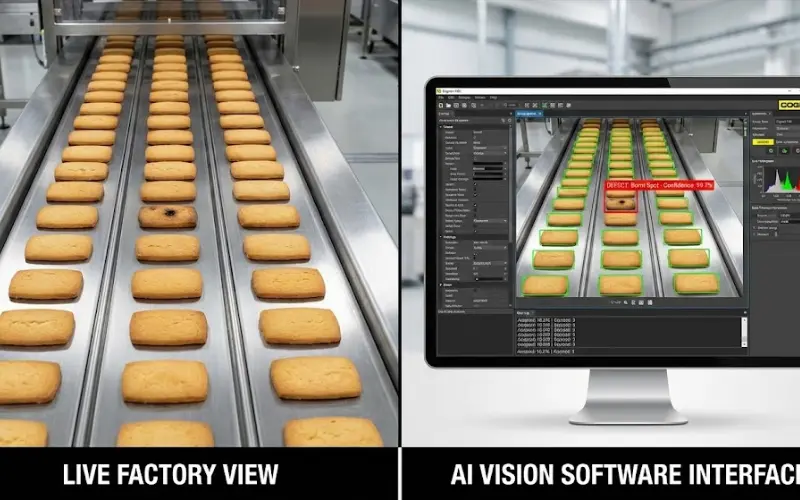
Machine Vision and AI (Vision Systems)
Traditional vision systems relied on rigid, rule-based programming.
For example, a rule might state: "Reject if diameter is less than 50mm."
While effective for simple geometry, this approach fails with organic or complex products.
Modern AI vision systems have revolutionized this process through Deep Learning.
They can identify unstructured and variable defects that rule-based systems miss.
Surface Defects:
AI can detect subtle issues like uneven baking color (burnt spots) on a biscuit.
It can identify micro-cracks that compromise structural integrity.
It can even spot uneven distribution of toppings, such as frosting or sesame seeds.
OCR Verification:
Optical Character Recognition (OCR) is critical for packaging compliance.
The system verifies that the date code and lot number are printed clearly and correctly.
Integrity Checks:
The system checks if the packaging is sealed properly before it reaches the conveyor diverter.
It ensures no product is trapped in the seal area.
2. Metal Detection and X-Ray
This technology represents the absolute baseline for food safety.
It is the non-negotiable standard for any responsible manufacturer.
When a metal detector identifies ferrous, non-ferrous, or stainless steel contaminants, it reacts instantly.
It sends a Dry Contact Signal to the rejection system conveyor.
The Challenge of Signal Latency:
It is important to understand that detection is not truly instantaneous.
The detector has a processing time, typically ranging from 5 to 10 milliseconds.
On a high-speed line, this latency matters significantly.
In that fraction of a second, the product has already moved several centimeters forward.
When designing your how to reject rejection logic, you must mathematically compensate for this system latency.
If you fail to account for it, your rejector will fire too late.
This results in missing the contaminant or partially crushing the product.
Chapter III: Ejection Mechanisms — High-Speed Physics
III. Ejection Mechanisms: High-Speed Physics
This is the core physical execution component of the conveyor reject mechanism.
It is the "muscle" that executes the "brain's" command.
Choosing the wrong mechanism is a recipe for disaster.
It can lead to product jams, tipped containers, or even damage to the rejection equipment itself.
1. Air Jet / Air Blast Rejection
Ideal Application Scenario:
This method is best suited for lightweight products, typically under 200g.
Common examples include naked biscuits, empty pouches, or small confectionery items.
Operational Principle:
It utilizes a high-pressure pulse of compressed air controlled by a fast-acting solenoid valve.
The pressure is typically set between 5 and 8 bar (70-115 psi).
This blast instantly blows the product off the travel path.
The Advantages:
It is incredibly fast, with response times often under 5 milliseconds.
It is a non-contact method, making it extremely hygienic and gentle on the belt.
There are no moving mechanical parts to wear out or clean.
The Limitations:
It is completely ineffective for heavy or dense items.
If the facility's air pressure fluctuates, the rejection trajectory becomes unstable.
This can lead to products not fully clearing the belt.
2. Pusher Conveyor (Pneumatic Ram)
Ideal Application Scenario:
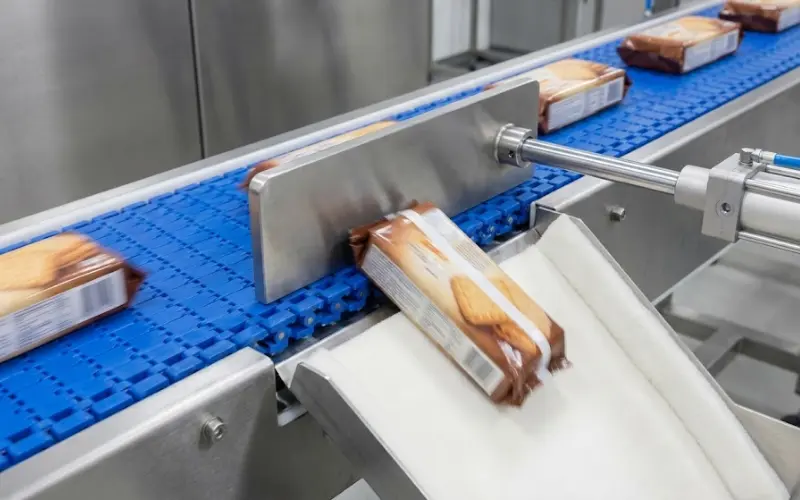
This is the workhorse for medium to heavy packaged products.
It handles items ranging from 500g to 20kg, such as cartons, bottles, and bagged foods.
Core Design features:
The Conveyor pusher mechanism is typically driven by a pneumatic cylinder or a high-speed servo motor.
A Pusher Plate extends rapidly from the side of the conveyor.
It pushes the product laterally into a reject chute or bin.
Engineering Calculations:
To work effectively, the pushing force (
It must be greater than the maximum static friction between the product and the belt.
The formula is expressed as:
Here,
However, theoretical calculation is just the starting point.
To ensure instantaneous acceleration without tipping the product, engineers apply a safety factor.
The actual design thrust is usually 3 to 5 times the calculated theoretical value.
3. Retracting Tail (Retracting Conveyor)
Industry Benchmark:
The Dorner retractable conveyor is widely considered the gold standard in this category.
Ideal Application Scenario:
This is perfect for products arriving in organized rows.
It is also the only viable solution for sticky products or raw dough.
It is used when you cannot disturb the orientation of the product.
Operational Principle:
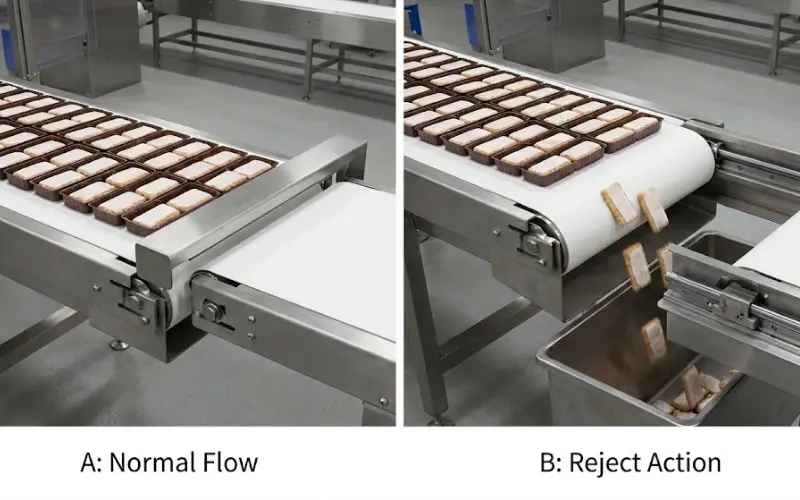
The end of the conveyor belt (the Nose Bar) is mounted on a pneumatic slide.
Upon a reject signal, the entire tail rapidly retracts (pulls back) horizontally.
This creates a physical gap in the conveyor line.
The defective product simply falls off the edge into a bin below.
Once the defect clears, the nose bar extends back to its original position to catch the next good product.
The Advantages:
It is the ultimate hygienic solution.
The product is never pushed, touched, or slid sideways.
There is zero risk of product smearing on a pusher plate.
It leaves no residue on the belt, making it ideal for naked food applications.
Deep Dive: Learn more about innovative conveyor designs in our Turning Conveyor Design Guide.
4. Diverters and Drop-Gates
Conveyor Diverter Arm:
This consists of a mechanical arm or paddle that swings across the belt.
It gently guides the product into a separate lane.
It is suitable for slower speeds and fragile items like glass bottles that might shatter if pushed.
Drop-Gate (Trap Door):
This mechanism involves a section of the conveyor floor or bed opening up.
The product falls through due to gravity.
It is highly effective for bulk flow items, such as grains, powders, or loose frozen vegetables.
Chapter IV: Synchronization Control — The Brain of the System
IV. The Critical Role of Synchronization (Timing)
You could possess the world's fastest pusher conveyor.
But if it fires at the wrong millisecond, it creates nothing but chaos.
The rejector will hit the wrong product, or worse, cause a jam.
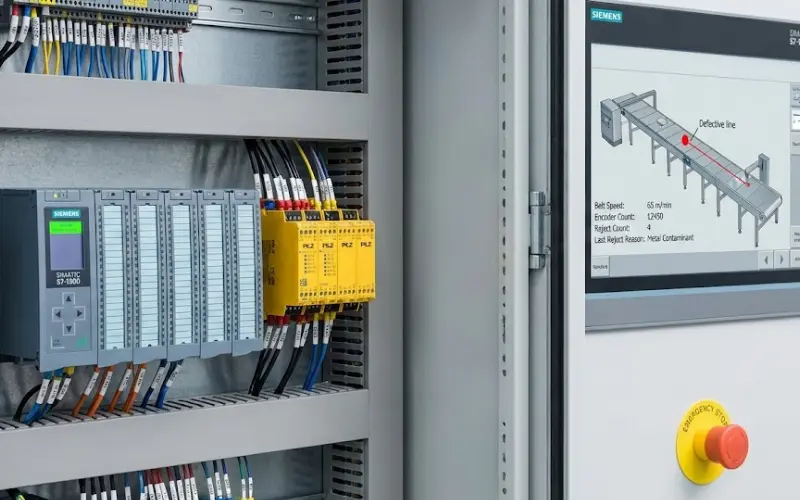
This is the battlefield of PLC synchronization logic.
1. Encoders & Shift Registers
The system is never as simple as "see it, reject it."
There is always a physical distance between the detection point and the rejection point.
This distance can range from 0.5 meters to over 2 meters.
Distance Tracking:
We use a rotary encoder mounted on the conveyor drive shaft.
This device converts the physical movement of the belt into digital pulses.
This allows the system to track position regardless of speed fluctuations.
The Logic (Shift Register):
When the vision system identifies a defect at Position A, the PLC tags it.
It creates a "virtual product" in its memory data block.
As the belt moves, the encoder counts the pulses.
When the pulse count indicates the virtual product has reached Position B (the rejector).
The PLC triggers the rejection conveyor action.
Note: On a variable speed line, you must trigger based on distance (pulse count).
Never trigger based on time, as speed changes will throw off the timing.
Deep Dive: For a comprehensive look at synchronization, read our Conveyor Synchronization Guide.
2. Reject Verification (The Closed Loop)
This is a critical safety loop that is often overlooked by inexperienced integrators.
The Problem:
Mechanisms fail.
A cylinder might stick, a solenoid valve might burn out, or the pusher conveyor might miss.
If the rejector fails, the contaminant continues down the line to the customer.
The Solution:
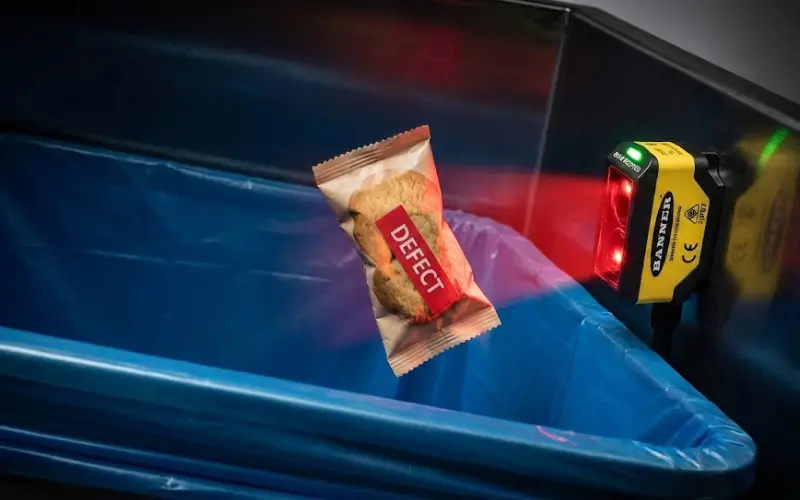
You must install a photo-eye sensor at the entrance of the reject bin.
This is known as the Reject Verification Eye.
If the PLC sends a signal to reject, but the Verification Eye does not see an object fall.
The system must assume the rejection failed.
It must immediately trigger an Emergency Stop and sound an alarm.
This "fail-safe" logic is a mandatory requirement for GFSI and HACCP audits.
Chapter V: Hygiene & Maintenance — Lessons from Leaders
V. Sanitary Design & Maintenance
In a food factory, the rejection system conveyor is a high-risk zone for contamination.
Defective products are often broken, leaking, or crumbling.
This means the rejection area accumulates more debris than any other part of the line.
1. Sanitary Design Standards
Let's look at the standards set by leaders like Dorner conveyors.
An excellent food-grade rejection system must prioritize cleanability.
Tool-less Removal:
Operators should be able to disassemble the pusher plates, guides, and belts without tools.
If it requires a wrench, it won't get cleaned often enough.
Cantilevered Frame:
This design supports the conveyor from only one side.
It allows the belt to be removed and replaced from the open side.
This reduces a complex maintenance task to a simple, minutes-long operation.
Rounded and Sloped Surfaces:
The frame design should avoid flat horizontal surfaces.
Water must be able to drain off freely during washdown.
This prevents the pooling of water, which encourages bacterial growth.
Deep Dive: Understand the material considerations for sanitary conveyors in our Conveyor Belt Material Selection Guide.
2. Foldable and Space-Saving Designs
In tight factory layouts, accessibility is a major challenge.
Sometimes, the reject bin blocks an aisle or walkway.
The Foldable Conveyor Solution:
Some designs incorporate a foldable conveyor section for the reject lane.
When the line is not in production or during cleaning.
The reject lane can be folded upwards to clear the aisle.
This adheres to Lean Manufacturing principles by optimizing floor space.
Chapter VI: Regulations & Safety — The OSHA Perspective
VI. Safety Compliance: OSHA & LOTO
A Rejection conveyor is a high-energy, high-speed device.
It presents significant risks of crushing, pinching, and impact injuries.
1. Guarding Requirements
According to OSHA 1910.212, all moving parts must be guarded.
This explicitly includes the rod and extension path of the conveyor pusher mechanism.
Operators must not be able to reach into the rejection zone.
Interlocks:
Guarding is not enough; it must be intelligent.
If an operator opens a guard door for cleaning or jam clearing.
Interlock switches must immediately cut power to the rejector.
2. Energy Isolation (LOTO)
Maintenance on a Dorner retractable conveyor or pusher requires strict protocols.
You must follow Lockout/Tagout (LOTO) procedures.
The Hidden Killer:
Electrical power is not the only danger.
Pneumatic systems store energy in the form of compressed air.
Even if the power is off, a pusher can still fire if the air is not bled.
You must ensure the main air valve is locked out and the system is depressurized.
Chapter VII: Frequently Asked Questions (FAQ)
VII. Frequently Asked Questions
We have curated real-world questions from PPA (People Also Ask) and Quora.
These answers address the most common confusion points regarding rejection conveyors.
Q1: What is a reject conveyor?
A: A Reject conveyor is an automated system integrated into a production line. Its sole purpose is to physically remove non-conforming products from the main flow based on preset quality standards (weight, metal, visual defects). It combines sensors, PLC logic, and a mechanical device like a pusher or air jet.
Q2: What are the three types of conveyors used in rejection systems?
A: The three most common base conveyors are:
Belt Conveyor: The most versatile option, suitable for most pusher conveyor applications.
Modular Belt Conveyor: Used for applications requiring durability, drainage, or Dorner retractable conveyor mechanisms.
Roller Conveyor: Essential for heavy cases; often paired with a conveyor diverter utilizing pop-up wheels.
Q3: What are the OSHA rules for conveyors and rejection mechanisms?
A: The primary standards are OSHA 1910.212 (Machine Guarding) and ASME B20.1 (Safety Standard for Conveyors). Key mandates include:
Guarding all pinch points and shear points.
Installing readily accessible Emergency Stop (E-Stop) buttons.
Lockable energy sources for LOTO procedures.
Catch pans or netting if the conveyor runs overhead to prevent falling objects.
Q4: What is a reclaim conveyor?
A: A Reclaim conveyor is often situated downstream or underneath the rejection conveyor. Its function is to collect the rejected products and transport them to a rework area or waste disposal. In a biscuit factory, this belt might carry broken biscuits back to a grinder to be turned into rework powder.
Q5: How to prevent "False Rejects" in a conveyor system?
A: False rejects are almost always a synchronization issue.
Check your encoder for slippage on the drive shaft.
Ensure product pitch is stable; use a vacuum belt on the auto rejection + conveyor belt system to prevent products from sliding during detection.
Clean your photo-eyes regularly to prevent dust from triggering false signals.
Deep Dive: Maintaining consistent product pitch is crucial. See our guide on Speed-Up Conveyor Dynamics for more.
Q6: Why use a Dorner retractable conveyor over a pusher?
A: For organized rows of biscuits or sticky dough, a pusher conveyor is destructive. It can deform the product or cause it to stick to the pusher plate. A retractable tail allows the product to fall naturally via gravity. It maintains product orientation and keeps the belt surface far cleaner.
Chapter VIII: Conclusion — The Zero-Defect Commitment
VIII. Conclusion: The Zero-Defect Commitment
In the modern manufacturing landscape, the Rejection Conveyor is not a trash can.
It is the guardian of your brand's integrity.
It is the last line of defense before your product reaches the customer.
A well-designed rejection system conveyor delivers three massive benefits:
Absolute Safety:
It ensures 100% interception of metal and foreign contaminants.
Operational Efficiency:
It allows high-speed lines to continue running without stopping for defects.
Data Intelligence:
It provides actionable data to optimize upstream processes.
Every detail matters, from selecting the right conveyor pusher mechanism.
To implementing rigorous how to reject rejection verification logic.
These details determine your Return on Investment (ROI).
Do not let a sub-par rejection system become the bottleneck of your factory.
Professional Services CTA
Send us a video of your product. Our engineers will analyze its characteristics and recommend the best stacking technology to maximize your line's efficiency and protect your product quality.
Sofia | Export Vice President | EverSmartWhatsApp: +86 137 94619343Email: [email protected]

Ready to start your journey toward a customized solution? Contact me directly on WhatsApp to begin the conversation.