Mastering the Curve: The Ultimate Guide to 90°, 180°, and Z-Type Conveyors for Food Production
Author: David Wang, Senior Automation Engineer | 16+ years of experience in F&B packaging line integration for multinationals like Nestlé and Orion.Date: 2025Read Time: 40 Minutes
SEO Title: Turning Conveyor Design Guide: 90°, 180° & Z-Type SolutionsURL Slug: /turning-conveyor-design-guide-food-industryMeta Description: Master the design of turning conveyors. Learn how to beat centrifugal force, maintain product pitch, and optimize factory layout with 90°, 180°, and Z-type systems.
I. Introduction: When the Production Line Meets Physics
In the high-stakes world of modern food manufacturing, space is money.
This is especially true for biscuit, bakery, and flexible packaging environments where every square foot of the factory floor represents a significant capital investment.
The core design challenge often boils down to a brutal trade-off.
How do you maximize throughput capacity while simultaneously minimizing product waste within a constrained physical footprint?
Designing an efficient turning conveyor system is not simply about connecting Point A to Point B.
It is, in reality, a complex engineering art form dedicated to battling Centrifugal Force and Gravity.
The true solution lies in breaking free from two-dimensional "flat" thinking.
We must leverage tapered roller geometry, smart differential speed control, and Z-type 3D layouts.
These technologies allow us to change flow direction within the smallest possible footprint.
Crucially, they do this while locking in the product's Pitch and structural integrity, which is essential for the overall Biscuit Cooling and Handling process.
For the Factory Owner, this strategic approach translates directly to higher Space Efficiency.
For the Chief Engineer, it means significantly less downtime and reactive maintenance.
For the Finance Manager, it equates to a demonstrably lower Total Cost of Ownership (TCO).
This comprehensive guide will go deep into the design philosophy behind everything from a standard 90 degree turn conveyor to complex Z-type elevation systems.
We will reveal the technical nuances that your competitors—and often your suppliers—rarely discuss.
🔑 Key Takeaways for Decision Makers
Think in 3D, Not 2D: Break the limitations of the flat factory floor by utilizing Z-Type Conveyors and 180° U-Turns to push space utilization to its absolute physical limit.
Defy the Laws of Physics: Deploy Tapered Rollers and Smart Differential technologies to counteract centrifugal force, ensuring your products never drift or crumble during high-speed turns.
Hygiene Equals Efficiency: Prioritize Cantilever Design for all food applications; it slashes belt changeover times from four hours down to just 20 minutes, radically cutting downtime costs.
Precision Control is King: Solve the nightmare of jamming small products by utilizing Knife-Edge Transfers and PID Closed-Loop Synchronization to maintain perfect product pitch.
II. The Physics of the Turn: Battling Centrifugal Force and Maintaining Pitch
Before we even glance at an equipment catalog or a spec sheet, we must understand the invisible forces at play.
We need to grasp why the curve conveyor is statistically the most likely failure point on any production line.
1. The Enemy is Centrifugal Force
Imagine a delicate shortbread biscuit or a freshly packed carton entering a curve at high speed.
Sir Isaac Newton’s first law of motion immediately asserts its dominance.
An object in motion wants to stay in straight-line motion.
This resistance to turning creates what we call centrifugal force.
The Physical Phenomenon:
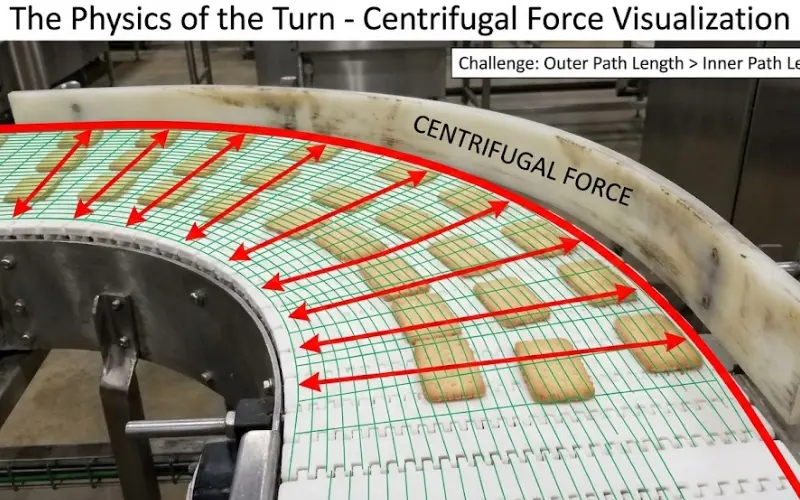
Your product will inevitably drift toward the outer edge of the conveyor belt.
The Consequence:
Without proper curved conveyor belt design, products will crush against the outer guardrails.
This leads to damaged edges on fragile biscuits, creating waste and rework.
Worse yet, it causes misalignment that can trip Precision Rejection sensors downstream.
Note:Centrifugal force doesn't just change a product's position; it destroys the product's Pitch. If your line feeds into an automated packaging machine, pitch disruption is fatal and will cause constant jamming alarms.
2. The Criticality of Maintaining Product Pitch
"Pitch" refers to the precise, consistent spacing between products on the belt, both longitudinally and latitudinally.
Maintaining pitch is trivial on a straight conveyor.
However, on a 90 degree curve conveyor, the geometry changes everything.
The path along the outer radius is significantly longer than the path along the inner radius.
If the surface speed of the belt is uniform across its width—like a standard cylindrical roller—disaster strikes.
The outer side of the product will lag behind the inner side.
This causes your neat array of products to "fan out" and lose their orientation.
The Core Challenge:
How do we make the outer edge of the belt travel faster than the inner edge, at the exact ratio required?
This geometric puzzle is the secret behind how do curved conveyor belts work.
III. Mechanical Solutions: How Geometry Conquers Physics
To solve these physical dilemmas, mechanical engineers have developed specific turning conveyor belt technologies.
We should never select these based on price alone.
Selection must be dictated by the product's physical characteristics: friction coefficient, bottom flatness, and fragility.
1. Tapered Roller Technology
This is the classic, time-tested solution for roller curve conveyors.
It relies on pure geometry to solve the speed differential problem.
The Principle:
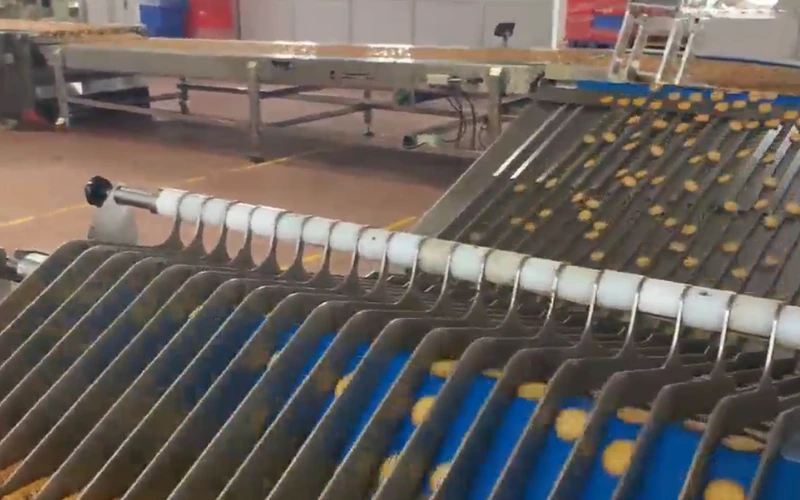
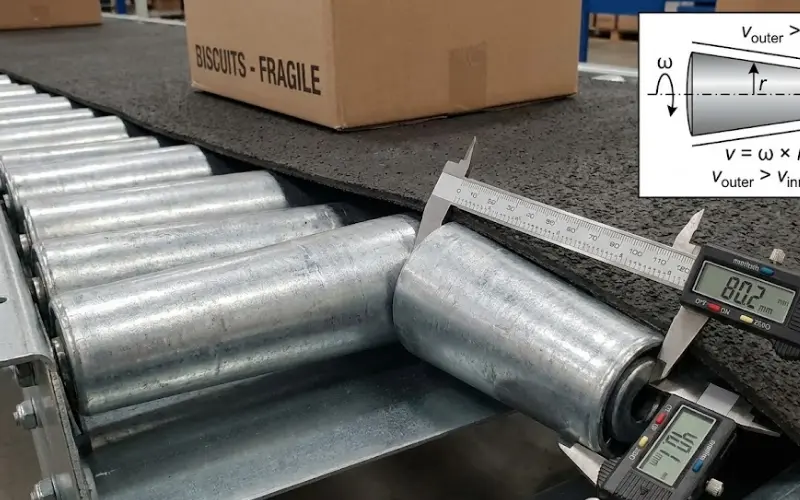
The curve conveyor roller is machined into a conical shape.
The outer diameter is larger, while the inner diameter is smaller.
According to the formula
The Advantage:
When the taper is calculated to match the turn radius perfectly, the product experiences pure rolling friction.
It eliminates the sliding friction that causes twisting.
Your product maintains perfect posture through the curve without complex electronic controls.
Ideal Applications:
Cardboard cases, plastic trays, and packaged food items with rigid bottoms.
💡 Pro Tip:While Tapered Rollers are durable, they can cause slight deformation on soft-bottomed bagged products, like flour sacks. In these specific cases, a modular belt surface is often the superior choice to distribute weight evenly.
2. Side-Flexing Modular Belts
In curve conveyor modular systems, we utilize specialized plastic belt links.
These links are engineered with a unique hinge mechanism.
Design Highlight:
This structure allows the belt to "collapse" on the inner radius and "fan out" on the outer radius.
This creates a perfect arc without stretching the material.
Industry Advantage:
Made from durable engineering plastics like POM or PP (compliant with FDA CFR 21), these plastic modular belts are impervious to water and chemicals.
This makes them ideal for meat, dough, or raw food transport where frequent washdowns are mandatory.
When paired with precision curved conveyor guide rails, tracking issues are virtually eliminated.
3. Smart Active Dual-Belt Differential
For extremely fragile premium biscuits or product turning conveyor applications requiring strict orientation, mechanical compensation is not enough.
We need active control.
Technical Detail:
This is often referred to as a twin belt turning conveyor.
It utilizes two independent servo motors to drive the inner and outer belts separately.
A PLC algorithm precisely calculates and controls the speed difference between the two belts.
The Value:
This achieves a "Zero Pressure" turn.
You can even adjust the speed differential dynamically to actively correct a product's orientation before it enters the curve.
IV. Geometric Strategy: Deploying 90°, 180°, and Z-Types
Factory design is fundamentally an exercise in spatial management.
Different turning angles play different strategic roles on your layout.
1. The 90° Turn: The Axis Changer
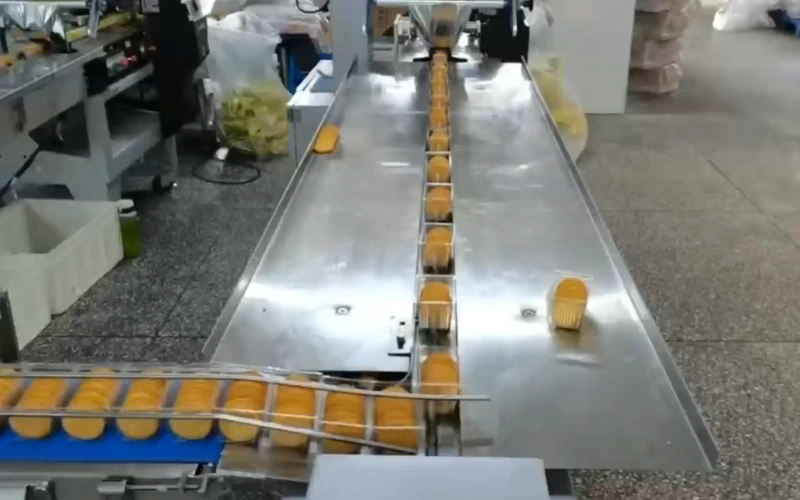
The 90 degree turning conveyor is the standard configuration for connecting two perpendicular production lines.
It is the workhorse of the L-shaped factory layout.
Typical Scenario:
Transitioning from a long, narrow baking tunnel oven into a wider, multi-lane packaging hall.
Design Trap:
At the node of the turning cross conveyor, poor transfer plate design is a common failure.
This leads to "dead zone accumulation" where products stall and rot.
High-quality designs utilize Micro-Transfers to eliminate this risk entirely.
2. The 180° U-Turn: The Space Magician
One of the smartest uses of a curve conveyor is to trade Time for Space.
The Scenario:
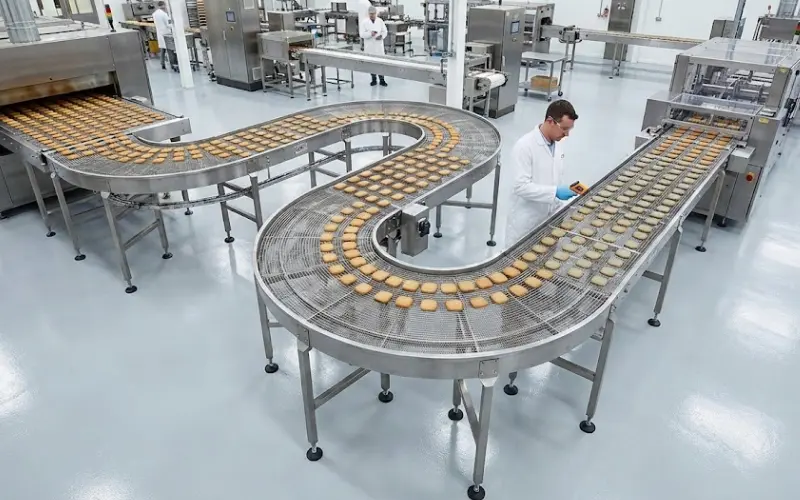
Freshly baked biscuits require five minutes of ambient cooling before they can be wrapped.
If you lay this out in a straight line, your conveyor would need to be hundreds of feet long.
This would likely exceed the length of your building.
The Solution:
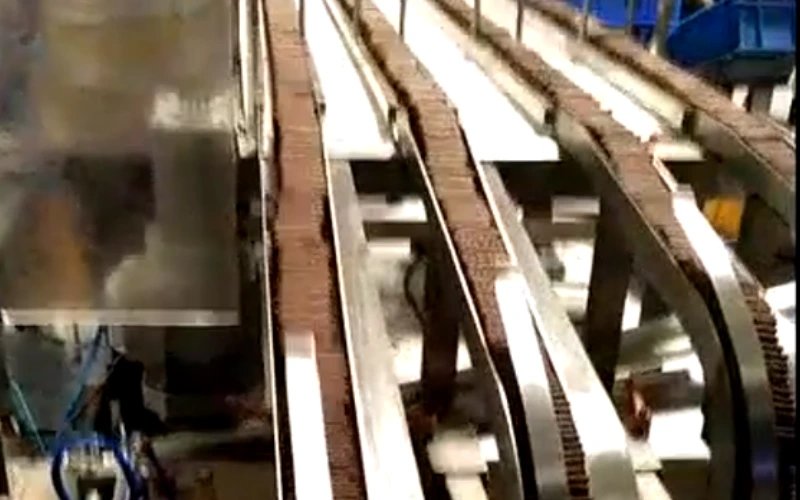
Use multiple 180-degree turning conveyors to build an S-shape or U-shape loop.
This extends the travel path within a compact footprint.
It also eliminates the multiple failure points found in right-angle transfers.
Note:When designing U-turns for Cooling Conveyors, you must calculate the Open Area percentage of the belt. A mesh that is too dense will block airflow, leading to "Soggy Bottom Syndrome" on your biscuits.
3. The Z-Type Conveyor: Conquering the Vertical Dimension
This is our top recommendation for differentiating your factory layout.
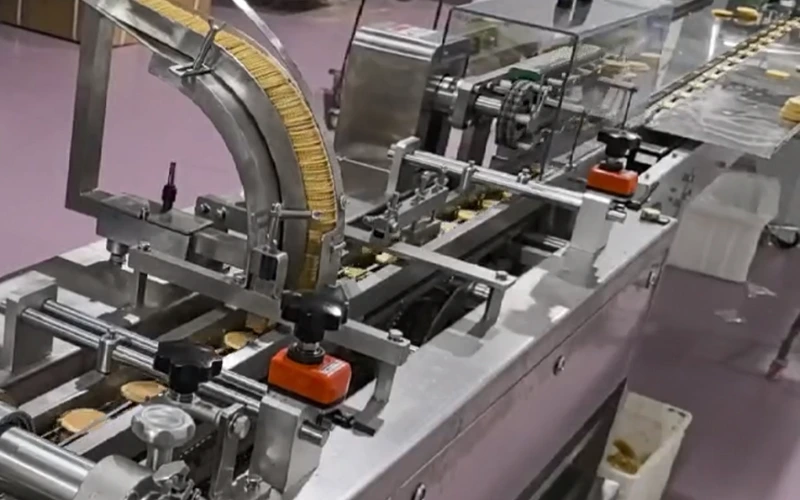
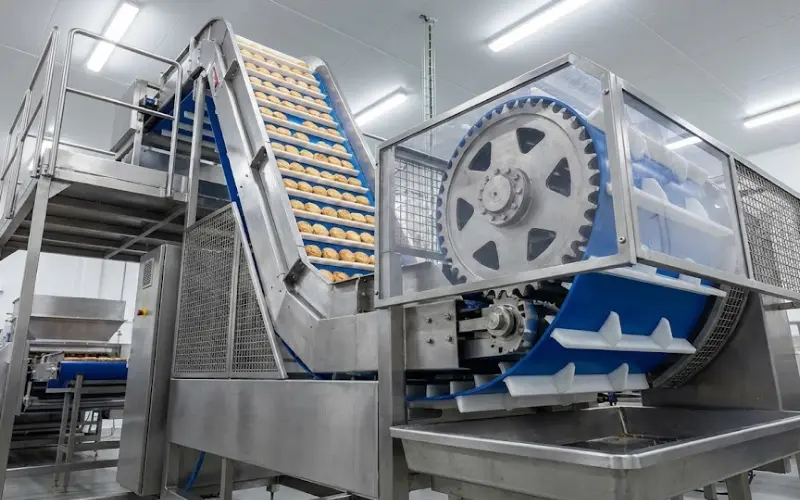
When horizontal space is exhausted, the Z type turning conveyor (or Goose-Neck Conveyor) takes you into the third dimension.
Vertical Feeding:
Elevate raw ingredients from a low-level mixer directly into a high-level forming machine hopper.
Obstacle Crossing:
Use the Z-structure to bridge over pedestrian walkways or other equipment lines.
This maintains EHS safety compliance without forcing operators to walk around long lines.
Anti-Slip Mastery:
In a biscuit factory, grease and oil are omnipresent.
Standard friction-drive belts will slip catastrophically on the incline section of a Z-conveyor.
Best Practice:
You must specify positive drive systems (sprockets engaging the belt).
Use a turning chain conveyor or a belt with welded cleats.
This design acts like a tank tread, ensuring precise synchronization regardless of how much oil is on the line.
💡 Pro Tip:Never rely on friction for a Z-type incline in a bakery. In greasy dough or cream environments, only Positive Drive (Sprocket Engagement) guarantees zero slippage and zero tracking issues.
V. Electrical Synchronization and Transfer Management
To an electrical engineer, a biscuit turning conveyor is not just a piece of iron.
It is a motion axis requiring millisecond-level precision.
1. Line Synchronization
The speed of the turning unit must match the upstream and downstream belts perfectly.
The Synchronization Crisis:
If the turn is slower than the upstream feed, products will crash and pile up (Jamming).
If it is too fast, the gap between products will expand unpredictably (Gapping).
The Solution:
Do not attempt to control this with manual potentiometers.
Modern turning table conveyors must be equipped with Variable Frequency Drives (VFDs) and photo-eyes.
These feed into a PLC to establish a PID closed-loop control.
When upstream flow fluctuates, the turn conveyor responds instantly to adjust its speed.
2. Knife-Edge Transfers
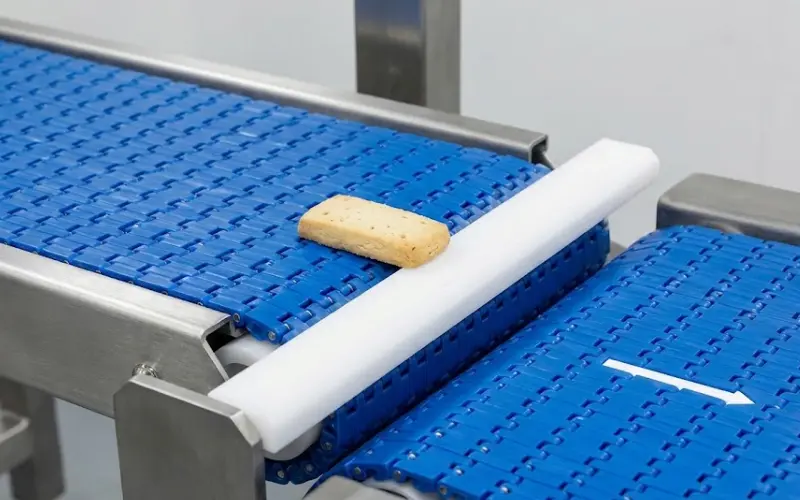
This is a detail often overlooked in pack turning conveyor specifications.
The Gap Problem:
Traditional rollers often have a diameter of 50mm or more.
Placing two of these end-to-end creates a large "valley" gap.
For a small 40mm biscuit, this valley is a trap where it will stall or flip.
The Knife-Edge Solution:
We replace the terminal roller with a fixed Nose Bar having a diameter of less than 6mm.
This forces the belt to wrap around an extremely tight radius.
It achieves a "fingertip" transfer, allowing even the smallest products to glide across smoothly.
Note:Because the Nose Bar has a tiny radius, friction generates heat rapidly. Design specifications must call for high-temperature, low-friction materials. Belt tension must be moderate; otherwise, you will accelerate belt aging and failure.
VI. Operations & TCO: The Owner and Maintenance Perspective
Buying a used turning conveyor might seem like a way to save cash upfront.
However, when you factor in maintenance and downtime, the Total Cost of Ownership (TCO) of modern designs is far lower.
1. Hygienic Cantilever Design
In a food factory, cleaning time is nothing but lost production time.
The Traditional Pain:
Replacing an endless turning conveyor belt usually requires disassembling the motor, bearings, and side frames.
This process consumes 4 to 6 hours of skilled labor.
The Revolutionary Design:
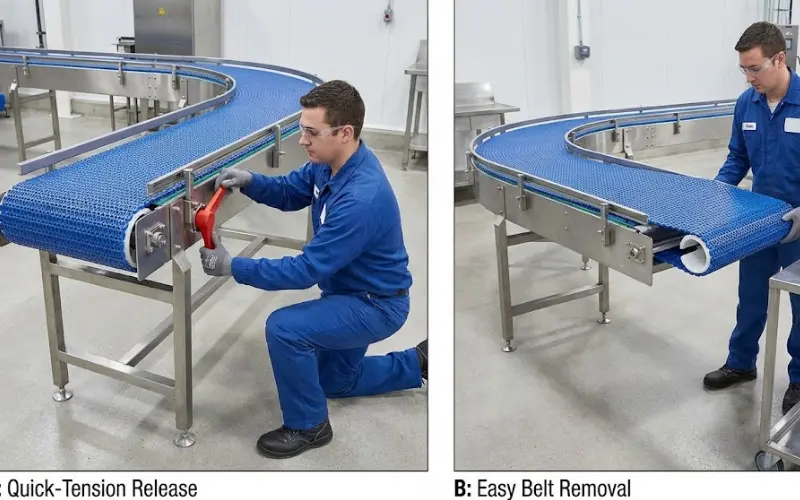
Enter the Cantilever Framework.
The conveyor is supported structurally from only one side, or the frame has a quick-release mechanism.
The Result:
A maintenance technician needs no tools.
They simply release the quick-tensioner.
Within 20 minutes, the entire belt can be slid off the side for deep cleaning or replacement.
This feature is critical for passing unannounced FSMA or GFSI audits.
2. Modularity and Logistics Costs
Shipping Advantage:
Large curve conveyors are bulky, awkward shapes that are expensive to ship.
Modern modular curve conveyor designs allow the equipment to be shipped flat-packed.
It is assembled on-site, reducing ocean freight costs by up to 50%.
Spare Parts Management:
The universality of curve conveyor parts is a key financial driver.
Instead of stocking unique custom belts for every machine, you stock standardized curve conveyor chain and bearings.
This significantly reduces capital tied up in MRO inventory.
💡 Pro Tip:A Cantilever Design may cost 15-20% more upfront than a standard frame. However, consider the 4 hours of labor and 4 hours of lost production saved during every belt change. You will typically recover the price difference during the very first major maintenance event.
VII. Conclusion: The Strategic Edge
As we move into the competitive landscape of 2025, the conveyor system is no longer just auxiliary equipment.
It is a decisive factor in overall factory efficiency (OEE).
Choosing the correct conveyance strategy means you need to adopt three distinct mindsets:
Think like a Physicist: Use tapered rollers and differential speeds to neutralize centrifugal force.
Plan like an Architect: Squeeze value out of every inch with Z-types and tight-radius turns.
Calculate like a CFO: Relentless focus on TCO by investing in cantilever designs and modular parts.
Whether you are scouring the market for a curve conveyor for sale or upgrading an existing turning mechanism for conveyor belt, remember this.
The best design is the one you forget is even there.
It is invisible because the product flow is always smooth, silent, and jam-free.
VIII. Frequently Asked Questions (FAQ)
We have curated these answers based on high-intent search queries from Reddit, Quora, and Google's "People Also Ask" data.
Q1: What is the minimum turning radius required for a curve conveyor?
(Based on keyword: curve conveyor design)
A: The minimum radius is dictated by the belt width and the specific link type. Generally, for a modular curve conveyor, the minimum inner radius is approximately 2.2 times the belt width (R = 2.2 x W). For example, a 500mm wide belt requires an inner radius of at least 1100mm. If you require a tighter turn (such as a compact 90 degree turning conveyor), you may need specialized Zero Tangent belts or machined slat turners. Be aware that these compact options will increase the capital cost.
Q2: Is it worth buying a Used Turning Conveyor?
(Based on keyword: used turning conveyor, used curve conveyor)
A: For core production lines, we strongly advise against purchasing used equipment. There are three critical risks:
Hidden Wear: Wear on curve conveyor guide rails is often invisible to the naked eye but causes chronic tracking issues.
Allergen Risk: Used equipment may harbor allergens (like peanuts or gluten) from a previous owner, which is a fatal risk for a controlled food facility.
Custom Fit: Curves often need to be exact to the millimeter to fit a layout; used units rarely fit perfectly without expensive modifications.
Q3: Why does my turning conveyor belt keep tracking off-center?
(Based on keyword: turning conveyor belt, curved conveyor belt design)
A: Mistracking is usually caused by one of three issues:
Uneven Tension: The tension balance between the inner and outer radius is incorrect.
Guide Wear: The wear strips on the curved conveyor guide rails are worn flat and no longer provide lateral support.
Debris Buildup: Biscuit crumbs trapped between the curve conveyor roller and the slider bed create uneven friction. We recommend upgrading to a system with auto-tensioners and debris clean-out ports.
Q4: Which is better: A Bump Turn or a Curve Conveyor?
(Based on keyword: bump turn conveyor, box turning conveyor)
A: This depends entirely on your product and line speed.
Bump Turn: Uses a static bar to physically hit and spin the product.
Pros: Extremely cheap and simple.
Cons: Only works for slow speeds and rigid boxes (box turning conveyor applications).
Curve Conveyor: Provides a smooth, carried transition.
Pros: Protects product integrity, allows high speeds, maintains array.
Cons: Higher initial capital cost.Verdict: If you are moving naked biscuits or fragile items, you must use a Curve Conveyor. If you are moving sealed shipping cases, a Bump Turn is the cost-effective choice.
Q5: How does your Z-type conveyor prevent greasy biscuits from sliding back?
(Based on keyword: turning chain conveyor, biscuit turning conveyor)
A: Slippage is a classic pain point for biscuit turning conveyor applications. We do not rely on friction coefficients alone. Our Z-type designs utilize:
High-Friction Top Material: Specialized PU or rubber surfaces.
Cleats (Flights): T-shaped or L-shaped barriers thermally welded to the belt at set intervals to physically cradle the product.
Positive Drive: Using a turning chain conveyor or cogged belt ensures the drive sprocket mechanically locks with the belt. This eliminates slippage completely, even in heavy oil environments.
Ultimate Service Conversion CTA
Send us a video of your product. Our engineers will analyze its characteristics and recommend the best stacking technology to maximize your line's efficiency and protect your product quality.
Sofia | Export Vice President | EverSmartWhatsApp: +86 137 94619343Email: [email protected]

Ready to start your journey toward a customized solution? Contact me directly on WhatsApp to begin the conversation.