Siemens vs Omron Control for Sandwich Biscuit Sandwiching and Flow Wrapping Lines: A Decision Guide
On a sandwich biscuit production line, the handoff between the sandwiching machine and the wrapper decides line efficiency far more than the PLC brand does. This guide from EverSmart Food Equipment Limited sets out the order of decisions: motion architecture, plant standards and local support first, platform second.
Handoff first: Stack integrity between machines drives most stoppages.
Architecture before brand: Motion design narrows which platform fits.
Verify early: Interfaces and safety scope need agreement before purchase.
What Does a Controlled Sandwich Biscuit Production Line Actually Consist Of?
A controlled sandwich biscuit production line is a chain of four linked machines: base biscuit feed, cream depositing and sandwiching, accumulation and orientation, and flow wrapping. The controls have to coordinate all four as one system, not as four separate machines.
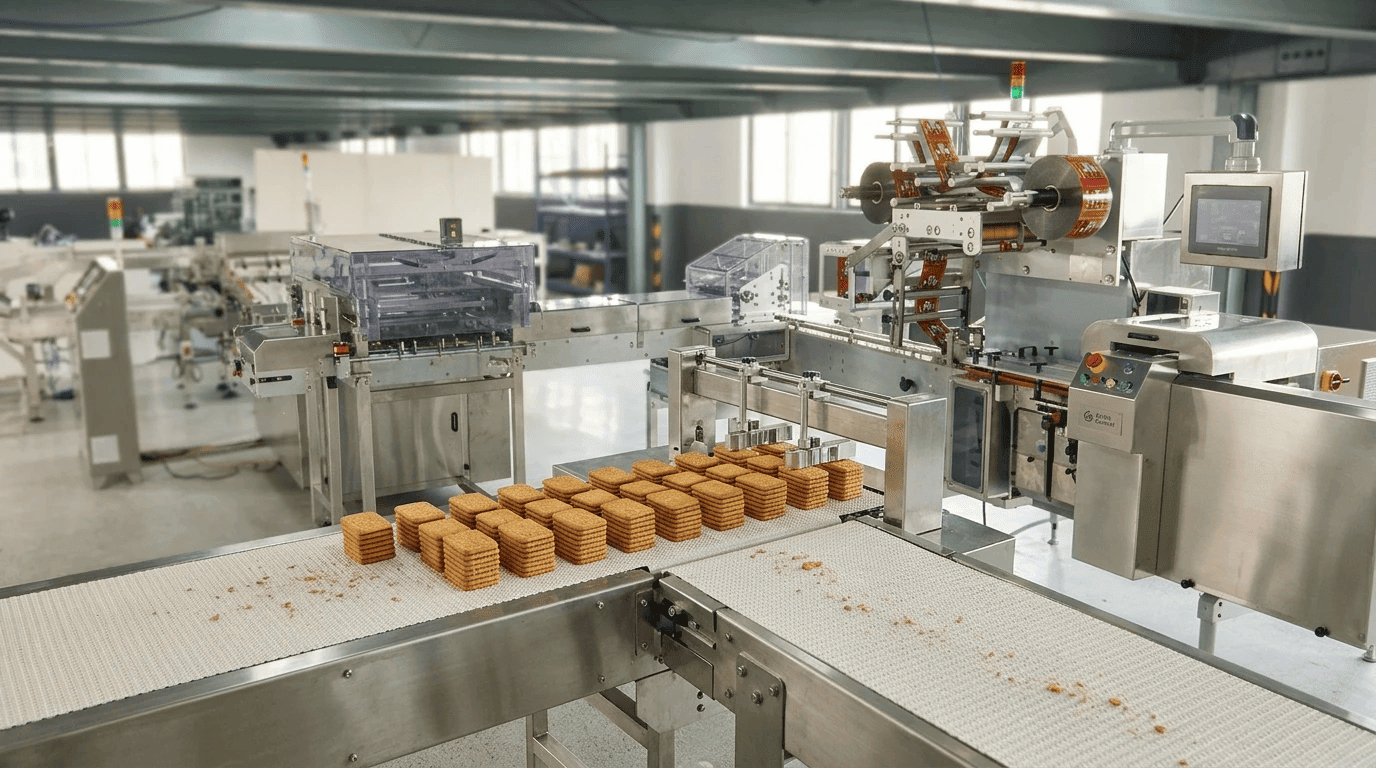
The base biscuit feed delivers oven-cooled biscuits in aligned lanes, with one half usually turned face up and the other face down. The depositing and sandwiching station places cream on the lower biscuit and presses the top biscuit onto it. Its timing depends on biscuit position, so depositor and conveyor motion must stay synchronised.
Accumulation and orientation is the buffer. Finished sandwiches are collected, grouped into stacks or columns and turned to suit the wrapper. This stage absorbs speed differences, and it is where sliding, toppling and breakage often start.
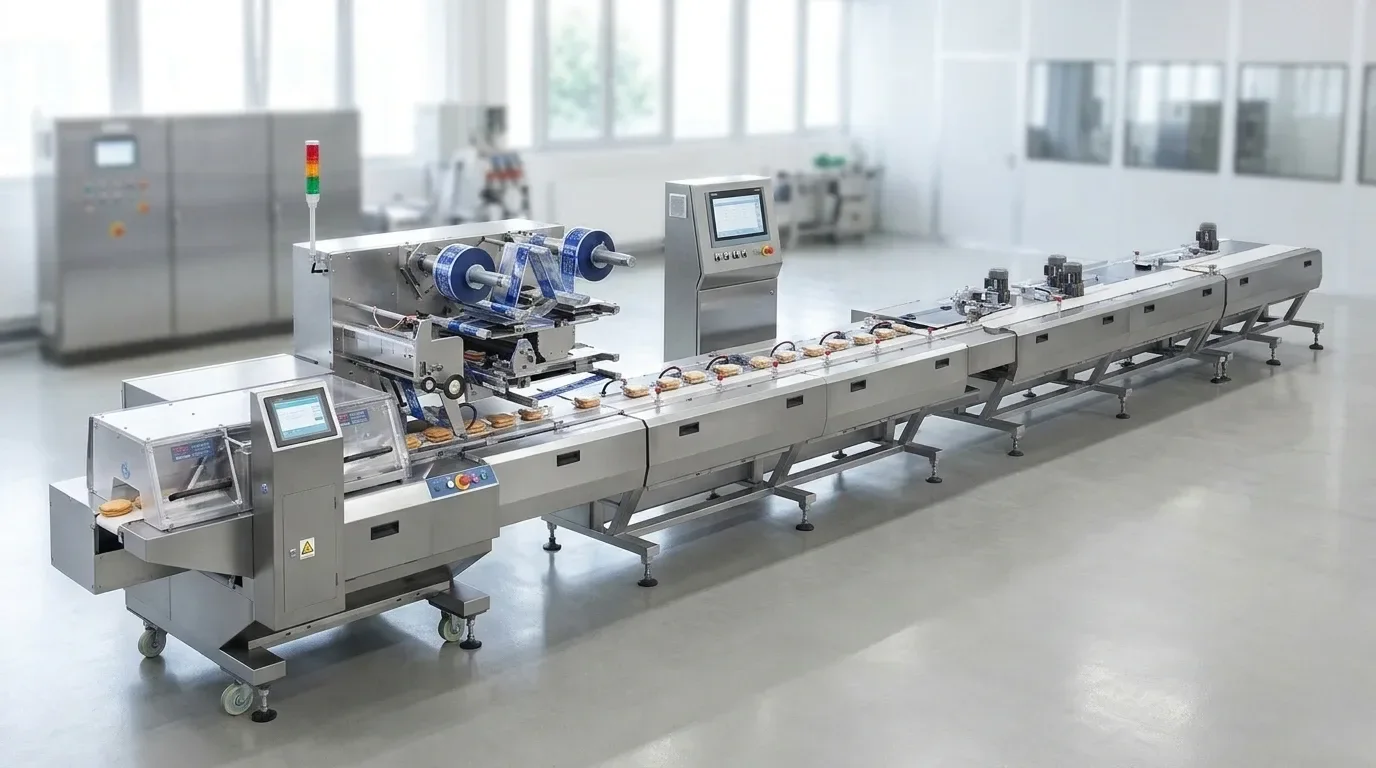
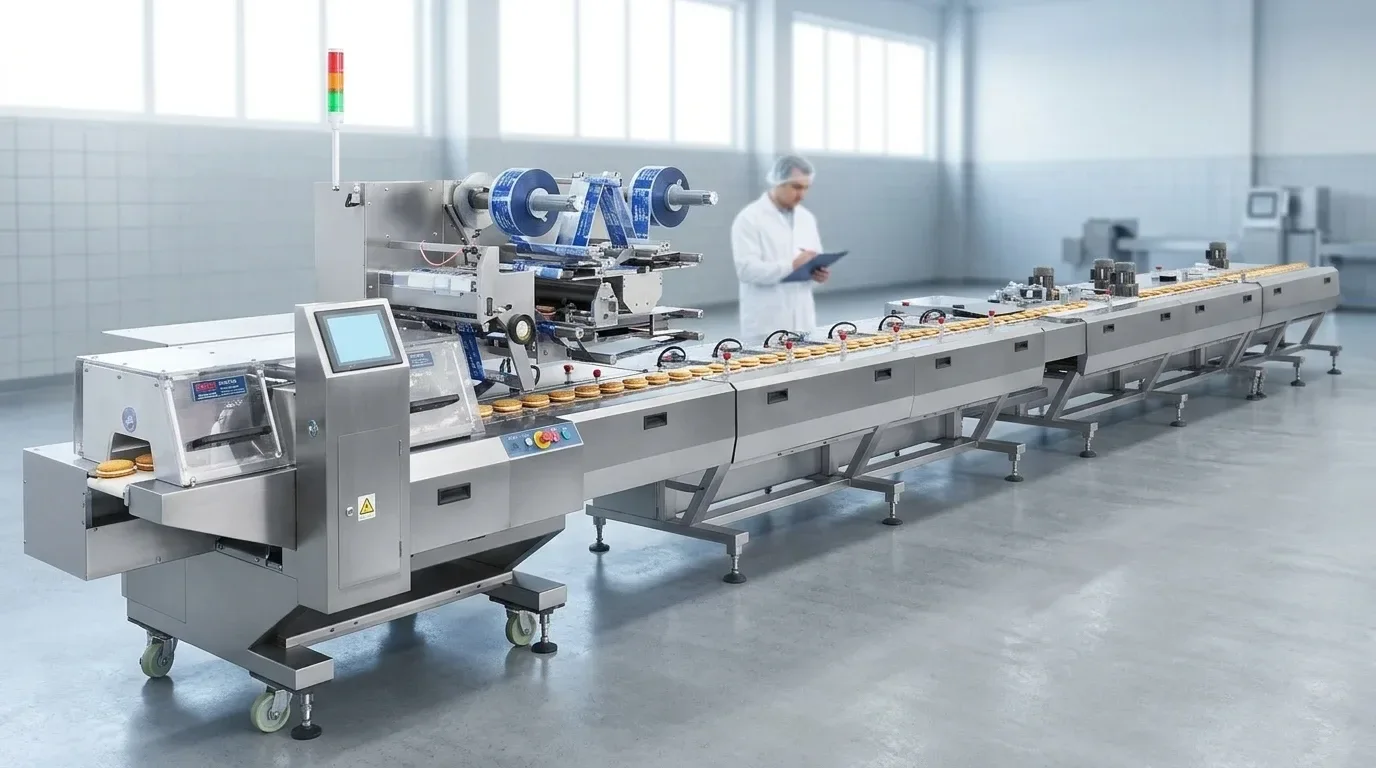
The flow wrapper is a horizontal pillow-type machine that forms film into a tube around the product, seals it and cuts it into packs. It is typically the pacing machine, so a stop here backs up everything upstream.
A PLC (programmable logic controller) usually handles sequencing and interlocks, while servo drives handle depositing, infeed and film axes. Where one machine hands product to the next, control signals matter as much as mechanics. Those interfaces are what the rest of this guide examines.
Which Decision Comes First: Control Platform, Motion Architecture, or Line Layout?
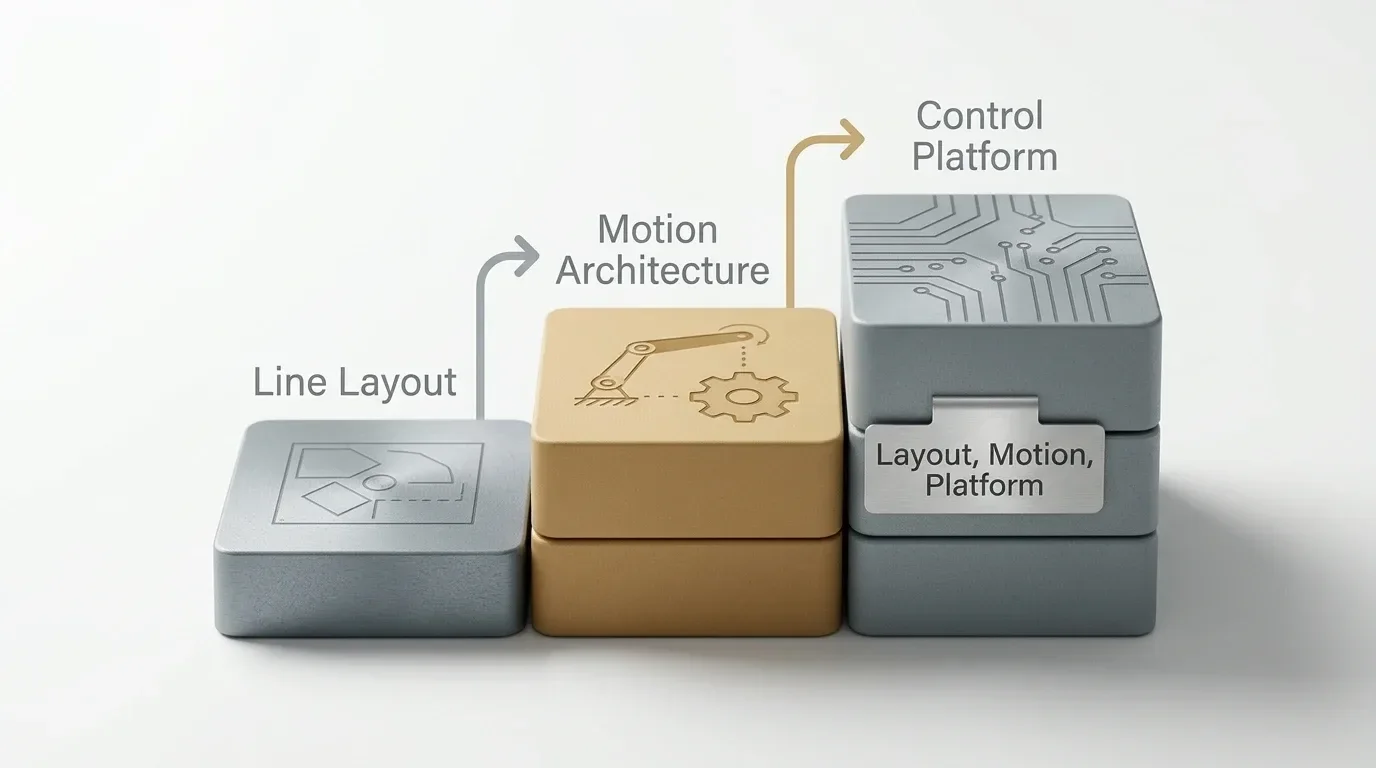
Settle line layout first, motion architecture second, and the control platform last. The order matters because each earlier choice narrows what the later one can be without redesign.
Layout fixes where product changes hands: how far the sandwiching machine sits from the wrapper, whether accumulation is a buffer or a straight transfer, and how many lanes feed the infeed. Those distances and lane counts decide how much buffering the line needs and how tightly the machines must be synchronised. A short, direct transfer demands tight signal coupling. A long buffered one tolerates looser coordination.
Motion architecture follows from that. If the wrapper's film, jaw and infeed axes must follow one master position, you need either a controller with cam or electronic gearing functions or drives that carry those functions themselves. That choice then limits which controllers and drives are sensible. Pick the PLC brand first and you may find its motion library fits your architecture awkwardly, or needs extra modules you did not budget for.
When the rule breaks
Plant standards can override the order. If your maintenance team supports one platform only, and spares and engineering licences are already in place, the platform becomes a fixed constraint. In that case, work backwards: confirm the preferred platform can deliver the motion architecture your layout needs, and rule out machines that cannot be built on it. A retrofit into an existing line works the same way, since the installed equipment sets the boundaries.
The guide takes these decisions in the sequence below.
Layout and handoff: define transfer distance, buffering and lane count.
Motion architecture: choose centralised cam control or standalone drives.
Wrapper and depositor control: specify registration, sealing and fill-weight requirements.
Platform: compare Siemens and Omron against plant standards and support.
Verification: confirm safety, hygiene, data and acceptance tests.
Settling these in order keeps the platform comparison honest, because both candidates are judged against the same fixed requirements.
How Does Biscuit Flow Wrapping Work, and Where Does Control Matter Most?
A line runs cleanly for an hour, then the wrapper starts throwing packs with crushed ends and leaking seals. The sandwiching machine is fine, the film is in spec, and yet every fault clusters around the same few seconds of the cycle. That pattern is typical, because flow wrapping is a timing problem more than a mechanical one.
A flow wrapper (pillow-type wrapper) is a machine that pulls film into a tube around a column of product, seals the tube along its length, then seals and cuts it across to separate packs. Product arrives on an infeed conveyor with lugs or a belt pitch, the film unwinds from a reel, and the former folds it around the column. Registration between product, film and cutter is where control quality shows.
Film Handling, Registration Marks and Sealing Jaws
Most biscuit packs use printed polypropylene film, usually a metallised or laminated structure. Polypropylene film heat sealing depends on temperature, dwell time and jaw pressure acting together, and the window narrows as film gets thinner or line speed rises. Too cold gives weak seals. Too hot distorts the print and can pinch the film.
The registration mark is a printed eye-mark that a sensor reads so the cross-seal lands between graphics. The controller compares mark position against jaw position and corrects the film feed on every pack. If the sensor sees a poor contrast mark or the film slips on the draw belts, the correction chases noise and the print drifts.
Jaw timing matters most with stacked or sliding biscuit columns. Sandwich biscuits are fragile and slippery, so a column that arrives a fraction late can be caught by the jaws. The result is trapped crumb or cream in the seal, a broken biscuit, or a pack that fails later in distribution. One bad seal can spoil a whole carton.
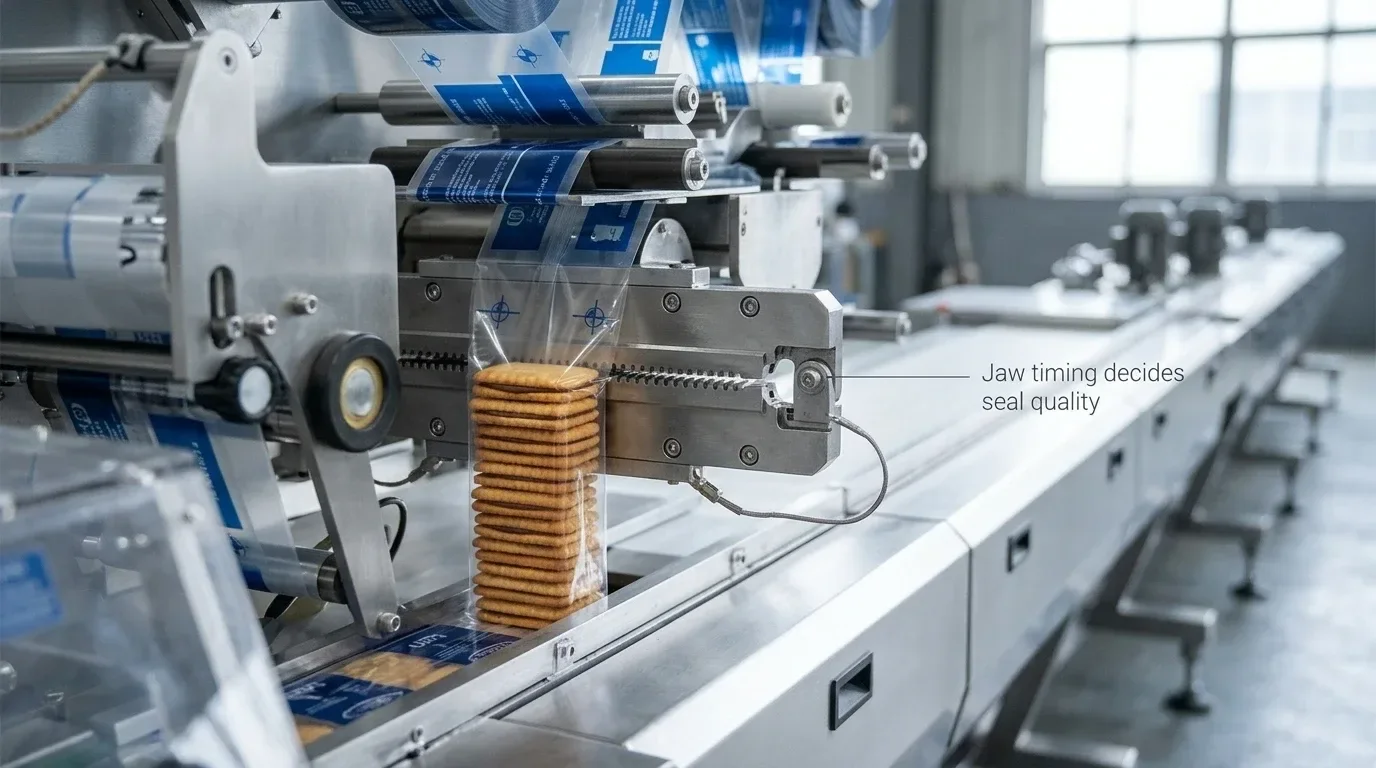
Good practice is to make the wrapper react to the product, not just run to a fixed rhythm. A no-product, no-bag function stops film being wasted, and a jaw-protect response on a misplaced column avoids damage. Both depend on how quickly the control reads the infeed sensors and moves the axes, which is why motion architecture matters here.
Servo Control for Biscuit Flow Wrapper Axes: Cam-Based or Standalone Drives?
There are two ways to drive the axes of a flow wrapper. One is a centralised architecture, where the PLC's motion control runs every servo from a single controller using electronic cams and a virtual master. The other is a set of standalone drives, each with its own motion profile and a simple speed or trigger signal from the PLC. Both work. They fail in different places.
Centralised PLC Motion Control
With one controller, the film feed, the crimp jaws, the cutter and the infeed conveyor all follow the same master position. Electronic cam profiles tie jaw closure to registration marks and to product position, so a speed change on the line moves every axis in proportion. Changeovers become a matter of loading a different cam set and recipe.
The cost is dependency. The motion library, the controller's scan and bus cycle time, and the commissioning skills all have to be right, and a fault in that one controller can stop the entire wrapper. It also suits new builds far better than existing machines, because the mechanical layout has to support it.
Standalone Drives
Standalone drives keep each axis self-contained, which makes them easier to add to an existing wrapper and simpler to troubleshoot axis by axis. Many older machines can be upgraded this way without replacing the main controller.
The trade-off is coordination. Synchronisation depends on fast, deterministic signals between drives, and the tighter the registration requirement, the harder that becomes. Jaw timing against a sliding biscuit column is where drift usually shows up first.
For a new integrated line, centralised motion control is generally the better fit. For a retrofit on a mechanically sound wrapper, standalone drives usually carry less risk and cost, provided you accept looser coupling between axes.
How Is Servo-Driven Cream Depositing Controlled to Keep Fill Weight Stable?
Servo-driven cream depositing is a method in which a servo motor drives a piston or rotary pump, so each cream dose follows a programmed motion profile rather than a fixed mechanical stroke. Stable fill weight depends on four things.
Position synchronisation. The depositor should follow the base biscuit's actual position, taken from an encoder or a registration sensor, not a timed guess. If the biscuit drifts on the conveyor, the cream lands off-centre and the sandwich leans or squeezes out at the edge.
Pump profile by recipe. Dose volume, acceleration, suck-back and cut-off each need their own values per SKU. A thick filling and a light aerated one will not share a profile, so store the settings in the recipe instead of leaving them to adjustment at the machine.
Viscosity and temperature. These are the main sources of drift. Cream stiffens as it cools and thins as it warms, so hopper and line temperature control matter as much as the servo tuning. Many lines add periodic checkweighing to catch slow drift before it becomes a giveaway or an underweight pack.
Feedback and limits. Set alarm bands around the dose, and decide in advance whether an out-of-band reading stops the line or only flags it. The trade-off is nuisance stops against unnoticed variation.
Siemens or Omron: Which Platform Fits Your Line?
Siemens and Omron both run PLC motion control on packaging lines, and neither wins by default. Siemens usually fits plants already standardised on its drives, TIA Portal engineering and a wider factory network. Omron tends to fit sites that favour a single Sysmac Studio environment for logic, motion and safety. The deciding factors are your installed base, motion library fit, engineering skills and local service coverage.
| CRITERION | SIEMENS | OMRON |
|---|---|---|
| Motion control | Technology objects with cam and gearing functions | Integrated motion with cam and gearing blocks |
| Engineering software | TIA Portal, broad but heavier | Sysmac Studio, single-tool approach |
| HMI | Siemens panels, tightly linked to the PLC | Omron panels, tightly linked to the PLC |
| Connectivity | OPC UA available on current controllers | OPC UA available on current controllers |
| Spares and support | Depends on local distributor presence | Depends on local distributor presence |
| Drive integration | Best with its own drive family | Best with its own servo family |
The table's main point: the differences are qualitative, and local support often outweighs feature gaps.
If your maintenance team already holds one licence and spares stock, stay with it. For a new site, ask each vendor's local service team for response commitments in writing. Request motion code examples for a flow wrapper before you decide. EverSmart Food Equipment Limited is one supplier that can configure either platform on request, so confirm the choice early in specification rather than at build.
What Should the HMI and Recipe Management Handle on a Multi-SKU Line?
The common assumption is that a touch panel is only a display for starting and stopping the line. On a multi-SKU line it is the changeover tool, and it fails when it is treated as a screen.
HMI touch panel recipe management should hold every parameter that changes between products: depositor dose and pump profile, wrapper pack length, film registration offset, jaw temperature, and infeed lane settings. One recipe selection should load them across the sandwiching machine and the wrapper together, so no one retypes values from a paper sheet.
Access control matters as much as storage. Operators should select recipes, engineers should edit them, and every change should carry a user and a timestamp. The fault log should record stop reasons in plain language, since those entries feed later analysis.
Tip: Limit operator-editable parameters to a short list, such as recipe selection and minor fill trim within set limits. Lock jaw temperature, cutter timing and pump profiles behind an engineer login.
How Do OPC UA Connectivity and OEE Monitoring Fit Into the Line?
You ask: what should the line actually send to the plant network? Machine states, stop reasons and counters, exposed over OPC UA. OPC UA is a vendor-neutral industrial communication standard that lets controllers publish structured data to other systems. A Siemens sandwiching machine and an Omron wrapper can then report in one format.
Why does it matter? OEE monitoring is only as honest as its inputs. If the system infers downtime from a stopped conveyor, every stop looks the same. If the wrapper reports "film splice," "jaw fault" or "infeed starved," you can see which handoff is costing availability.
Agree the data model before commissioning. Settle tag names, state definitions, counter resets and who owns each machine's data. Retrofitting naming conventions after startup is slow, and mismatched definitions of "running" or "blocked" corrupt the numbers silently.
One limit: connectivity adds a cybersecurity burden, so segment the network and restrict write access.
Which Safety and Hygiene Standards Apply to the Line?
The most common failure here is a line that passes factory acceptance and then stalls at installation because nobody assigned responsibility for safety validation or cleaning access. Three layers of obligation apply, and each one shapes the machine differently.
Machinery safety is governed in the EU by the Machinery Directive 2006/42/EC, which is being replaced by the Machinery Regulation (EU) 2023/1230. Safety functions such as guard interlocks and emergency stops are usually designed and validated to EN ISO 13849-1, which rates them by performance level. Packaging-specific requirements come from EN 415, the series covering packaging machinery safety, including the hazards around sealing jaws and cutters on a flow wrapper.
Food hygiene works differently. HACCP is a plant-level food safety management system, not a machine certificate, but it drives what you ask of the equipment. EN 1672-2 sets hygiene design requirements for food processing machinery, which affects cream-contact materials, sloped surfaces, sealed fasteners and how easily operators reach areas that need cleaning.
Note: Applicability depends on your market and on how each supplier declares conformity. Confirm which edition and regime apply before signing, and name one party in the contract as responsible for validating the combined line.
What to Verify Before You Commit: Steps From Specification to Acceptance
A fixed sequence of checks, run in order, removes most commissioning surprises. Skipping one tends to push its problem onto the installation site.
Write the specification around product, pack formats, target speed and changeover count, and state the handoff between sandwiching machine and wrapper explicitly.
Define interfaces in writing: signals, handshakes, buffer behaviour, fault reactions and the OPC UA data model.
Review the PLC program and HMI structure before shipment, checking recipe handling, alarm texts, access levels and commented code.
Run the factory acceptance test (FAT) with your own biscuits and film, and include stops, restarts and recipe changes, not only steady running.
Confirm safety validation and cleaning access against the standards agreed for your market, with a named party responsible for each.
Complete site acceptance after installation, then compare results with FAT records.
Agree spares, software backups and licence ownership at handover, including offline copies of programs and drive parameters.
The order matters. Interface gaps found at step four cost far more to close than at step two.
FAQ
Can one PLC brand run both the sandwiching machine and the wrapper?
Yes. A single platform simplifies spares and handoff signals, though the wrapper often arrives with its own controller.
Is it practical to retrofit servo control onto an existing flow wrapper?
Sometimes. It suits mechanically sound machines, but check frame rigidity first.
How are breakage and wrapping jams usually reduced through control settings?
Smoother accumulation speeds, tuned infeed timing and registration offsets help most.
What spare parts and software backups should be agreed at handover?
Drives, sensors, jaw heaters, plus program backups and passwords.
Who is responsible for safety validation when machines come from different suppliers?
The party that assembles the line, for example, the integrator or a supplier such as EverSmart Food Equipment Limited if contracted, must validate it.

Ready to start your journey toward a customized solution? Contact me directly on WhatsApp to begin the conversation.