Magazine Feeders vs. Inline Connection: Choosing Your Level of Automation
Introduction: The "Zero Labor" Myth
Every factory owner dreams of the "Dark Factory"—a production line where dough enters one end and wrapped cases exit the other, untouched by human hands. In the world of Industrial Biscuit Sandwiching, this is called "Inline Automation."
It promises high speed, zero labor, and perfect hygiene. But is it always the right choice?
The Counter-Argument:For producers with high SKU counts or unstable ovens, going fully automatic can be a disaster. It turns a flexible operation into a rigid chain where one small error stops the entire plant. Sometimes, the "Old School" method of Magazine Feeders is actually more profitable.
This guide compares the engineering reality of Semi-Automatic (Off-Line) versus Fully Automatic (In-Line) production, helping you calculate the Labor vs. CAPEX tipping point.
🚀 Key Takeaways
The Tipping Point: Inline automation becomes profitable when production exceeds 1,000 kg/hour or shifts exceed 16 hours/day.
Flexibility Tax: Inline systems hate changeovers. If you change products 3 times a day, stick to Magazine Feeders.
The Buffer Effect: Magazine feeders act as a natural buffer. Inline systems require complex accumulation conveyors.
Skill Gap: Inline systems require Mechatronic Engineers; Semi-auto systems can be run by general operators.
Hygiene Risk: Manual loading introduces human bacteria. Inline systems are closed loops (ISO 22000 compliant).
The Semi-Automatic Approach (Magazine Feeders)
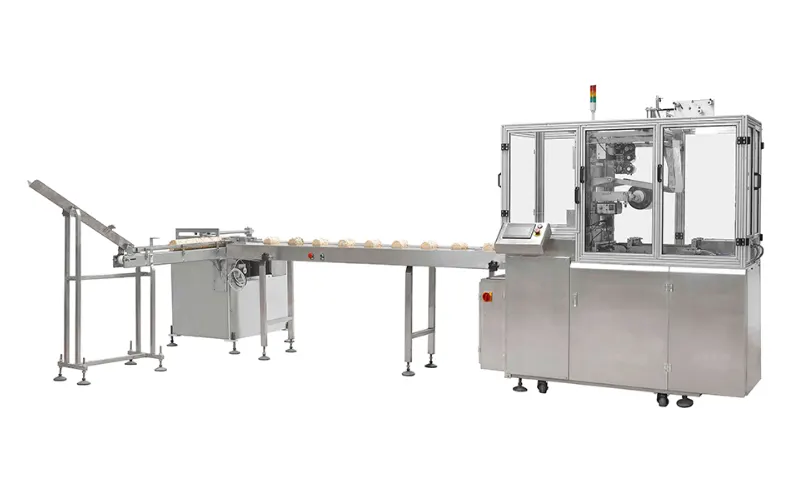
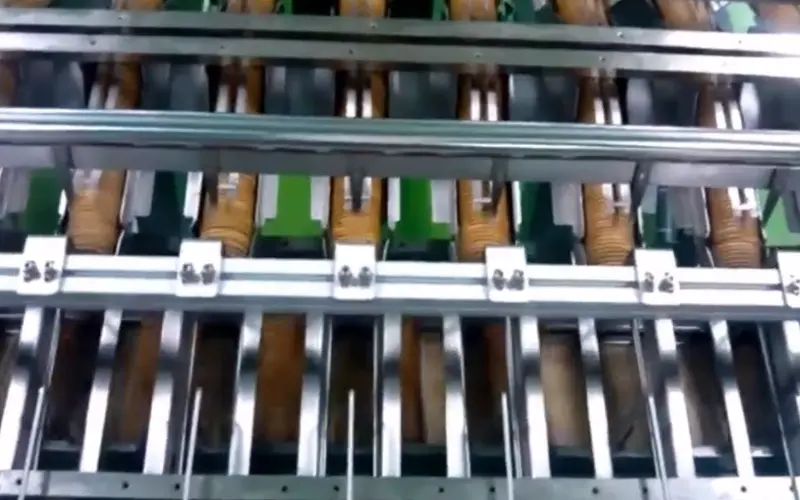
This is the traditional way to make sandwich biscuits. Biscuits are collected into bins and loaded manually into "Magazines" (vertical chutes).
How Magazine Feeders Work
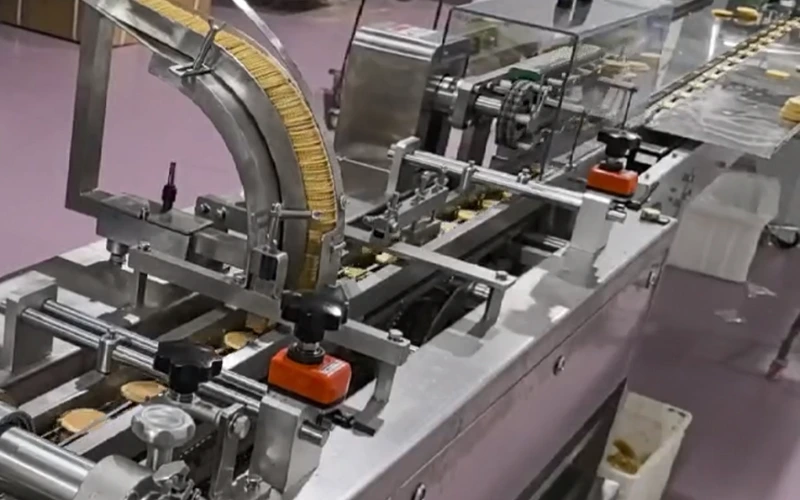
The mechanism is gravity-fed. An operator places a stack of 20-30 biscuits into a chute. At the bottom, a pusher chain strips one biscuit at a time.
Engineering Requirement: Biscuits must be uniform to stack flat. Warped biscuits will jam.
Troubleshooting: Issues with jams? Check our
Rectangular Biscuit Alignment Guide
The "Penny Stacker" Variation
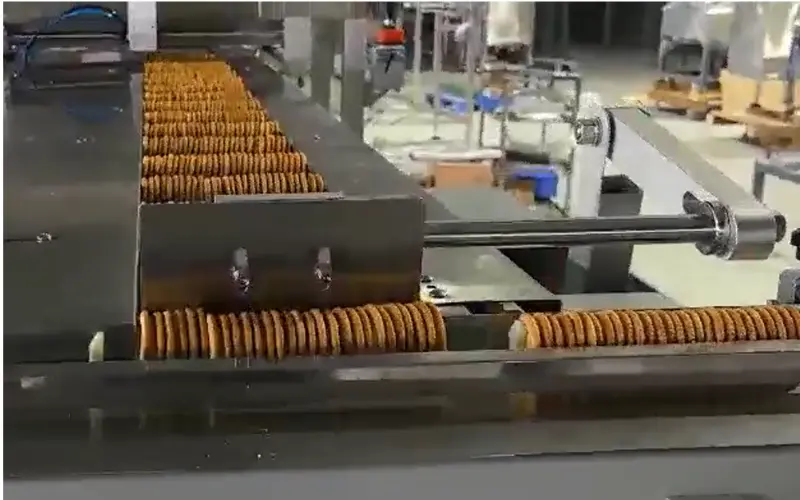
To reduce labor, some lines use a Penny Stacker to stand biscuits on edge. Operators scoop entire logs (300mm long) to transfer them.
Pros: Ultimate Flexibility. Operators visually inspect and reject burnt biscuits. Low CAPEX.
Cons: High Labor (2-4 operators). Hygiene Risk (Human contact).
The Fully Automatic Approach (Inline Connection)
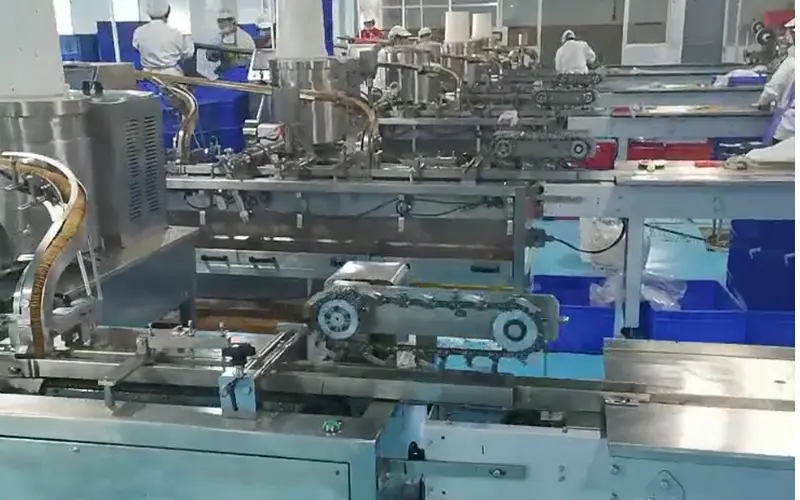
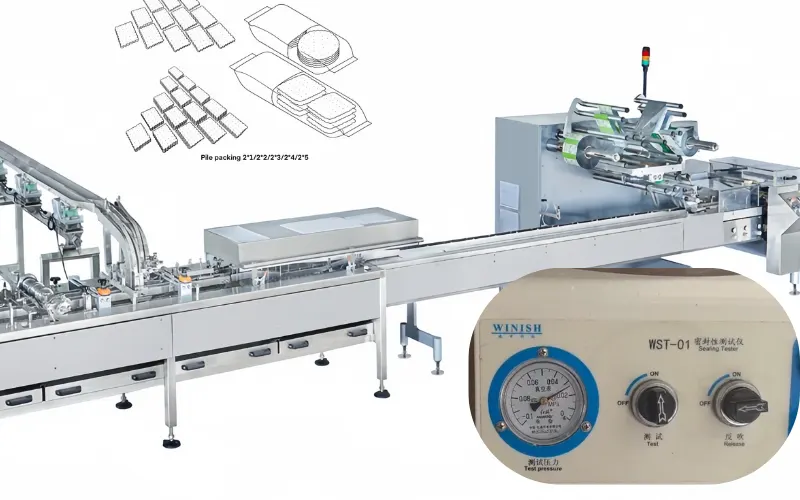
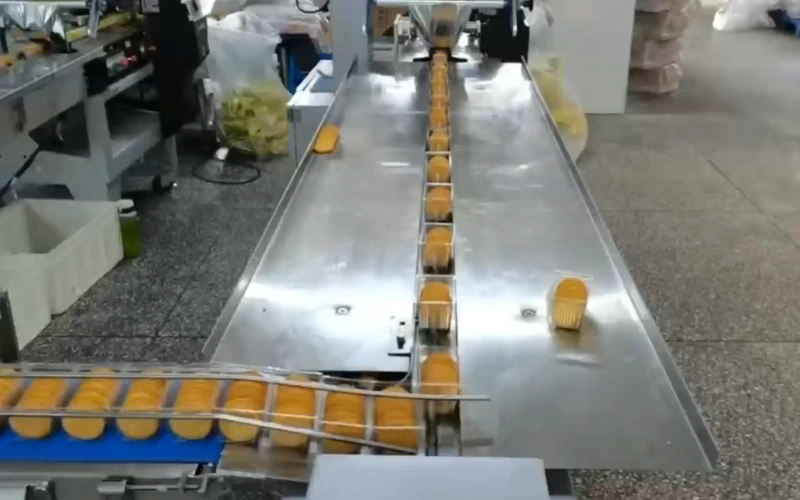
This is the "Formula 1" approach. The biscuit never stops moving from oven to wrapper.
The "Cooling-to-Creaming" Link
Connecting an oven to a sandwicher requires complex flow management:
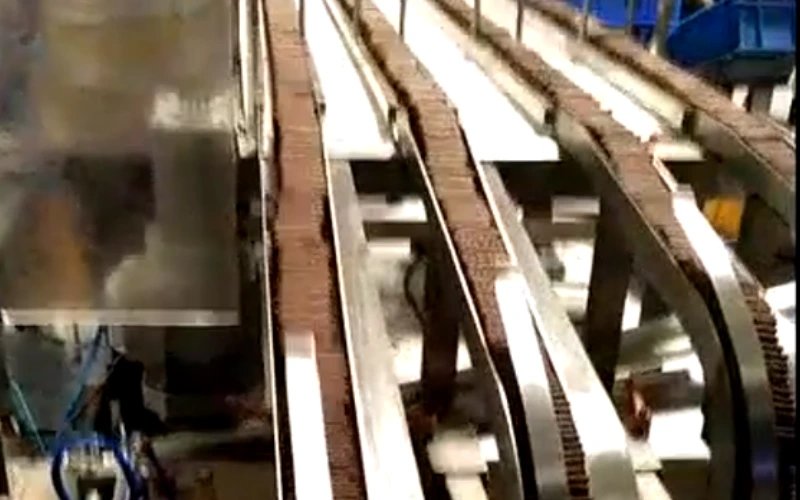
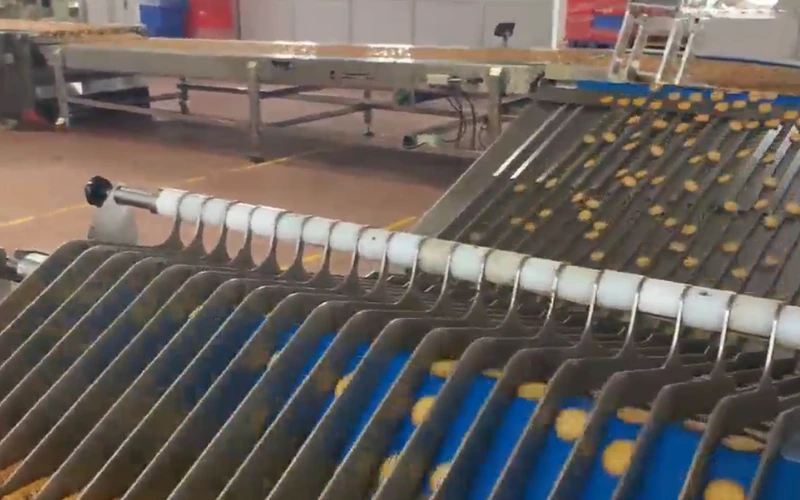
Row Distribution: Splitting oven output into lanes.
Lane Multiplication: Using
Lane Multipliers Synchronization: The sandwicher speeds up/slows down based on oven output.
The "Coupled" Risk
In an Inline system, the Oven and Sandwicher are Coupled. If the Sandwicher jams, the Oven cannot stop. Therefore, you must have Dump Gates and Buffer Systems.
Deep Dive: Learn how to protect your oven with our
Biscuit Production Buffer Systems Guide
The ROI Calculator (The Tipping Point)
When does it make financial sense to upgrade? It is a math problem: Labor Cost vs. Automation Cost.
Scenario: 4-lane sandwicher, 2,000 SPM, 2 Shifts.
Manual Cost: 10 Staff x $20k = $200,000 / Year.
Automation Cost: Feeding System CapEx = $150,000.
The Verdict: Payback in 9 months. Automation is a "No-Brainer."
However, if you run only 1 shift, the payback extends to 18+ months, making Manual Feeding a viable option.
The Hidden Factor: Shape & SKU Complexity
ROI isn't just about money; it's about OEE (Operational Efficiency). Inline systems hate variety.
The "Changeover" Nightmare
Inline Changeover: Adjust 20m of guides, recalibrate Vision, tune sensors. Time: 4-8 Hours.
Magazine Changeover: Adjust chute width. Time: 20 Minutes.
Strategic Advice:
High Volume / Single SKU: Go Inline (e.g., Oreo).
High Mix / Low Volume: Go Magazine (e.g., Contract Manufacturer).
Learn More: Optimize your transitions with our
Biscuit Machine Quick Changeover Guide
Operational Realities
Before you sign the check for automation, assess your workforce.
The "Skill Gap"
A Manual line needs Dexterity. An Automated line needs Logic.
The Trap: If you fire 10 manual loaders and hire 1 expensive engineer, what happens when that engineer is sick? Automation requires a deeper bench of technical talent.
Upstream Quality Dependency
A human can compensate for a burnt or oval biscuit. A machine cannot. If your oven produces variable shapes, automation will jam.
Rule: Fix your oven before you automate your packing hall.
FAQ: Automation Strategy
Q1: Can I have both? (The Hybrid Buffer)A: Yes. The line runs inline, but if the wrapper stops, a Penny Stacker collects biscuits into logs for manual re-feeding later.
Layouts: See our
Hybrid Biscuit Production Line Guide
Q2: Does Inline affect cream weight accuracy?A: Yes, positively. Constant flow allows the cream pump to run at a steady state, improving accuracy.
Q3: How much space does Inline take?A: A lot. An Inline system can add 10 to 15 meters to your layout. Check your floor plan with our
Conclusion: Define Your Strategy First
Don't buy automation just because it looks cool. Buy it because it solves a specific bottleneck.
Choose Magazine Feeders if you are a "Job Shop" running many shapes.
Choose Inline Connection if you are a "Volume Producer" needing to slash labor.
The EverSmart Approach: We can start you with a Magazine Feeder today, designed with a "Modular Front End" that allows us to bolt on an Inline Feeder three years later.
Audit Your Labor Costs.Are you spending too much on manual loading?
[CTA Button]Calculate Your Automation ROIInput your labor costs and line speed. Get a custom report.

Ready to start your journey toward a customized solution? Contact me directly on WhatsApp to begin the conversation.