The 2025 Strategic Guide to Food Packaging Systems: Maximize ROI with AI, Robotics, and TCO
Advanced Food Packaging Systems: The 2025 Guide to Tech, Trends & TCO
Introduction: Matching the Right Packaging Technology to Your Product
Choosing the right automation strategy is the bedrock of efficiency in food packaging. For high-volume bagged products like snacks and candies, a Vertical Form-Fill-Seal (VFFS) system is the ideal solution.
Conversely, for products demanding greater shelf presence and diverse bag styles, such as stand-up pouches, a Horizontal Form-Fill-Seal (HFFS) system offers superior advantages. High-precision servo-driven auger fillers ensure exact portioning for powders and granules. Meanwhile, integrated robotic and vision systems provide the gentle, flexible automation required for delicate and irregularly shaped fresh produce.
These systems form the foundation of modern packaging, but the true industry revolution emerges from their fusion with cutting-edge technology. Today's food manufacturers, particularly at the executive level, face challenges that extend far beyond simple production speed.
Rising labor costs and a persistent skills shortage are compelling companies to embrace automation with unprecedented determination. Simultaneously, global supply chain volatility, stricter food safety regulations like the <a href="https://www.fda.gov/food/food-safety-modernization-act-fsma/fsma-final-rule-requirements-additional-traceability-records-certain-foods" target="_blank" rel="noopener noreferrer">FSMA 204 traceability rule</a>, and firm sustainability mandates from major retailers present immense pressure on brands.
Therefore, innovation in the modern food packaging system is no longer a race for "bags per minute." It must deliver a comprehensive solution encompassing intelligence, flexibility, risk mitigation, and total lifecycle value.
This guide will delve deep into the key technologies reshaping the industry. We'll analyze how they solve the core pain points for every stakeholder—from the CEO to the frontline maintenance engineer—and show you how to select a system and partner that will secure your long-term competitive advantage, a central theme in our evaluation of leading packaging machine manufacturers.
Key Takeaways
Core Technology Fusion: Robotics, AI vision inspection, and sustainable packaging solutions are no longer isolated trends. They are converging to solve the industry's primary challenges of labor, quality, and environmental responsibility.
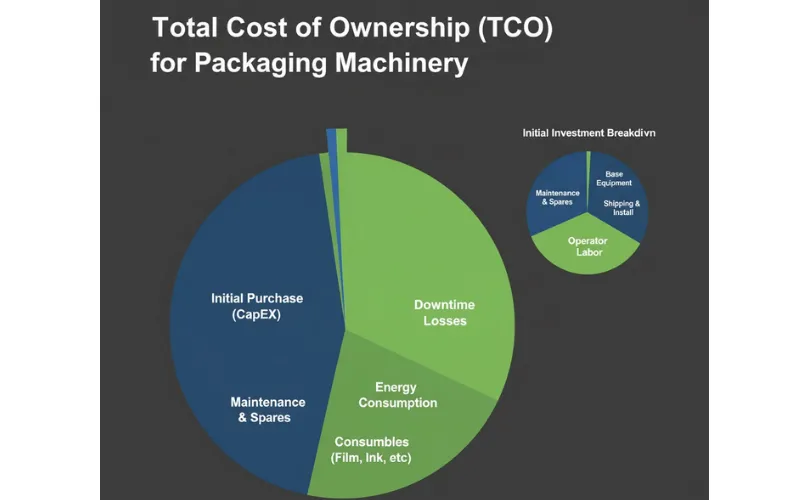
TCO as the Gold Standard: Smart investment evaluation looks beyond the initial purchase price. It focuses on the Total Cost of Ownership (TCO), which includes maintenance, energy, and the high cost of downtime.
OEE as the Core Efficiency Metric: Maximizing Overall Equipment Effectiveness (OEE) through technologies like rapid changeover and smart maintenance is fundamental to boosting a production line’s profitability.
Hygienic Design is Non-Negotiable: Adherence to international standards like EHEDG is essential for mitigating food safety risks. This protects your brand's reputation and bottom line.
Partnership Determines Success: A supplier's local service, spare parts availability, and remote technical support capabilities are as critical as the machinery itself for ensuring long-term success.
Core Automated Packaging Systems by Application
Before diving into advanced technologies, it is essential to understand the foundational systems that form the backbone of any modern food packaging line. A complete overview of these different types of food packaging machinery and their applications can provide a solid basis for your technology selection process.
These systems are the vehicles for automation. Their design and intended use case dictate the fundamental efficiency and flexibility of your entire production line.
H3: 1. Vertical vs. Horizontal Form-Fill-Seal (VFFS & HFFS)
These two machine types represent the heart of flexible packaging automation. They define the very method by which a bag is formed and filled.
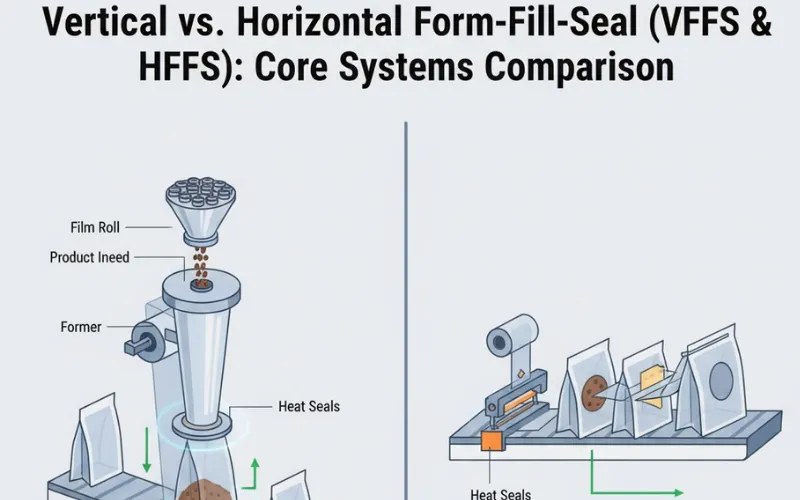
Vertical Form-Fill-Seal (VFFS) Systems:A VFFS system creates a tube from a roll of film by forming it over a vertical tube. It then seals the bottom, fills the product from above, and seals the top.
This continuous or intermittent motion makes it perfectly suited for high-speed, high-volume production runs.
Best For: Free-flowing and bulk products like potato chips, nuts, candies, coffee beans, cereals, and frozen vegetables.
Advantages: VFFS machines have a smaller footprint and are exceptionally fast, with some high-end models exceeding 200 bags per minute. This results in a lower cost per package.
Technical Notes: They are typically integrated with multi-head weighers or auger fillers to create a complete
automated food packaging system. For businesses focused on maximizing output, VFFS is an indispensable choice.Horizontal Form-Fill-Seal (HFFS) Systems:Unlike VFFS, an HFFS machine forms, fills, and seals pouches in a horizontal process. It can handle pre-made pouches or create a wide variety of bag styles from rollstock, including three-side seal, four-side seal, stand-up, and zippered pouches.
Best For: Sauces, ready-to-eat meals, meat products, cheeses, baked goods, and other retail products where a premium appearance is crucial.
Advantages: HFFS offers superior flexibility in bag style and can easily incorporate features like zippers and spouts. The finished package is often more visually appealing and better suited for retail shelves.
Technical Notes: The mechanical complexity of HFFS machines generally means slower speeds compared to VFFS, but their versatility makes them essential in many high-value product categories.
Specialized Filling and Sealing Technologies
Choosing the right filling and sealing technology is critical. It directly impacts product shelf life, cost control, and the end-user experience.
Servo-Driven Filling:In the world of powder and granule packaging, precision is profit. Traditional clutch-and-brake auger fillers have inherent delays in start-stop control, leading to product overfill, also known as "giveaway."
Servo-driven fillers, however, use a servo motor to precisely control the auger's rotation, achieving accuracy within ±0.5%. For a CFO, a mere 1-gram overfill on a $10 bag of coffee, scaled across a million bags per year, translates to tens of thousands of dollars in lost raw material. Servo technology is the direct solution to this critical pain point.
[Image Prompt: A close-up shot of a servo-driven auger filler dispensing a precise amount of coffee powder onto a digital scale, showing an exact weight. Style: clean, industrial, high-detail.]
Note: Precision is profit. In powder or high-value granule packaging, a servo-driven filler can save a company tens or even hundreds of thousands of dollars annually by minimizing product giveaway, one fraction of a gram at a time.
Modified Atmosphere Packaging (MAP) & Vacuum Skin Packaging (VSP):For fresh meats, ready-to-eat meals, and baked goods, extending shelf life is the primary goal.
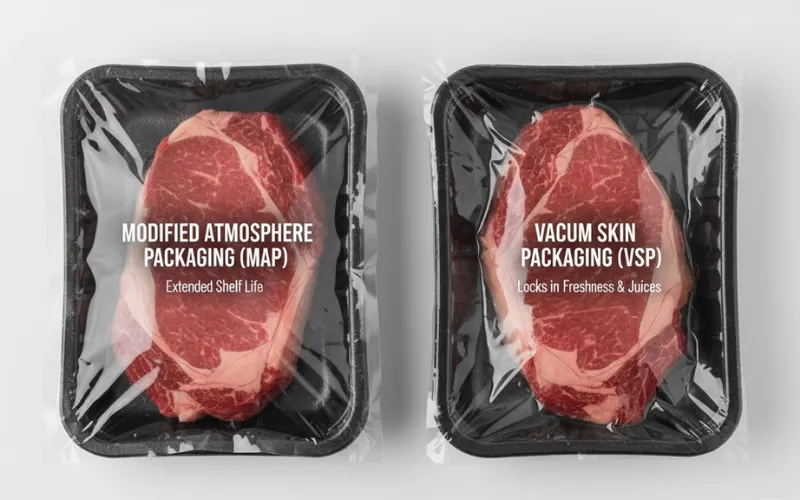
Both technologies significantly reduce spoilage-related losses, directly boosting the bottom line.
MAP: This technology works by removing the air from a package and replacing it with a specific blend of gases (typically CO₂, N₂, and O₂). This process inhibits microbial growth and slows oxidation, extending the product's shelf life several times over.
VSP: This method involves heating a high-barrier film and draping it over a product on a tray. A vacuum then removes all air, causing the film to conform to the product like a second skin. VSP not only maximizes shelf life but also locks in juices and provides a premium, 3D appearance that enhances shelf appeal.
Key Technology Trends Driving Packaging Intelligence
While foundational systems provide the "bones" of a packaging line, the following advanced technologies provide the "brains" and "nervous system." They are the core drivers for solving labor shortages, elevating quality assurance, and meeting new market demands.
Robotics and Advanced Automation
In the past, packaging automation focused on high-speed, repetitive tasks. However, many processes requiring delicate handling, flexible picking, or irregular placement remained heavily reliant on manual labor.
The proliferation of robotics is fundamentally changing this landscape.
Applications and Value:
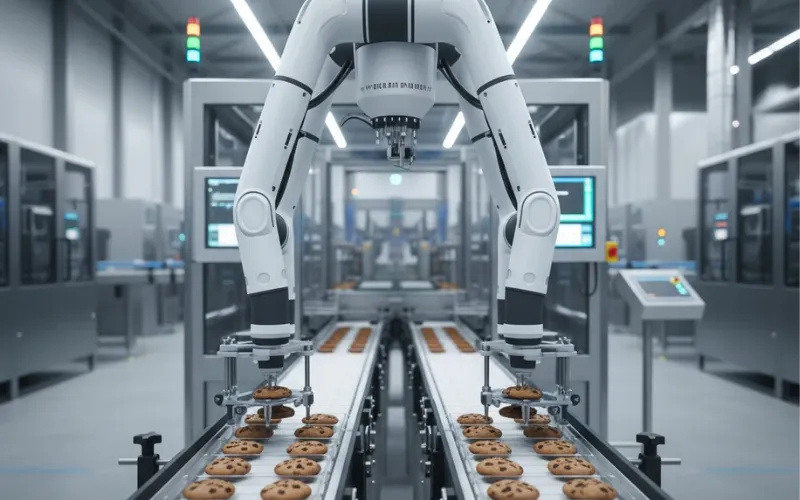
Upstream Infeed and Collation: For baked goods, confections, or irregular fresh produce, high-speed delta robots (spider robots) use vision systems to rapidly identify, sort, and place products accurately onto the infeed conveyor of a packaging machine. This directly addresses labor shortages and frees human workers from monotonous, repetitive tasks.
Downstream Case Packing and Palletizing: After primary packaging is complete, 6-axis articulated robots can flexibly pick up bags or boxes, place them into shipping cases, and finally stack the cases onto a pallet in a predetermined pattern. This allows the entire end-of-line process to run fully automated, 24/7.
The Technology Core: The intelligence of robotic
smart food packaging systemslies in the fusion of "vision" and "software." 3D vision systems give robots their "eyes," enabling them to handle disordered and randomly oriented products. Advanced motion control software and simulation platforms allow engineers to deploy and debug robotic applications in a virtual environment, drastically reducing integration time.
Artificial Intelligence (AI) and Machine Vision Inspection
Traditional quality control methods, like metal detectors and checkweighers, solve only part of the problem. For decades, inspecting package appearance, seal quality, and printed information relied on manual spot-checks—a method that is both unreliable and incapable of 100% coverage.
The advent of AI-powered vision inspection is revolutionizing quality assurance.
Applications and Brand Protection:
Note: The core value of AI vision inspection is brand protection. Its ability to perform 100% in-line inspection prevents costly recalls caused by labeling errors or faulty seals, making it a proactive risk management investment, not a passive cost center.
Seal Integrity Inspection: An AI vision system can use thermal imaging or high-resolution cameras to inspect the seal area of every single package in real-time. It can identify minuscule defects that are invisible to traditional methods, such as product contamination in the seal, wrinkles, or heat-sealing temperature anomalies, thus preventing leaks and spoilage.
Label and Code Verification (OCR/OCV): The system can read and verify the date codes, lot numbers, and barcodes on every package with 100% accuracy. If a misprint, smudge, or missing code is detected, the package is immediately rejected from the line. This is paramount for preventing a costly product recall. A single incorrect date code can lead to an entire shipment being rejected by a retailer or penalized by regulators—a brand and financial risk no business owner can afford.
Compliance for
Food Packaging Traffic Light System: In Europe and other regions, nutritional "traffic light" labels are required on packaging. AI vision ensures the position, color, and content of this critical information are fully compliant with regulations, preventing legal liabilities.
Sustainable Packaging Solutions
Environmental pressure from consumers, governments, and retail channels is driving the food industry toward packaging that is recyclable, compostable, or made with less material. However, these new eco-friendly materials—such as paper-based composites, mono-material films, and bioplastics—present significant challenges for packaging equipment.
Mechanical Innovations for New Materials:
Narrower Processing Windows: Traditional multi-layer films have a wide heat-sealing temperature range, making them forgiving. In contrast, mono-material films have a very narrow "sealing window." A slightly too high temperature will melt the film, while a slightly too low temperature will result in a weak seal. This demands that a
foodpackaging system has an extremely precise temperature and pressure control system.New Sealing Technologies: For paper-based or heat-sensitive materials, traditional constant-heat sealing is no longer viable. The industry is moving toward advanced technologies like ultrasonic sealing (which uses high-frequency vibrations to generate frictional heat for an instant, strong seal) and impulse heat sealing (which applies heat only for the moment of sealing, reducing energy consumption).
Precision Web Tension Control: Eco-friendly films are often more delicate and have different properties than traditional plastics. Packaging machines must be equipped with servo-driven, feedback-controlled film transport systems to ensure constant tension throughout the
food packaging process, preventing stretching, wrinkling, or tracking issues.
Beyond Speed: Evaluating a System's Total Cost of Ownership (TCO)
Today’s procurement decisions have evolved beyond the initial capital expenditure (CapEx). Savvy managers, especially those in finance and procurement, are focused on the entire lifecycle cost of equipment: the Total Cost of Ownership (TCO).
A deep dive into understanding the Total Cost of Ownership for packaging machinery is the first step toward making a wise investment. The design philosophy of a truly superior food packaging system is inherently focused on lowering TCO, a core criterion in our comprehensive manufacturer comparison.
Hygienic Design and Compliance
In the food industry, hygiene is the undisputed bottom line. A single microbial contamination event can destroy a brand.
Therefore, the hygienic design of a machine is directly linked to both food safety risk and production efficiency.
Stakeholder Focus: While a mechanical engineer focuses on the design's integrity, the CEO focuses on the risk it mitigates.
Key Design Features:
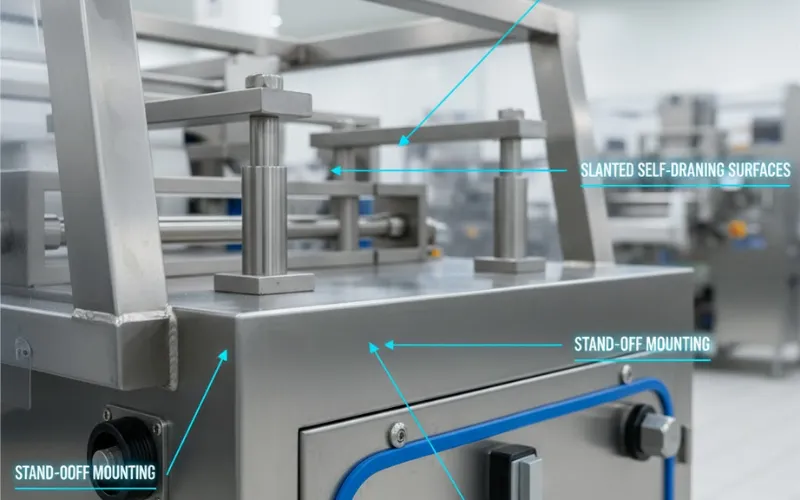
Note: Hygienic design is the cornerstone of food safety. There are no compromises. Choosing equipment that meets international standards is the most effective way to mitigate contamination risks and protect your brand reputation from the ground up.
Open-Frame Design: Avoids enclosed cabinets and hard-to-reach corners. The machine frame should be constructed from tubular or slanted profiles to facilitate washdowns and prevent water or product debris from pooling.
IP Ratings: Electrical components like motors and sensors in direct food contact or washdown zones must have a rating of at least IP65, and often IP67 or higher.
Materials and Surface Finish: All product-contact parts must be made from food-grade stainless steel (typically SUS304 or SUS316L). Welds must be polished smooth, with no cracks or pits where bacteria can harbor.
International Standards: Look for equipment that complies with globally recognized standards like those from the FDA, 3-A, or <a href="https://www.ehedg.org/" target="_blank" rel="noopener noreferrer">EHEDG (European Hygienic Engineering & Design Group)</a>. Compliance itself is an assurance of quality and safety.
Operational Efficiency (OEE): Rapid Changeover & Smart Maintenance
Overall Equipment Effectiveness (OEE) is the gold standard for measuring manufacturing performance. It is a composite score of availability, performance, and quality.
To learn how to maximize packaging machinery uptime and efficiency, you must focus on OEE. With the market trend toward smaller batches and more product variety, frequent production changeovers are the new normal. Reducing changeover downtime is therefore critical to boosting OEE.
Stakeholder Focus: Mechanical and maintenance engineers are the executors, while the CFO sees the direct profit growth from improved OEE.
OEE – Rapid Changeover (SMED):Reducing changeover time from one hour to ten minutes can add hours of productive runtime each day. Technologies that enable this include:
Tool-less Adjustments: Key adjustment points, like forming tubes and conveyor guide rails, should feature handwheels and quick-lock clamps that require no tools.
One-Touch Auto-Changeover: On high-end equipment, selecting a new product recipe on the HMI can trigger multiple servo motors to automatically adjust all machine parameters to preset values, drastically reducing human error and setup time.
OEE – Smart Maintenance:Traditional maintenance models—either "breakdown maintenance" or "preventive maintenance"—lead to either unexpected downtime or unnecessary parts replacement. Having an effective ultimate guide to food packaging equipment maintenance is the foundation, but smart maintenance takes OEE to the next level.
Tip: The first step to improving OEE is accurate measurement. Start tracking your downtime and categorizing it by cause (changeover, mechanical failure, material issues). This data will reveal your biggest opportunities for improvement and build a strong business case for investing in smart maintenance and rapid changeover technologies.
Predictive Maintenance (PdM): This is a critical element in
the role of smart packaging system in food supply chain. By installing sensors on key components (motors, bearings, etc.), the system continuously collects operational data. AI algorithms analyze this data for patterns that precede a failure. If a bearing's vibration frequency changes, the system can issue an alert weeks or even months in advance, allowing maintenance to be scheduled during planned downtime.Augmented Reality (AR) Remote Assistance: This is a game-changing service differentiator. When a local technician encounters a complex issue, they can wear AR glasses to establish a live video link with a remote expert. The expert sees exactly what the technician sees and can superimpose diagrams, instructions, or annotations directly onto their field of view, guiding them step-by-step through the repair. This can reduce the Mean Time To Repair (MTTR) from days to hours.
Call to Action (CTA): Download Your Free TCO Calculator
Theory is the foundation, but application is key. To help you apply the TCO philosophy to your real-world decisions, we've created a detailed Packaging Machinery TCO Calculator Template.
Download it now to start quantifying the true cost of your current and future investments.
[Whatsapp us to Get Your Free TCO Calculator Template]
Industry 4.0 Connectivity & Data-Driven Decisions
In a smart factory, no machine should be an information silo. As the final step in production, the food packaging system is a priceless node for collecting critical manufacturing data.
Stakeholder Focus: The electrical engineer focuses on technical implementation, while the CEO wants to use the data for strategic decision-making.
Key Technical Features:

Open Architecture and Standard Protocols: Modern systems should be built on an open architecture that supports industry standards like OPC UA. This allows an electrical engineer to easily integrate the packaging machine with the plant's MES or ERP systems. This process is a key step toward achieving full packaging line optimization and integration.
Data Visualization and Remote Monitoring: Data is only valuable when it's visible. The system should provide an intuitive HMI dashboard displaying real-time KPIs like OEE, output, and downtime reasons. This data should be remotely accessible, allowing managers to monitor production status from anywhere.
Flexible Modularity & Future-Proofing
Markets change instantly. Today's bestseller can be tomorrow's obsolete product. Investing a huge sum in a fixed-function machine is a high-risk proposition.
Modular design is the best strategy to counter this uncertainty.
Stakeholder Focus: The procurement manager and CEO must consider future scalability when making an investment decision.
Key Technical Features:
Modular Platform: Look for a robust and scalable platform. A company can start with a basic HFFS machine and, in the future, easily add on a robotic infeed unit, an AI vision module, or an upgrade kit for handling recyclable mono-materials.
Software-Defined Functions: Many new capabilities can be unlocked via software updates rather than expensive hardware retrofits. This ensures your investment remains relevant for the next 5-10 years, protecting the long-term value of the asset.
The Buyer's Guide: How to Select Your System & Partner
Now that you understand the technology, how do you translate that knowledge into a smart purchasing decision? Our step-by-step guide on how to choose the right food packaging machine provides a clear framework.
Define Your Product and Production Needs
Product Characteristics: Deeply analyze your product. Is it a liquid, powder, fresh, sticky, or fragile? This will determine the required filling technology and machine mechanics.
Packaging Goals: Is your core objective high throughput (VFFS), high flexibility (HFFS), or maximizing shelf life (MAP/VSP)?
Compliance Requirements: What specific regulations for food-contact materials or hygienic design exist in your target markets? For example, Japan's
positive list system for food utensils containers and packagingis very strict.
Calculate TCO, Not Just the Purchase Price
The CFO's Perspective: Don't be swayed by a low initial quote. Request a detailed TCO analysis from potential vendors. This report should include, at a minimum:
Average energy consumption (kWh).
A list of recommended annual spare parts and their prices.
An estimate of annual material waste due to filling inaccuracies.
Data on Mean Time Between Failures (MTBF) and Mean Time To Repair (MTTR).
Vet Your Supplier's Service and Support Capabilities
The Procurement Manager's Reality: Machines will eventually fail. How quickly the issue is resolved is what matters most. Learning how to properly vet and select the best packaging machinery suppliers can prevent costly mistakes down the road.
Tip: When speaking with potential suppliers, ask specific questions: "How many service engineers do you employ in my state/country?" "What is the lead time for a new servo drive?" "Can you demonstrate your AR remote support system?" Clear answers are a strong indicator of their service capability.
Local Service Network: How many certified field service engineers does the supplier have in your region? What is their average response time (SLA)?
Spare Parts Supply Chain: Are critical spare parts warehoused locally? Is the promised delivery time 24 hours or two weeks?
Depth of Technical Support: Do they offer 24/7 remote diagnostics? Do they have the AR remote assistance capability discussed earlier?
Conclusion: Building Your Future-Ready Packaging Operation
The technological revolution in food packaging systems is about far more than just speed and automation. True industry leaders are fusing AI and robotics with deep-seated engineering values.
These values are: superior hygienic design, maximized Operational Effectiveness (OEE), seamless IIoT data connectivity, and future-proof modular adaptability.
For forward-thinking food manufacturers, selecting a new food packaging system is no longer a simple machine purchase. It is the selection of a long-term strategic partner who understands the immense challenges of compliance, cost, efficiency, and brand protection.
Ultimately, investing in solutions that deliver a lower Total Cost of Ownership and are backed by a reliable local service network is the only way to ensure your company remains competitive for the next decade. Our analysis of the top 10 food packaging machinery manufacturers is built on this very philosophy.
Frequently Asked Questions (FAQ)
1. Q: How do I choose the right type of packaging system (e.g., VFFS vs. HFFS) for my product? A: The choice depends on your product characteristics and market goals. If your product is a free-flowing solid and your goal is maximum throughput at the lowest cost per unit, VFFS is your best bet. If you need diverse package formats like stand-up pouches or your product is irregular, and shelf appeal is a priority, the flexibility of HFFS is the superior choice.
2. Q: What is the actual difference between Smart Packaging and Active Packaging?A: Both are advanced concepts but solve different problems. Active Packaging intervenes to extend shelf life by using materials that actively improve the internal environment (e.g., oxygen absorbers). Smart Packaging informs to provide data by using sensors or indicators to monitor the product's condition (e.g., temperature) and communicate that information.
3. Q: My company wants to improve efficiency. Why do experts emphasize OEE instead of just machine speed?A: Because a machine's rated speed is not the same as your line's actual output. OEE is a more holistic metric that reveals efficiency losses from downtime (changeovers, failures), speed loss (micro-stops), and quality defects. A line with a slower but extremely reliable machine can have a much higher OEE—and be more profitable—than a line with a faster but frequently stopped machine.
4. Q: Is investing in AI and robotics realistic for a small or medium-sized business?A: Yes, it is more accessible and necessary than ever. The cost of collaborative robots and modular AI vision has dropped significantly, with ROI often realized in 12-24 months. Given labor shortages and rising quality demands, automation is key to staying competitive. You can start by investing in modular solutions to address your most critical production bottlenecks first.
5. Q: Besides the machine's price, what is the single most important factor when evaluating suppliers?A: Service and support capability. A world-class machine that is down for a week due to a lack of spare parts or technical support can cost you more than the price difference between suppliers. Always conduct deep due diligence on a potential partner’s local service team, parts inventory, response time SLAs, and advanced support tools like remote diagnostics and AR assistance.
Get an Expert Consultation & Customize Your Solution
Navigating these technological innovations can be a daunting task. Every business has unique products, processes, and goals.
If you want to have an in-depth discussion about which food packaging system is best suited for your business, or if you'd like a comprehensive TCO and OEE assessment of your current production line, our team of experts is ready to help.
Schedule a complimentary 30-minute online consultation with us today. We will listen to your challenges, analyze your needs, and help you tailor a smart packaging solution that boosts efficiency, lowers costs, and is ready for the future

Ready to start your journey toward a customized solution? Contact me directly on WhatsApp to begin the conversation.