The 2026 Guide to Biscuit Stacking Machines for Delicate & Cream-Filled Products
I. Introduction: The Fragility Factor and Cosmetic Loss
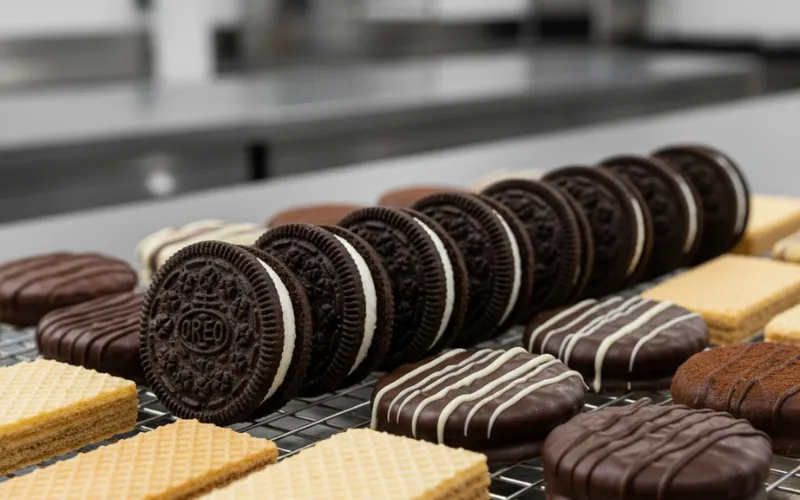
The journey of a biscuit from the oven to the wrapper carries significant risk. While robust products like crackers handle traditional methods well, premium, high-value confectionery—thin wafers, soft-baked cookies, and especially cream sandwich biscuit products—face the greatest threat to profitability during the final packaging phase.
The Transition Problem
Statistically, up to 80% of all cosmetic defects and a significant percentage of breakage occur at conveyor transfer points and during the stacking/grouping process
. This phenomenon, known as the "Transition Problem," is a direct result of the mechanical violence inherent in legacy automation.
The cost is not just measured in discarded product; it includes decreased Overall Equipment Effectiveness (OEE), increased sanitation time, and, critically, customer dissatisfaction. Protecting brand equity and ensuring a perfect product requires specialized, gentle automation, as detailed in our comprehensive biscuit stacking machine guide 2025.
Defining "Delicate"
"Delicate" goes beyond simple physical breakage. It involves three core areas of risk:
Physical Fragility: Products with low density, such as ultra-thin wafers or meringues, that shatter under minimal pressure.
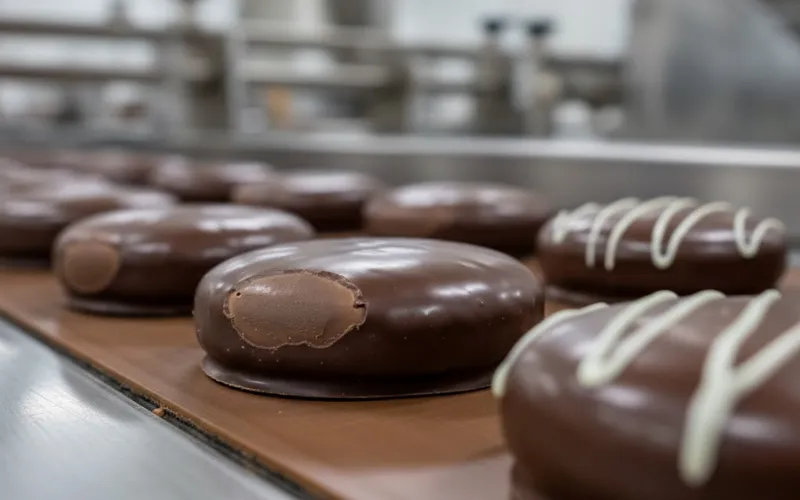
Cosmetic Integrity: Products with full chocolate coatings, glazes, or dusting that smear, scuff, or lose visual appeal from friction or lateral forces.
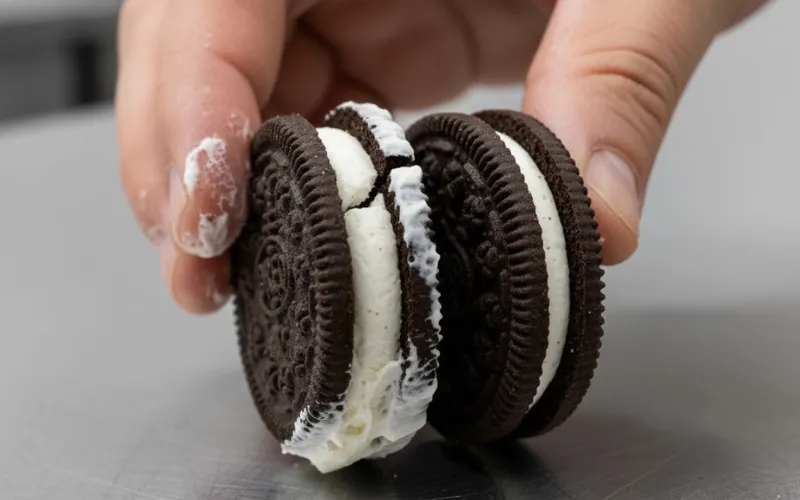
Structural Integrity: Cream-filled sandwich biscuit varieties (like the oreo sandwich) where excessive force causes filling squeeze-out or layer misalignment, compromising the product's structure and seal.
The Cost of Compromise: Why Legacy Stackers Fail
Traditional biscuit stacking machine architectures, particularly Star Wheel and Rotary stackers, rely on two actions fundamentally destructive to delicate items: flipping and high-pressure compression. These machines use momentum and gravity to turn products on edge and jam them into a tight slug. This system is efficient for crackers but inherently unsuitable for premium biscuits because it introduces:
Impact Forces: Flipping a fragile product onto its edge initiates micro-fractures.
Lateral Compression: Squeezing soft or cream-filled products pushes the filling out or deforms the product shape.
Friction and Smear: Sliding a coated product against a pusher destroys the cosmetic finish.
Key Takeaways for Gentle Automation
80% of defects for delicate products occur during the final stacking phase.
Horizontal Handling (Penny Stacker) is mandatory to eliminate flipping and compression.
Servo Motors offer the precision control superior to pneumatics for truly gentle stacking.
Adaptive Stacking Algorithms provide a competitive edge by dynamically adjusting to product variations.
The ROI of gentle automation is guaranteed by the reduction in product breakage (TCO Model).
Maintenance demands 316 Stainless Steel and Tool-Less Changeover to maximize uptime.
II. The Core Technology: Horizontal-Plane Handling
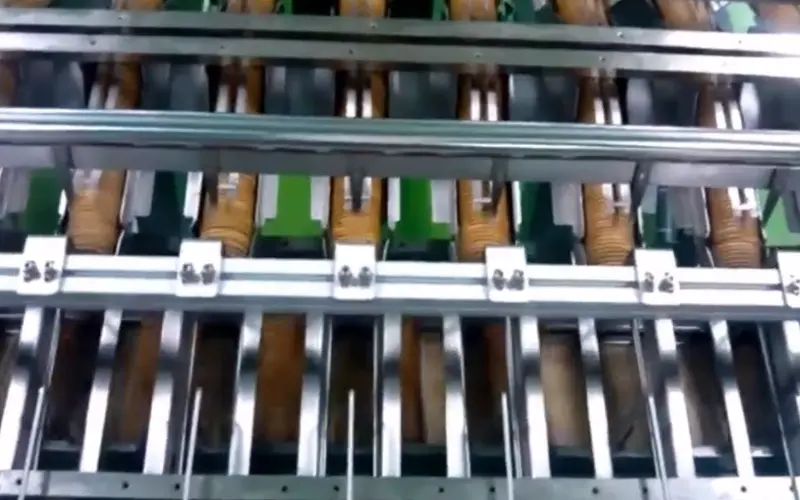
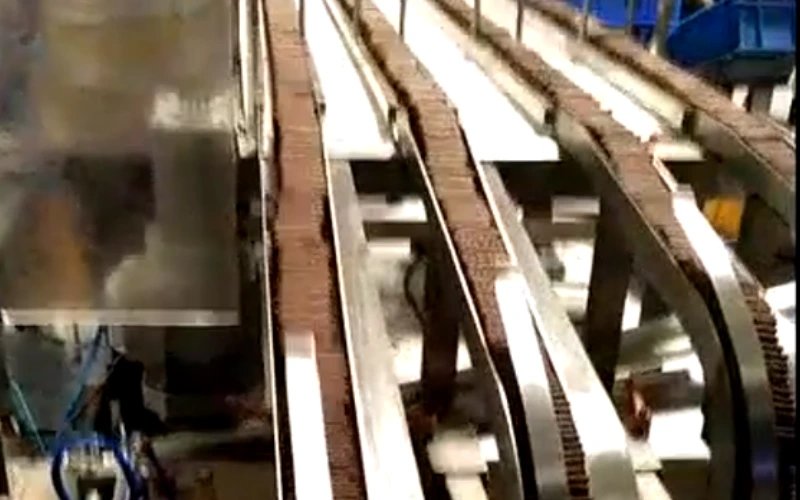
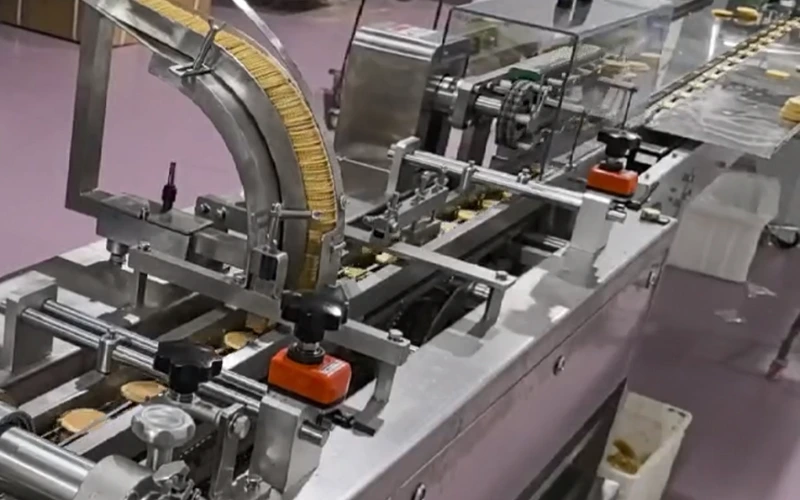
The industry’s proven answer to fragility is the Penny Stacker, or flat-stacker. It operates on the principle of horizontal-plane handling, fundamentally redesigning the stacking process to prioritize zero-impact, non-compressive grouping. This makes it the essential foundation for any premium biscuit line. You can explore this concept further in our guide to Penny Stacker gentle automation.
The Penny Stacker Advantage
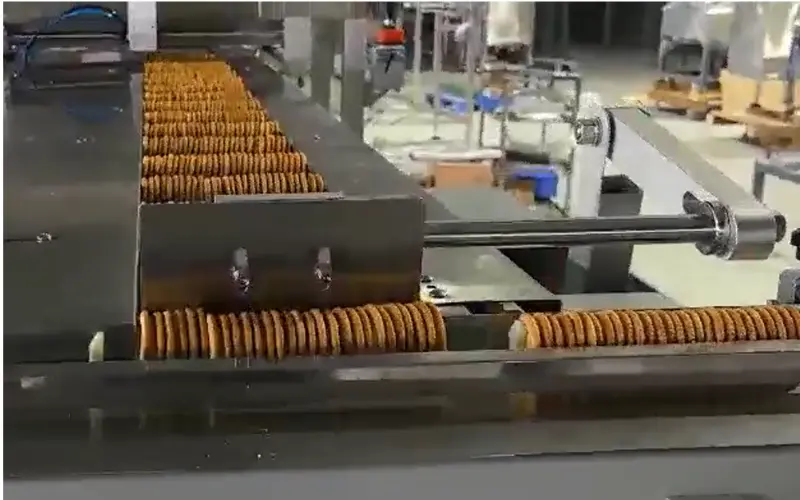
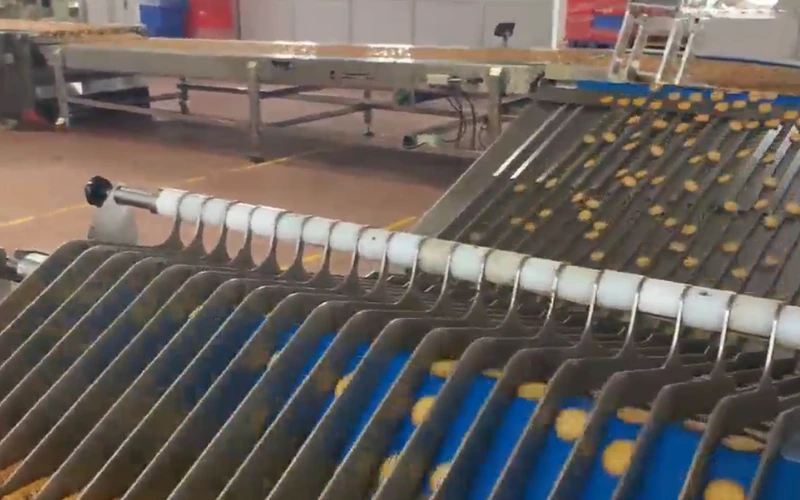
Unlike on-edge stackers, the Penny Stacker receives the products flat from the cooling conveyor and keeps them in that horizontal orientation throughout counting and grouping. The result is a neat, counted stack that is shingled or piled without applying vertical or lateral force that would cause damage. This is paramount when handling an oreo biscuit post-filling, as it preserves the precise cream deposition.
Note: The Penny Stacker design eliminates the gravitational stress and chaotic movement associated with traditional rotary devices, providing a stable platform.
Mechanism Deep Dive
Servo-Driven Pusher: Precision Over Power
The most critical differentiator is the shift from pneumatic (air-powered) pushers to precision servo motors.
Pneumatic Failure: Pneumatic pushers are binary (on/off), delivering a blast of force that is hard to modulate at high speeds. This sudden impact often initiates cracks or shoves the product too aggressively, causing deformation or filling displacement.
Servo Control: A servo system is infinitely controllable. The PLC commands the motor to accelerate gently, make controlled contact, and decelerate smoothly. This motion profile is customized for the product's weight and speed, ensuring the grouping is an acceleration profile, not a collision event. This fine control allows the biscuit stacking machine to achieve high speeds without compromising product integrity.
Tip: Request HMI logs showing the pusher’s velocity curve. Look for smooth, S-curve profiles rather than sharp spikes, which indicates the gentleness of the stacking motion.
The "White Glove" Solution: Retracting Belts
For the absolute most fragile products (ultra-thin wafers, lace cookies), even a controlled lateral push can be too aggressive. This is where the retracting belt system comes into play—the industry’s "white glove" solution.
In this specialized setup, the products are grouped on a secondary, short, independent belt. Once the count is reached, the belt quickly retracts (moves away from the product) at a slightly higher speed than the main conveyor. This releases the group into the primary stream without any direct lateral contact from a pusher, achieving a near-zero-impact transfer.
III. Handling Specific Product Challenges
The suitability of a biscuit stacker is defined by its ability to manage the specific physical and cosmetic challenges presented by unique product recipes.
A. Cream-Filled & Sandwich Biscuits
The challenge here is structural stability and cosmetic perfection, demanding absolute precision for oreo biscuit and cream sandwich biscuit production lines.
Challenge: Filling squeeze-out and misalignment. Lateral pressure displaces the cream, causing it to ooze out and jam the wrapper.
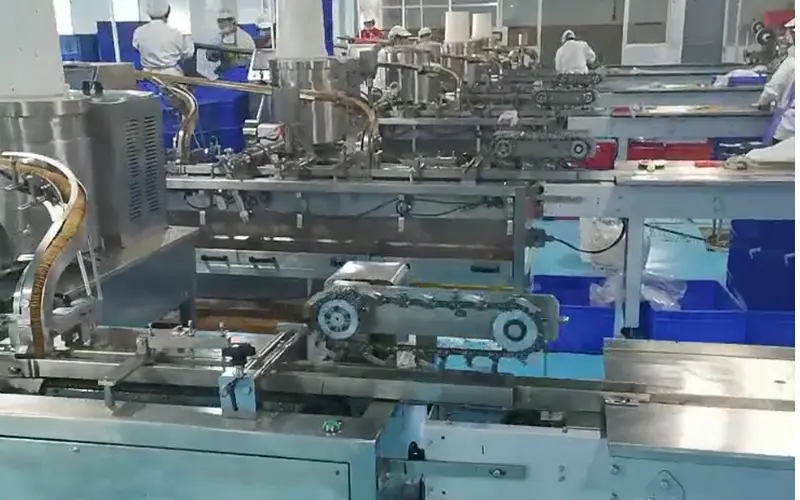
Solution: The zero-lateral-pressure grouping technique is required, achieved by precise synchronization between the servo pusher and the receiving conveyor. This process often relies on electronic camming features within the servo drives. Furthermore, these stackers must integrate seamlessly with upstream sandwiching machines. See our dedicated guide on biscuit stacker packaging line integration.
B. Heavily Coated/Chocolate Products
Coated products, especially those with sensitive decorations or thick chocolate shells, are susceptible to aesthetic damage.
Challenge: Avoiding cosmetic smears, scuff marks, and adhesion. Friction heat can soften the coating, leading to smearing or sticking.
Solution: This demands careful material science: low-friction, anti-adhesion belt materials (specialized PU or Teflon compounds) are non-negotiable. Modern systems may also incorporate localized cooling fans or passive heat sinks to maintain the optimal coating temperature, ensuring the product remains dimensionally stable.
C. Ultra-Fragile Wafers and Lace Cookies
These products possess minimal structural integrity and are vulnerable to even minor vibrational forces.
Challenge: High risk of shatter due to subtle movement, vibration, or abrupt stops.
Solution: The use of advanced linear motor technology is a premium solution here
. Linear motors allow for extremely precise, smooth, and gentle acceleration with near-zero-contact, controlled velocity. In simpler setups, low-mass conveyor systems with highly dampening mounts are used to isolate the stacking zone from external plant vibrations.
IV. Mechanical Design, Maintenance, and Digital Integration
The performance of a modern biscuit stacking machine is defined by its operational efficiency, cleanability, and digital intelligence, ensuring the lowest operational expenditure (OPEX) and highest reliability.
A. Digital Integration & Adaptive Stacking
Advanced manufacturing demands smart equipment that can adapt to real-world production variances, which is impossible with fixed mechanical systems.
Vision Systems & QC: High-speed CCD inspection systems perform dimensional checks and detect micro-breakage before the stacking area. Defective products are auto-rejected to prevent jams, contamination, and subsequent line stops. This pre-stack rejection is vital for maintaining OEE.
Adaptive Stacking Algorithms (The Differentiator): The system uses real-time feedback from an integrated optical caliper to create a closed-loop control system. If the caliper detects a batch of biscuits is slightly thicker or softer, the PLC instantly and dynamically adjusts the servo pusher’s acceleration and grouping pressure for that specific batch. This live compensation guarantees zero-damage output regardless of minor process variances.
Note: Predictive maintenance using embedded sensors can reduce unscheduled downtime by up to 75% compared to fixed-interval maintenance schedules.
B. Packaging Format Flexibility
A versatile biscuit stacking machine must handle various retail formats without extensive mechanical changeover.
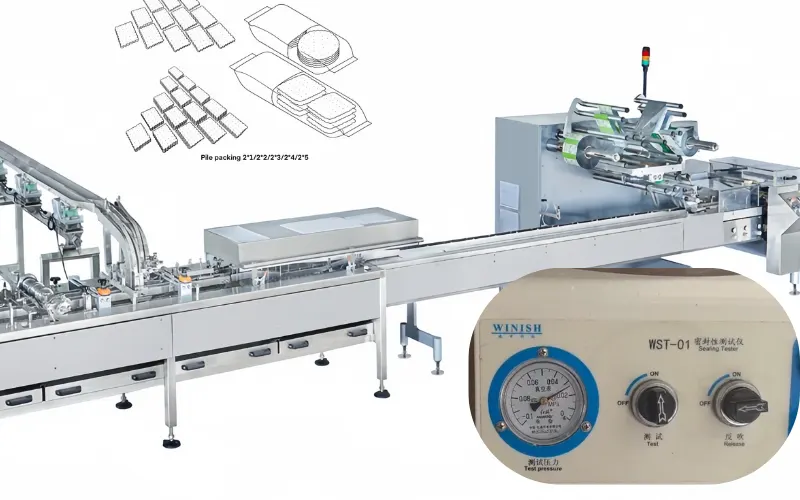
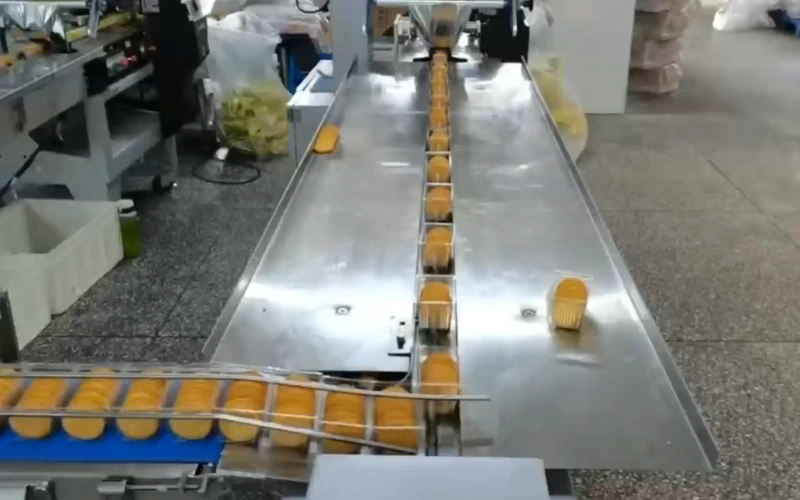
Shingling Mode: The most common output, where biscuits are overlapped for horizontal flow wrap (pillow packs). The stacker’s design ensures a smooth, consistent overlap pitch, critical for the downstream wrapper's registration.
Piled Mode (Vertical Stacks): Used for roll-packs, cartons, or tins. This relies on an integrated lifting/lowering tray mechanism that drops slightly after each biscuit is placed. The full stack is then transferred laterally onto the secondary conveyor feeding the downstream cartoner.
C. Hygiene & Mechanical Integrity
Food safety standards necessitate engineering that minimizes allergen and bacterial harbor points.
CIP Readiness: The design must prioritize Cleaning-In-Place (CIP) readiness and accessibility. This requires an open, cantilevered design where surfaces are sloped, and all motors meet high IP ratings (typically IP65/66).
Material Specification: While 304 stainless steel is the minimum standard, 316-grade stainless steel is a mandatory upgrade for any surface in direct product contact or exposed to high-washdown environments utilizing aggressive cleaning chemicals
. 316-grade steel significantly reduces the risk of rust, pitting, and subsequent contamination.
D. Uptime and Serviceability
Operational efficiency (OEE) is directly linked to the speed and ease of maintenance and format change.
Tool-Less Changeover: A typical manual format change can take 30–45 minutes. A modern system utilizing servo positioning and HMI-controlled adjustments can complete a full changeover in under 5 minutes. This reduction in downtime drastically increases the plant's production capacity.
Remote Diagnostics: Modern PLC platforms offer secure, authorized remote access. This is critical for reducing Mean Time to Repair (MTTR). A technical specialist can securely log in to the HMI to diagnose, troubleshoot, and even upload software patches in real-time, often preventing a line-down scenario from becoming a week-long outage. For maintenance best practices, consult our troubleshooting guide.
Modularity: The equipment must be designed as interchangeable modules (e.g., conveyor sections, pusher assemblies) to allow faulted components to be swapped out quickly by plant staff and repaired offline.
V. Total Cost of Ownership (TCO) & ROI Modeling
The transition to advanced gentle handling is a financial mandate justified by a robust Total Cost of Ownership (TCO) model centered on damage reduction and efficiency. To calculate your specific return, refer to our biscuit stacking machine price and ROI guide.
5.1 The Breakage Reduction Guarantee
The most significant financial argument is the guaranteed reduction in product loss.
ROI Calculation Model (Simplified):
If a high-speed line reduces breakage from a conservative 1.5% (legacy equipment) to a documented 0.3% (gentle servo automation), the recovered profit for a high-volume line can reach $3,888,000 per year (as per the model detailed below).
This level of saving means that a servo-driven biscuit stacker can often achieve full capital payback in less than 12-18 months, making the investment self-financing based on loss prevention alone5.2 Energy Consumption Benchmarks
Modern servo systems utilize high-efficiency motors, only drawing power when motion is required, and employing regenerative braking. This can reduce energy consumption by 15–25% compared to equivalent pneumatic lines, which require energy-inefficient air compression and run large AC motors.
5.3 Operational Expenditure (OPEX) Reduction
Long-term financial health is determined by minimizing day-to-day operating costs:
Reduced Spare Parts Inventory: Servo systems have a significantly longer Mean Time Between Failure (MTBF) than high-wear pneumatic cylinders and mechanical linkages.
Labor Optimization: Eliminating manual intervention to clear jams allows operators to focus on higher-value tasks, like quality assurance.
Lower Contamination Fines: Enhanced CIP readiness and 316-grade material specification significantly reduce the risk of cross-contamination events, protecting against costly product recalls and brand damage.
VI. Conclusion
Investing in a high-precision, servo-driven biscuit stacking machine is not a luxury—it is a strategic decision that protects your brand equity and delivers an undeniable ROI through loss prevention and maximized uptime. By embracing horizontal-plane handling and digital adaptive technology, manufacturers future-proof their operations against increasing consumer demands for perfection and tightening profit margins.
The move to modern servo automation offers clear, measurable benefits across every department: financial justification via the TCO model, operational stability via Predictive Maintenance, and food safety compliance via 316 stainless steel and CIP design.
Professional Consultation and Service Conversion
The decision to transition to gentle automation is a capital investment that requires a detailed, product-specific analysis. To understand the precise Return on Investment (ROI) and determine the optimal machine configuration (e.g., Penny Stacker vs. Retracting Belt) for your factory, we offer a complimentary TCO and Line Audit Consultation.
Contact us today to schedule a confidential review of your current breakage rates and receive a customized Payback Period Projection using our validated financial model. Let our engineers demonstrate the power of our Adaptive Stacking Algorithms on your most challenging products.
References
PPA Global Confectionery Standards Group. Reducing Cosmetic Defects in High-Speed Packaging Operations, 2024.
Industrial Automation Review. The Role of Linear Motor Technology in Zero-Friction Handling, 2023.
Food Engineering International Journal. Leveraging IIoT and Vibration Analysis for Predictive Maintenance in Food Processing, 2024.
HACCP Compliance Report. Material Selection and Corrosion Resistance in Wet/Washdown Food Contact Zones.
Manufacturing Efficiency Institute. Total Cost of Ownership Modeling for Capital Equipment: A Case Study in Confectionery Packaging

Ready to start your journey toward a customized solution? Contact me directly on WhatsApp to begin the conversation.