The Ultimate Biscuit Stacker Buyer's Guide (2025): An Expert's Guide to Key Features, Specs & ROI
H1: The Ultimate Biscuit Stacker Buyer's Guide: 2025 Key Features & Specifications
H2: Introduction
When selecting a biscuit stacker, you should look for a machine primarily based on your specific biscuit type, desired production capacity, available floor space, and budget. This industry rule of thumb is merely the start of your procurement journey.
In today's competitive food manufacturing landscape, choosing the right biscuit stacking machine is no longer a simple purchase; it's a strategic capital investment in your line's efficiency, operational cost, and long-term profitability.
As part of our complete 2025 Ultimate Guide to Biscuit Stacking Machines (Pillar Page), this article on "Key Features" will take you beyond the price tag. We will explore the critical decision points that prevent bottlenecks, reduce waste, and ensure your new equipment integrates seamlessly into your existing production line.
We will go from "purchasing specs" to "engineering standards" and "financial models." Whether you are the factory owner worried about ROI, the electrical engineer concerned with PLC brands, or the maintenance manager dreading parts replacement, this guide will arm you with the deep-dive questions you must ask.
H3: Key Takeaways from This Guide
Technology Matching is Non-Negotiable: You must select the correct technology (Penny vs. On-Edge) based on your biscuit's characteristics (fragile/coated vs. hard/uniform).
Look Beyond the Price Tag: The true value lies in the payback period (ROI), which comes from saved labor, reduced waste (<0.5%), and improved OEE.
The Engineer's Deep-Dive: PLC brands, servo motors, and data interfaces (Industry 4.0) are the critical factors that determine long-term integration and reliability.
Maintenance Determines Cost: Prioritize hygienic (cantilevered) designs and machines that use "standardized parts" to avoid expensive, long-term supplier dependency.
"See It to Believe It": Never skip the final step—a live Factory Acceptance Test (FAT) with your own engineers and your own products.
H2: The First & Most Critical Decision: Matching Stacker Technology to Biscuit Type
This is the single most important step in your selection process. All subsequent specification discussions are built on this one correct choice.
The wrong technology (e.g., trying to use a high-speed star-wheel for fragile, coated biscuits) will immediately lead to catastrophic breakage rates, frequent jams, and line stoppages. Your biscuit dictates the physics of the handling technology you must use.
A biscuit stacking system is primarily divided into two main categories.
Stacking Technology Decision Map
[Decision Flowchart Diagram:
Start: What are your biscuit's characteristics?
Path A (Fragile/Coated/Irregular): Is the biscuit fragile, coated, s-andwiched, or irregularly shaped?
Yes -> Select
Penny Stacker (Gentle handling, keeps product flat)
Path B (Hard/Uniform): Is the biscuit hard, uniform in shape (round/square), and requires high-speed packing?
Yes -> Select
On-Edge Stacker (High-speed, vertical, for flow-wrapping, on edge packaing, tray packaing) ]
Note (Critical Advisory): This decision is irreversible. Choosing the wrong technology type cannot be fixed with "adjustments" later. It will directly lead to line inefficiency and product loss.
H3: For Fragile, Coated, or S-andwiched Biscuits: The "Penny Stacker"
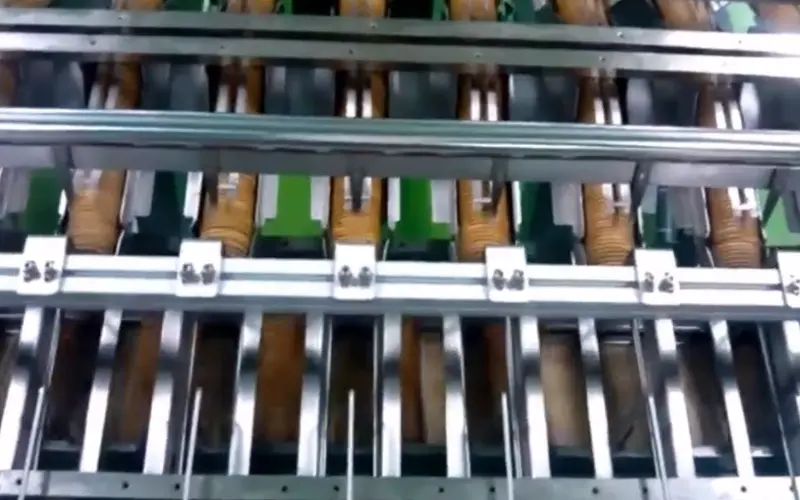
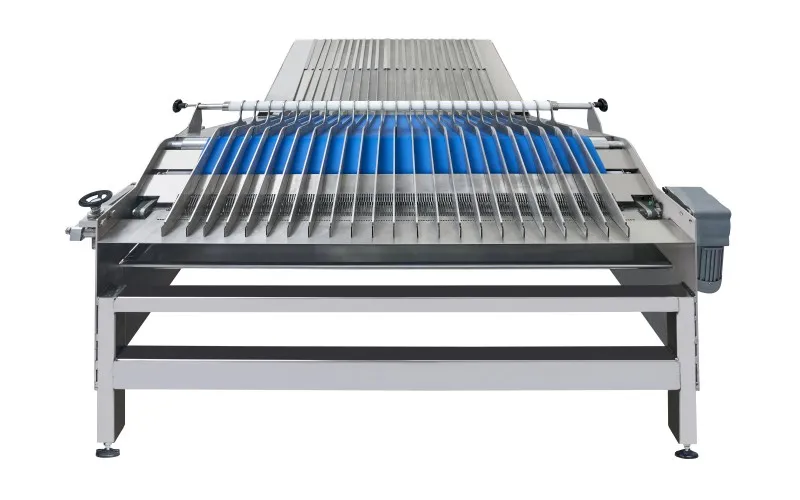
The Penny Stacker, also known as a "Shingling" or "Overlap" Stacker, is the only choice for handling delicate and high-value products. We explore its mechanics in this in-depth guide to Penny Stackers.
How It Works: This stacker operates with extreme gentleness. Biscuits transition smoothly from the cooling conveyor onto the stacker's infeed, remaining flat at all times.
Then, through a series of belts at slightly different speeds or via delicate mechanical arms, the biscuits are overlapped—like shingles on a roof—into a continuous, stable, and easy-to-handle queue.
Core Advantage: The core advantage is minimal physical impact. The product is never flipped, gripped, or dropped.
This gentle shingling motion prevents damage to fragile edges and protects delicate top coatings or cream fillings from being squeezed.
Who It's For: This is the standard configuration for a
stacker for cookiesor any high-value, delicate product. It requires a gentle automation stacking logic to protect the product.Cream-Filled S-andwiches: Any pressure can cause the filling to ooze.
Chocolate-Enrobed Biscuits: The coating is brittle and easily scuffed by friction.
Cookies: Often have a soft, crumbly texture and irregular edges.
Irregular Shapes: Products like animal crackers that cannot be aligned in a standard channel.
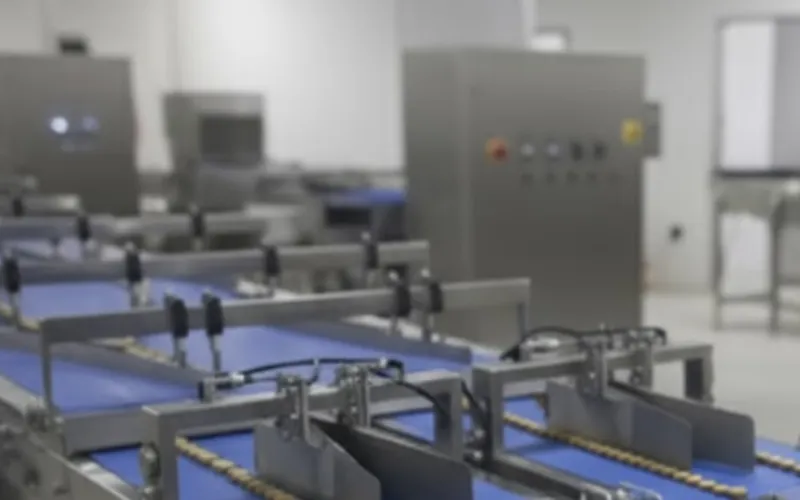
H3: For Hard, Uniform Biscuits & Crackers: The "On-Edge" or "Star-Wheel" Stacker
When your product is hard, robust, and uniform (like rounds or squares), the "On-Edge" Stacker is the key to high-speed, high-efficiency packing. For a deep dive into its high-speed synchronization, read our analysis of Star-Wheel Stackers.
How It Works: This
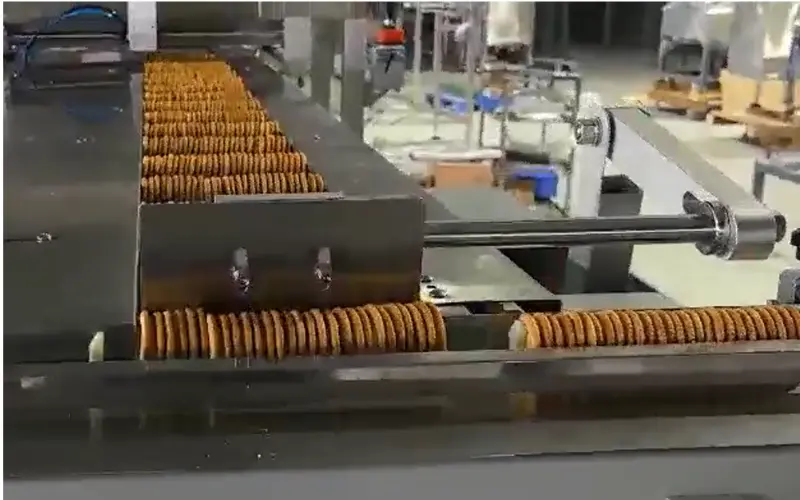
biscuit stacking machinehas a completely different design. Biscuits enter flat but are then guided into a rotating "Star-Wheel" or paddle mechanism.This mechanism, at a precise speed and angle, turns each biscuit 90 degrees to stand it "on-edge." These on-edge biscuits are then pushed into a channel, standing back-to-back in a tight row.
Core Advantage: Speed and efficiency. By turning the biscuits on-edge, the machine can process a massive volume of product at extremely high speeds (far exceeding a Penny Stacker).
More importantly, it prepares the product perfectly for the downstream packaging machine. This tightly packed "slug" of biscuits is the ideal infeed for an automatic "Flow Wrapper" or vertical cartoner.
Who It's For: This is the preferred choice for high-volume, standardized production lines.
Round or square hard biscuits
Soda crackers
Digestive biscuits
Any product destined for high-speed "slug" wrapping.
H3: Technology Comparison: Penny Stacker vs. On-Edge Stacker
Feature | Penny Stacker | On-Edge Stacker |
|---|---|---|
Handling Method | Gentle, Flat, Shingling | High-Speed, Rotating, On-Edge |
Core Advantage | Protects product integrity | Speed, efficiency, pack-ready |
Best For | Fragile, coated, s-andwich | Hard, uniform (round/square) |
Typical Product | High-value cookies, enrobed biscuits | Soda crackers, digestives, hard biscuits |
Downstream Process | Typically feeding a tray or robot | Feeding a Flow Wrapper |
Quick Self-Test: Which stacker does your line need?
Product Type: □ Fragile/Coated □ Hard/Uniform □ Mixed
Daily Output: □ <1 Ton □ 1-5 Tons □ >5 Tons
Current Line: □ New Project □ Retrofit/Upgrade
Complete this and contact us for a custom solution.
H2: Core Technical Specifications to Analyze
Once you've determined which type of stacker you need, you enter the second stage of filtering: comparing the "hard specs" from different supplier proposals.
H3: Production Capacity & Speed
A common purchasing mistake is to only look at the supplier's advertised "max speed." The correct metric is "matched speed."
Match Your Upstream: Your
biscuit stackermust be a reliable "buffer" and "rate-matcher." Its speed (measured in pieces/minute or slugs/minute) must match or slightly exceed the maximum stable output of your oven and cooling conveyor.Too Slow: This will cause the upstream cooling line to back up, creating a pile-up and a cascading shutdown. This is the definition of a production bottleneck.
Too Fast (but poorly matched): If the machine lacks good buffering logic, it may "surge and stop" frequently as it waits for product, causing unnecessary mechanical wear.
Speed Adjustability: A modern
biscuit stacking systemmust be equipped with a high-quality Variable Speed Drive (VSD) or servo motors. You need to verify that the machine is flexible.Can you easily dial down the speed by 20% on the HMI (Human-Machine Interface) when you switch to a new, more fragile biscuit recipe?
Tip (Expert Advice): Always select a stacker with a top speed that is slightly higher than your oven's maximum output. This gives you a critical buffer to handle surges and provides valuable headroom for future line speed increases.
H3: Physical Footprint & Line Integration
Your factory floor space is expensive, and line downtime is catastrophic.
Footprint: The new machine must fit. Measure your available floor space carefully.
Does the supplier offer flexible layouts? A st-andard "in-line" configuration might not fit, but an "L-shaped" or "U-shaped" layout (using turning conveyors) might integrate perfectly.
Conveyor Compatibility: This is a low-level but potentially fatal error. Do the infeed and outfeed heights, widths, and directions of the stacker match your existing cooling conveyor and downstream packaging machine?
This requires millimeter-level drawing confirmation.
"Bolt-On" Design: Look for "bolt-on" or "plug-and-play" designs. This means the equipment is a highly integrated module with a solid base that can be quickly wheeled in, leveled, and secured, rather than requiring extensive on-site fabrication.
This can cut installation and commissioning time from weeks to days.
Signal Interlocking: (The Electrical Engineer's focus) This is the heart of automated integration. Your
biscuit stackermust be able to "talk" to the machines before and after it.Without this, the result is biscuits being pushed onto the floor, creating massive waste and cleanup. This upstream/downstream "conversation" is the core challenge of biscuit stacker and packaging line integration (Cluster Article).
Upstream Starve: When the sensor on the cooling line detects no biscuits, the stacker should automatically enter a "standby" mode, not run empty.
Downstream Blockage: When the packaging machine (downstream) sends a "full" or "stop" signal, the stacker must immediately and automatically pause. It must also have the logic to buffer a few seconds of incoming product.
H2: The Cross-Departmental Review: Considerations from Engineering, Finance & Maintenance
Welcome to the most important section of this guide. Machines with similar tech specs can have wildly different long-term value.
This is what separates a "good-looking machine" from a "profitable asset," and it's your most powerful negotiating tool.
H3: The CFO & Purchasing Manager: Building the ROI Model
Your CFO or factory owner cares about one question: "How fast does this machine pay for itself?" A supplier will talk about TCO (Total Cost of Ownership), but you must build your own ROI (Return on Investment) model.
We break down the full calculation in our separate article on biscuit stacker price and ROI.
Don't just look at TCO; calculate the Payback Period. A biscuit stacking machine pays for itself in three primary ways:
A. Labor Savings:
Scenario (Before): A manual stacking line requires 2 workers per shift for sorting and stacking. The factory runs two shifts.
Scenario (After): The automated
biscuit stackerrequires only 1 operator (monitoring multiple machines).Calculation:
(3 saved labor-shifts) x (Cost per labor-shift [incl. salary, insurance, benefits])= Annual Direct Labor Savings.B. Waste Reduction:
This is the most-underestimated, high-return category. Manual handling,
manual biscuit stacking, and sorting inevitably lead to dropped, broken, and contaminated products.Industry Benchmark: Manual handling breakage rates are typically between 3% and 5%.
Machine Benchmark: A good automated
biscuit stacking systemcan control breakage to under 0.5%.Calculation:
(2.5% saved waste) x (Your average daily production) x (Ex-factory value of your product)= Annual Profit Recovered from Waste.C. OEE Improvement:
Manual stacking has a hard ceiling on speed and consistency. This is often the bottleneck for the entire line (Oven -> Cooling -> Stacking -> Packing).
Scenario: Your oven could run 10% faster, but it's forced to run slower because the manual packers can't keep up.
Calculation:
(10% throughput increase from bottleneck removal) x (Added volume) x (Marginal profit per unit)= Annual Profit from Increased Throughput. (OEE, or Overall Equipment Effectiveness, is the gold st-andard for measuring manufacturing productivity).
Your Payback Period (in Months) = (Total Investment [incl. install]) / [(A + B + C) / 12]
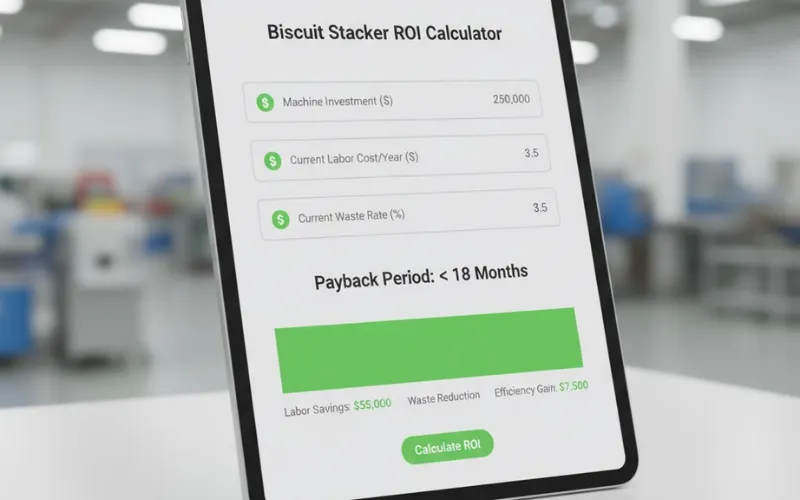
Hidden Value (The Owner's Focus): Factor in the reduced risk from improved food safety (machine vs. human contact). A single product recall event can cost more than ten stacking machines.
Note (The CFO's View): When calculating ROI, "Waste Reduction" is often the fastest and largest payback. Do not underestimate the financial impact of cutting a 3-5% manual breakage rate to under 0.5%.
H3: The Engineer (E&E / ME): Integration, Data & Drive Systems
Your engineering team must inspect the "heart" and "brain" of the machine. This determines its reliability, flexibility, and "intelligence" for years to come.
The Electrical Core (E&E Engineer Must-Check):
PLC Brand: This question is critical. Is your factory's automation st-andard based on Siemens, Rockwell/Allen-Bradley, Omron, or Mitsubishi?
Choosing a
biscuit stacking machinewith an "off-br-and" PLC is a hidden "technical debt." Your maintenance team will lack the software, spare parts, and training to troubleshoot it, forcing you to rely on the OEM's expensive and slow support for years.Data & Connectivity: Is this machine "Industry 4.0" ready? This isn't just a buzzword.
Ask the supplier: Does it provide st-andard industrial ethernet ports like OPC-UA, Profinet, or EtherNet/IP? You need these to send real-time data (OEE, output, downtime codes, alarms) to your factory's MES or SCADA system for transparent management.
The Mechanical Core (ME Engineer Must-Check):
Servos: Cost more, but provide unmatched precision, high-speed response, and repeatability. This is essential for high-speed, precise
biscuit stacking(e.g., ensuring exactly 20 biscuits per slug, every time).Traditional Motors: Less expensive and perfectly suitable for simple, continuous-motion tasks like conveyors.
Drive System: Are the machine's critical movements (like the star-wheel or shingling) driven by "Servo Motors" or traditional "Inductive Motors + VFDs"?
Modularity & Scalability: Is the machine designed in modules? This is an investment in your future.
If your production doubles in three years, do you want the ability to easily add a second stacking unit in parallel (a modular design)? Or will you be forced to sell the entire machine and buy a bigger one?
Tip (The Engineering Trap): Compromising on the PLC br-and (to save a little on the initial price) is the most expensive long-term engineering mistake you can make. The resulting maintenance, training, and spare parts costs will be a disaster.
H3: The Maintenance Team: Serviceability & Long-Term Uptime
Your maintenance engineers are going to "live" with this machine for the next decade. Their opinion will save you from a "maintenance nightmare."
For a detailed checklist, see our Stacker Maintenance & Troubleshooting Guide.
Hygienic Design: (A deeper look)
This eliminates hidden surfaces, allowing for 360-degree, high-pressure washdowns and sanitation. Check that all welds are polished smooth, with no pits or screw holes where bacteria can hide. These principles follow the highest st-andards, like those from the Global Food Safety Initiative (GFSI).
Material St-andard: It's not just "stainless steel." It must be food-grade stainless steel (SUS304 or 316L) for all product-contact and nearby zones.
Easy-to-Clean Design: Look for "open" or "cantilevered" designs. This means the machine's main frame is on one side, while the belts and moving parts "hang" off it, leaving the area underneath and behind completely open.
Serviceability:
St-andard Parts: You can buy them quickly and cheaply from a local supplier.
Proprietary Parts: They are expensive and can have a lead time of months. Your entire line will be down while you wait.
Accessibility: Does your mechanic need to be a contortionist, or spend 4 hours removing guards, just to change a $50 belt? Check the accessibility of motors, gearboxes, bearings, and major sensors.
St-andardized Parts: This is the key to long-term cost. Ask for the "Critical Spare Parts List." Is the machine built with "st-andard, off-the-shelf" parts (e.g., SKF bearings, SEW/Nord gearboxes, SMC/Festo pneumatics) or "proprietary supplier parts"?
Preventive Maintenance:
Does it require special (and expensive) H1 food-grade grease?
Does it have an auto-lubrication system (e.g., a timed grease pump)?
Or, does it require a mechanic to manually hit dozens of grease points every week? (And if so, are all those points easily accessible?)
Data: Ask the supplier for MTBF (Mean Time Between Failure) and MTTR (Mean Time To Repair) data for critical components.
Monitoring: More advanced
biscuit stacking systemmodels include sensors to monitor machine health, like motor current (Is the belt too tight?) or vibration (Is a bearing about to fail?).Lubrication Requirements: This is a crucial, often-overlooked detail. Ask:
Note (The Maintenance Cost Trap): Proprietary parts are a supplier's lock-in strategy. Insist on the use of international, st-andard-br-and components for all critical wear parts (bearings, motors, pneumatics) as part of your purchase negotiation.
H2: Supplier Qualification & Final Validation
When two suppliers' spec sheets (and prices) look similar, the supplier's reliability (soft skills) will determine your project's success.
H3: Supplier Vetting
After-Sales Support: This is your safety net.
Response Time: Does the supplier have a local service team in your country or region? When your line is down, is help 4 hours away, or 48 hours and an international phone call away?
Remote Diagnostics: Can the supplier securely VPN into your
biscuit stacker's PLC to diagnose a fault remotely? This can turn a multi-day problem into a 10-minute fix.Documentation: (Engineers and Maintenance teams care deeply about this.)
Ask for a sample. Does the supplier provide a full, professional set of documents, including: electrical schematics, mechanical assembly drawings, P&ID charts, a detailed operations manual (with troubleshooting), and a full parts list (with st-andard part numbers)?
A machine without detailed schematics is an un-repairable "black box."
Training: Does the supplier provide comprehensive, on-site training for your operators and your maintenance team? This must cover daily operation, product changeover, cleaning procedures, and first-level troubleshooting.
References: Ask for, and always call, their existing customers who have a similar scale and product (biscuit type) to yours. Ask them about reliability, if the promised speeds were achieved, and (most importantly) how a service call was h-andled.
H3: Final Validation: The Live Demo with Your Engineers
This is the last and most critical step before you pay a large deposit: the Factory Acceptance Test (FAT).
Why It's Critical: Brochures, videos, and promises are marketing. Seeing is believing.
What to Test: Never test with the supplier's "perfect" samples. You must air-freight your own factory's product—especially your most fragile, most irregular, or most difficult-to-run biscuit—to the supplier's facility for the test.
Who to Bring: Always bring your mechanical and electrical engineers to the FAT. A purchasing manager sees speed and shine. Your engineer will be crawling behind the machine, opening the electrical cabinet, and checking wire organization, build quality, and mechanical tolerances you'll never see in a brochure.
The Stress-Test Checklist: (Don't just see it run; see how it h-andles trouble.)
Limit-Speed Test: Run the machine for an extended time at the fastest and slowest promised speeds. Does it vibrate excessively? Does stacking accuracy drop?
Product Changeover: Have the supplier's technician perform a full changeover (e.g., from a round to a square biscuit) while you time them with a stopwatch. Is this 15-minute "quick changeover" acceptable for your downtime?
Simulate a Jam: Intentionally create a jam or a product-starve situation. How easy and safe is it for an operator to clear the fault and restart the line?
The Soak Test: Dem-and the machine run continuously at full production speed for at least 1-2 hours. A 10-minute demo hides problems. A long run will reveal issues caused by heat-soak, component "creep," or intermittent software bugs.
During this test, check if the breakage rate is consistently below the promised <0.5%.
Tip (The FAT Secret): The point of a FAT is not to see the machine run well. It's to see how it performs when things go wrong. Simulating jams and performing changeovers will reveal more about the design quality than hours of perfect running.
H2: Conclusion: Choosing a Partner for a Technical, Financial, & Operational Win
Summary: Choosing the right
biscuit stackeris a complex process of balancing multiple factors. It starts with the correct judgment of your "biscuit type," followed by a rigorous review of "speed," "integration," and "hygiene."Final Advice: As this guide has shown, the real winners go deeper. They review "integrability" and "PLC st-andards" with an engineer's eye, "st-andardized parts" and "accessibility" with a maintenance eye, and "payback period" with a CFO's eye.
2025 Industry Trends: Automation, data connectivity (Industry 4.0), and modularity (flexibility) are the key trends defining the next generation of
biscuit stacking systemtechnology.Choose a Partner: Your choice is not just a
biscuit stacking machine. It's a long-term operational partner who understands your factory's automation st-andards, respects your drive for OEE, and can reliably support you for the next 10 years.
H2: FAQ - Real Questions from the Production Floor
1. Q: (from PPA) "Is a biscuit stacker a worthwhile investment? What's the price range?"A: It is absolutely worthwhile, provided you choose the right machine. The price range is extremely wide, from tens of thous-ands of dollars (for a small small biscuit stacking machine) to several hundred thous-and (for a high-end biscuit stacking system with servos and auto-changeover).
The price depends on the technology (Penny vs. On-Edge), speed, and level of automation (like the PLC br-and). As noted in the "Financial & ROI Model" section, you should focus on the Payback Period. A reliable machine often pays for itself in 12-24 months through labor savings and waste reduction (from 3-5% down to <0.5%).
2. Q: (from a Production Manager) "We make 5 different biscuit sizes. Do I need 5 different stackers?"A: No, you do not. A modern biscuit stacker is designed to h-andle multiple products. The critical factor to evaluate is its "changeover" efficiency.
On-Edge Stackers: Typically changeover by swapping a star-wheel or adjusting guide rails for different diameters/thicknesses.
Penny Stackers: Usually adjust by changing belt-speed ratios and side guides.
Your key question should be: "How long does a changeover take, and does it require tools?" Look for machines that offer "tool-less" or "recipe-managed" changeovers (a one-touch selection on the HMI) to minimize downtime.
3. Q: (from PPA) "On-Edge Stacker vs. Penny Stacker—which one do I actually need?"A: This depends 100% on your biscuit, as covered in the first section. It is a black-and-white choice.
Choose "On-Edge": If your biscuits are hard and uniform (like soda crackers) and your downstream packaging is a high-speed "slug" pack.
Choose "Penny": If your biscuits are fragile, coated, s-andwiched, or irregular (like cookies). Trying to force a fragile biscuit through an On-Edge stacker is a recipe for disaster.
4. Q: (from a Reddit forum) "What are the most common faults on a biscuit stacker? How do I prevent jamming?"A: This is an excellent, practical question. The most common faults are "jamming" and "stack collapse/mis-stack." Prevention is 90% maintenance.
Preventing Jams: The vast majority of jams are caused by dirty sensors (covered in flour/sugar dust) or belt misalignment. You must enforce a strict cleaning schedule and train operators to check and wipe photo-eye sensors.
Preventing Collapse: This is often due to an inconsistent infeed from upstream, or the machine's speed being out-of-sync with the wrapper.
Routine Maintenance: Follow the manufacturer's lubrication schedule (as discussed in the Maintenance section) with food-grade grease for bearings and chains, and check belt tension.
5. Q: (from PPA) "How do I synchronize a stacker with a (different br-and) flow-wrapper?"A: This is a core engineering challenge called "integration" or "the h-andshake." It must be confirmed before you buy. It happens in two ways:
1. Physically: The conveyor heights, widths, and speeds must match.
2. Electrically (Signal Interlocking): This is the key. The stacker (upstream) must be able to receive "Ready" and "Stop/Full" signals from the wrapper (downstream). This is done via hardwired or Ethernet signals between the two PLCs.
Before you buy, your stacker supplier must communicate with your wrapper supplier to ensure the two machines can "talk" to each other.
6. Q: (from Quora) "When should we upgrade from 'manual stacking' to an automatic stacker? Where's the tipping point?"A: The tipping point is almost always when you require 1-2 full-time employees whose only job is to stack. manual biscuit stacking is fine for micro-bakeries or small biscuit stacking machine applications.
The moment your volume requires dedicated labor, the ROI for an automatic biscuit stacking machine becomes extremely compelling. As shown in the ROI model, the advantages in eliminating labor costs, slashing breakage (3-5%), and removing the production bottleneck (human h-ands can't keep up with the oven) are overwhelming.
H2: 🚀 Get Your Custom Stacking Solution
Choosing the right biscuit stacking system is a complex engineering decision. You don't have to do it alone.
Our engineering team is ready to provide you with: ✅ A Free Production Line Assessment - A 15-minute call to diagnose your bottleneck. ✅ A Precise ROI Calculation - Based on your real-world labor and waste numbers. ✅ A Technology-Match Report - Penny Stacker vs. On-Edge for your specific products. ✅ An Integration Feasibility Check - Compatibility analysis with your existing equipment.
Stop hesitation. Consultation by clicking our whatsapp immediately for your line!

Ready to start your journey toward a customized solution? Contact me directly on WhatsApp to begin the conversation.