How Food Packaging Machines Affect Accuracy: A Complete Guide
Introduction: Redefining the Role of Packaging Machinery
In today's hyper-competitive market, a food packaging machine is far more than a simple tool for sealing bags. It stands as a core strategic asset, pivotal for enhancing product consistency, driving down comprehensive operational costs, fortifying your brand's image, and building critical agile production capabilities.
Yet, many businesses fall into the trap of a surface-level comparison of speed and precision when navigating how to choose food packaging equipment. The truly decisive question is far more profound: How will this machine consistently and reliably generate value for my business over its entire lifecycle?
This guide will take you beyond the traditional spec sheet. We will dissect the process of making a wise, strategic investment from a holistic business, financial, and engineering perspective, while deeply exploring how food packaging machine affect accuracy—a topic that directly impacts your bottom line.
Key Takeaways
A Shift in Strategic Perspective: Your food packaging machine should be redefined from a line-item expense to a strategic asset that actively drives profitability and enhances brand equity.
Precision Equals Profit: Packaging accuracy is directly linked to raw material waste and regulatory compliance risks, making it a critical variable that directly impacts your company's net profit.
Look Beyond the Spec Sheet: Real-world production efficiency (OEE) and the Total Cost of Ownership (TCO) are infinitely more valuable for decision-making than theoretical maximum speeds.
Stability Over Peak Performance: The long-term, consistent stability of the machine's accuracy and reliability is far more important than peak performance data achieved under perfect laboratory conditions.
Investing in the Future: A modular equipment design and inherent flexibility are your primary defenses against future market shifts, ensuring the long-term protection of your initial investment.
Part 1: Decoding Core Parameters—Reading the Business Language Behind the Specs
When you receive a technical specification sheet, the numbers are just the beginning of the story. Understanding the profound business implications behind those figures is the foundational first step toward making the right decision.
1.1 Speed vs. Efficiency: It's More Than Just "Bags Per Minute"
The peak speed of "120 bags per minute" listed on a spec sheet is certainly appealing. However, this figure is almost always measured under ideal, non-production conditions.
For business leaders and managers, the far more critical metric is Overall Equipment Effectiveness (OEE). OEE provides a real-world measure of a machine's actual productivity against its theoretical maximum, calculated as a product of three key factors: Availability, Performance, and Quality.
A machine for packaging food built for high stability, even with a slightly lower theoretical speed, can easily outperform a faster but frequently down machine. Its superior reliability and rapid changeover capabilities result in a much higher long-term OEE.
For instance, modern quick-changeover technology can slash the time required to switch between products from 30 minutes to less than five. In a high-mix, low-volume production environment, the resulting boost in capacity and order responsiveness is exponentially more valuable than a marginal difference in peak speed.
Note: When evaluating packaging machinery suppliers, always insist on seeing OEE data from their typical customer installations, not just the theoretical maximum speed.
1.2 Precision & Accuracy: The Direct Line to Your Profit Margin
Precision is the most direct manifestation of how food packaging machine affect accuracy. But it is crucial to distinguish between "short-term precision" and "long-term stability."
Many suppliers will showcase impressive accuracy data achieved in a controlled lab environment with a single, ideal material. In a real-world factory, however, variables like voltage fluctuations, ambient temperature and humidity shifts, and minor variations in material properties will constantly challenge the machine's accuracy.
Therefore, a truly valuable accuracy guarantee should include its confidence interval and data on long-term performance stability. More importantly, you must recognize the direct financial consequences of accuracy deviation.
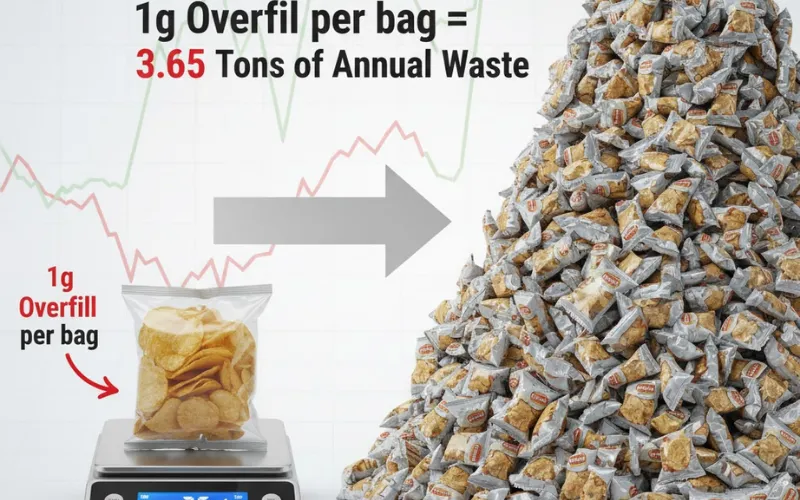
Under-filling creates serious compliance risks, such as those outlined by the U.S. Food & Drug Administration (FDA), and leads to customer complaints. Over-filling means you are constantly giving away free product—a silent drain on your profits.
Imagine a machine filling 10,000 bags per day, overfilling each by a mere 1 gram. Over a year, that amounts to 3.65 tons of wasted material. This "hidden cost" alone can completely erase any savings you thought you gained by choosing a lower-priced machine.
Tip: When conducting your cost analysis, monetize the annual material waste caused by accuracy deviations. This simple calculation will elevate your purchasing decision from a "price comparison" to a true "value comparison."
1.3 Machine Footprint & Flexibility: Designing for Tomorrow
The physical footprint of a food product packaging machine directly impacts your valuable factory floor space costs. A compact design is, in itself, a way to reduce fixed operational overhead.
Even more critical, however, is the machine's flexibility, which determines your ability to adapt to market changes. When selecting equipment, you must consider the future.
When your company launches a new recipe, a different product shape, or a new packaging format, can this machine be adapted with minimal cost and downtime? Building in the capacity to handle your product matrix for the next 3-5 years is essential to protecting your investment.
Part 2: The Multi-Front War on Inaccuracy—A Deep Dive into All Affecting Factors
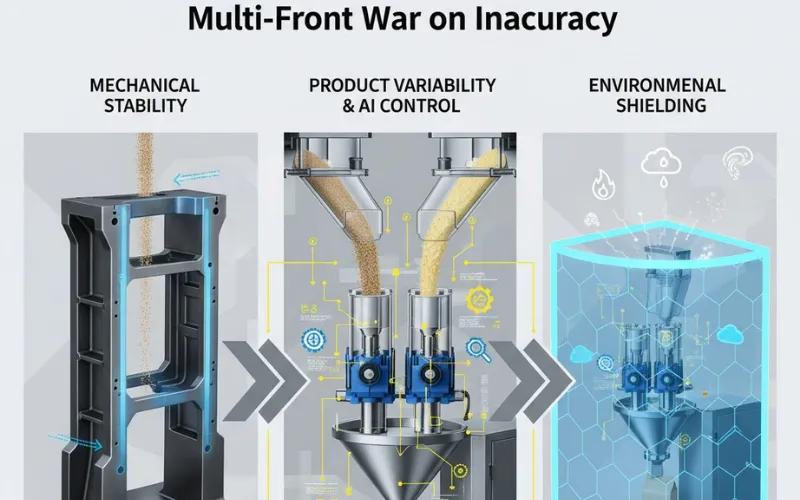
Achieving consistent accuracy is not the result of a single factor. It's a multi-front war waged across three battlegrounds: mechanical design, product characteristics, and environmental conditions.
2.1 The Bedrock of Mechanical Stability: Looking Beyond the "Servo Motor" Buzzword
Nearly every high-end machine today claims to use a "servo system." However, the true foundation of precision lies in the mechanical structure itself.
Consider the machine frame. A single-piece, high-precision cast base offers unparalleled rigidity and vibration resistance compared to a traditional welded frame. It fundamentally suppresses the stress deformation and micro-vibrations that occur during long-term operation, providing an unshakable foundation for all precision components.
This is the physical bedrock that ensures long-term accuracy stability and is a core differentiator between top-tier food packaging machinery manufacturers and average brands.
2.2 Dynamic Product Handling: From Passive Adaptation to Proactive Compensation
The physical properties of your material are the biggest variable affecting accuracy. For example, the fragility of potato chips is worlds apart from the flowability of nuts.
Even with the same type of flour, moisture content and adhesion properties can vary between batches. A standard machine packing food can only react passively to these changes, whereas an advanced system can proactively compensate.
The Differentiating Feature: Self-Adaptive Learning for Material Properties. Through advanced AI algorithms, the machine can learn and memorize the ideal filling parameters for different materials.
When it detects a change in material properties, such as flow resistance, the system automatically fine-tunes the filling speed, vibration frequency, or auger rotation. This achieves dynamic compensation, ensuring consistent accuracy from the first bag to the ten-thousandth. This directly answers the question of how to make food packaging * machine affect accuracy—through intelligent, proactive adaptation.
Note: During machine trials, it is absolutely critical to use your most challenging, real-world production materials to truly test the machine's adaptive capabilities.
2.3 The Real-World Gauntlet: Environment and Operations
Dust, humidity, and temperature fluctuations are the norm on a production floor. These factors can interfere with sensor readings, affect the performance of mechanical parts, and even alter the product itself (e.g., clumping due to moisture).
A well-engineered machine will combat these influences by using sensors with higher IP protection ratings, implementing air curtain isolation in critical areas, and employing temperature drift compensation algorithms.
On the operational front, data-driven predictive maintenance is another powerful weapon for ensuring long-term accuracy. By installing vibration and temperature sensors on critical internal components like main bearings and servo motors, the system can continuously monitor their health.
Algorithm models analyze this data and can issue a warning hundreds of operating hours before a component actually fails. This gives you the opportunity to schedule a replacement during planned downtime, completely avoiding the catastrophic accuracy failures and unplanned production halts caused by sudden component failure.
Tip: Ask potential suppliers if their equipment supports predictive maintenance. This is often a key indicator that separates one generation of technology from the next.
Part 3: The Engineer's Touch—The Hidden Details That Drive Competitive Advantage
True excellence is found in the details—the thoughtful design elements that may not appear on a spec sheet but have a daily impact on your operators and maintenance engineers.
3.1 Designing for Maintainability: Minimizing Downtime
Mean Time To Repair (MTTR) is a critical KPI for evaluating equipment design. Our philosophy is to "design for service."
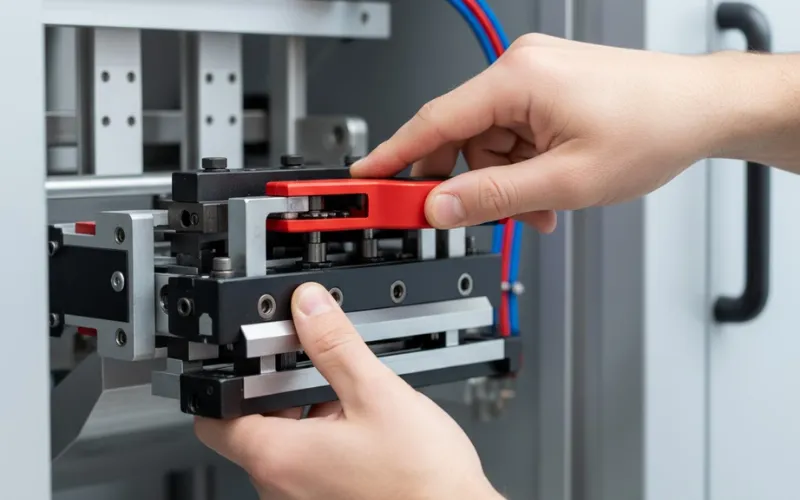
"Tool-less" Quick-Release Design: For components that require frequent cleaning or replacement, such as hoppers, forming tubes, and sealing jaws, we've engineered them for complete removal and installation by hand, without any wrenches or screwdrivers. This not only cuts daily cleaning time by up to 70% but also enables minute-level component swaps in the event of a failure.
Color-Coding & Cable Management: Complex electrical and pneumatic circuits are a maintenance engineer's nightmare. We utilize internationally recognized color-coding systems (e.g., red tubing for positive pressure, blue for vacuum) and apply unique ID tags to all cable connectors. Paired with clear, full-color system schematics, this makes troubleshooting intuitive and accurate, significantly reducing reliance on senior-level engineers.
3.2 Designing for Supply Chain Resilience: Safeguarding Your Production Continuity
We understand that an advanced machine without access to spare parts is just a pile of scrap metal. That's why we practice an open-source standard parts strategy.
We openly commit that our core components—PLCs, servo motors, HMIs, bearings, and seals—are all sourced from mainstream, industry-standard brands. This means you are never "locked in" to a single supplier and can easily and quickly source replacement parts from anywhere in the world, fundamentally guaranteeing the continuity of your production.
3.3 The Human-Machine Interface Philosophy: Reducing Reliance on "Master Technicians"
Employee turnover is a reality in manufacturing. How do you get new staff up to speed quickly? We've integrated an Augmented Reality (AR) guidance system.
When an operator encounters a problem, they can simply scan the equipment with a tablet or AR glasses. The screen will then overlay virtual step-by-step instructions, animated guides, or critical safety notes directly onto the machine.
For complex repairs, a remote expert can see the live field view through this system and provide real-time annotated guidance, as if they were standing right there. This dramatically shortens the training curve and maximizes the value of your expert resources.
Note: While design for maintainability doesn't appear on a performance spec sheet, it is one of the most critical factors determining the long-term total cost of ownership of your equipment. A deep dive into our food packaging equipment maintenance guide is crucial for ensuring production continuity.
Part 4: The Total Cost of Ownership—A Transparent Ledger for Financial Decision-Makers
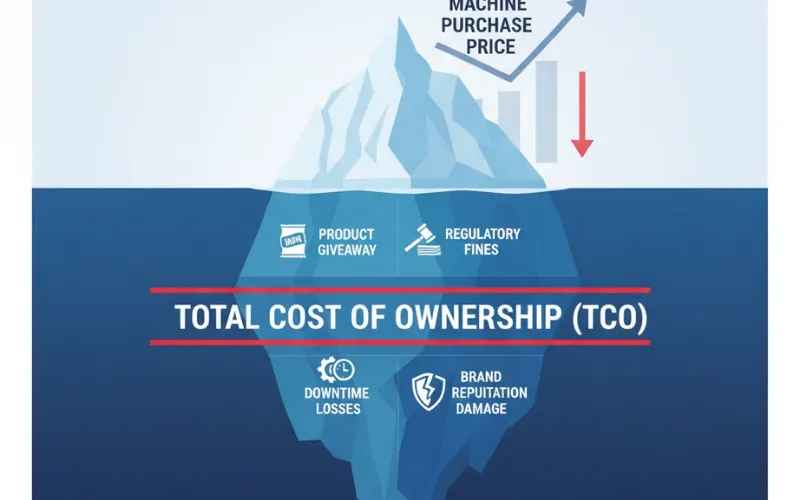
For the CFO and financial stakeholders, the purchase price is merely the tip of the iceberg. The real decision should be based on a comprehensive Total Cost of Ownership (TCO) model.
4.1 Building Your TCO Model: Seeing the Costs Below the Surface
A complete TCO model should clearly itemize the following cost components:
Initial Investment: Purchase price, shipping, installation, commissioning, and initial training.
Operating Costs: Energy consumption, compressed air usage, and consumables for regular maintenance (e.g., sealing tapes, cutting blades).
Maintenance Costs: Labor and parts for planned preventive maintenance, plus the costs of unplanned repairs and the associated production loss.
Material Waste Costs: Overfilling due to precision issues, and product waste generated during startup, testing, and malfunctions.
Labor Costs: The time investment required from operators and maintenance engineers.
End-of-Life Value: The residual or resale value of the equipment after depreciation.
Using this model, you will often discover that a machine with a 20% higher purchase price but 15% lower energy consumption, 30% lower scrap rate, and 10% higher residual value actually has a lower TCO over a 3-5 year period.
4.2 Quantifying Risk Costs: The Financial Impact of Inaccuracy and Downtime
In addition to direct costs, risk-related costs must also be quantified:
Compliance Risk: Fines from regulatory bodies and product recalls due to insufficient package weight.
Brand Reputation Risk: A crisis of consumer trust triggered by packaging quality issues, the cost of which is immeasurable.
Opportunity Cost: Emergency orders you cannot accept due to a lack of machine flexibility, or penalties for late order delivery caused by unplanned downtime.
4.3 New Dimensions of ROI: Flexibility, Data, and Upgradability
The return on investment for a modern food packaging machine is also found in:
The Value of Flexibility: The ability to respond rapidly to market changes is a core competitive advantage in the fast-moving consumer goods sector.
The Value of Data: The machine, as a data node on your factory floor, generates OEE, energy consumption, and output data that is essential for lean manufacturing initiatives and informed management decisions.
The Value of the Future: A modularly designed machine allows you to upgrade its capabilities as needed—by adding vision inspection, robotic palletizing, or data acquisition modules—protecting your initial investment from rapid obsolescence.
Tip: Demand that your supplier (or use our TCO calculation tool) provide you with a preliminary TCO analysis based on your specific production data. This will make your investment decision far more scientific.
Part 5: The Strategic Procurement Playbook—How to Make Decisions Like a COO
5.1 Assemble a Cross-Functional Evaluation Team
Never let the procurement department make this decision in a silo. You must form an evaluation team with representatives from Production, Maintenance, Finance, and Quality Assurance to ensure the machine is assessed from every professional angle.
5.2 Ask the Soul-Searching "Value Questions"
Go beyond comparing technical specs. Ask your potential suppliers the following questions:
"What is the projected breakdown of the TCO for your machine over its lifecycle? Can you provide a simulated analysis?"
"Beyond the standard warranty, how do you guarantee parts availability and technical support 7 or even 10 years from now?"
"When my product formulation or package size changes, how does your machine adapt with minimal cost and time? Please provide specific case studies and quotes."
"Can you provide an MTBF (Mean Time Between Failures) validation report or historical data for critical components like servo drives and main bearings?"
"How does your machine help us achieve the ultimate goal of better accuracy in purchasing the correct amount of food for immediate use, thereby reducing waste throughout our supply chain?"
5.3 Conduct a "Future-Focused" Factory Acceptance Test (FAT)
An FAT should not be conducted with only ideal, standard materials. You must bring your own most difficult and representative products to the test.
The test conditions should simulate your real-world shop floor environment. Attempt multiple product changeovers to fully evaluate the machine's stability, accuracy, and flexibility. A successful packaging line optimization and integration strategy begins with the high-performance foundation of a single machine.
Professional FAQ
Q:
Our powdered soup mix product is hygroscopic and tends to clump, causing our fill weights to become increasingly inaccurate. How can we solve this?A: This is a classic accuracy problem caused by a combination of environmental factors and changing product characteristics. We recommend a three-pronged approach. First, optimize your plant environment to control humidity. Second, select a filling machine with moisture-resistant design features, such as a sealed hopper and a nitrogen flushing system. Third, and most importantly, choose equipment with a weight feedback compensation system. This system continuously monitors the actual fill weight, compares it to the target, and automatically adjusts the filling parameters in real-time, fundamentally solving the accuracy drift caused by changes in material flowability.
Q:
How does food packaging waste affect the environment, and how can machinery help?**A: Food packaging waste impacts the environment primarily through resource depletion and landfill pressure. Advanced food packaging machinery can help reduce this waste at the source in three ways. First, through ultra-high-precision filling, it prevents over-packaging and product giveaway. Second, it is engineered to support the use of mono-material, recyclable, and other sustainable packaging films. Third, by ensuring a stable and reliable seal quality, it reduces product spoilage and waste caused by package failures. This creates a powerful environmental impact by both reducing inputs and safeguarding outputs.
Q:
On a limited budget, how should I choose my first automatic food packaging machine?A: In this scenario, Total Cost of Ownership and flexibility are more important than peak performance. We advise the following. First, prioritize a machine with a modular design, which allows you to upgrade its functionality in the future as your budget allows. Second, focus on the machine's reliability and ease of maintenance, not its top speed. Stable, medium-speed production is far superior to high-speed production with frequent downtime. Third, choose a brand that uses standard, non-proprietary components to lower long-term maintenance costs and reduce wait times for spare parts. Referencing our guide to food packaging machinery types and applications can help you find the best fit for your budget.
Q:
How to choose food packaging machine for a small startup?A: For a startup, the key is to balance cost, flexibility, and scalability. We don't recommend pursuing a large, complex line. A compact, easy-to-operate, and flexible vertical form-fill-seal (VFFS) machine is often the ideal starting point. It's crucial to confirm that the supplier provides comprehensive installation, training, and long-term technical support, which is vital for a small company without a mature maintenance team. You must also evaluate if the machine can keep pace with your initial business growth.
Q:
How to use food packaging machine to achieve better accuracy?A: Achieving optimal accuracy depends heavily on both operation and maintenance. First, strictly follow standard operating procedures (SOPs): always perform thorough parameter tuning and first-article inspection after every material change. Second, execute a preventive maintenance plan: regularly clean, lubricate, and calibrate sensors and weighing systems. Third, train your operators to understand the relationship between material properties and machine parameters (like fill speed and vibration amplitude), enabling them to make basic deviation adjustments. Superior equipment combined with disciplined operation is the only way to achieve stable, high-precision performance.
Consulting & Service Conversion
Are you struggling with the efficiency, accuracy, or stability of your current packaging line? Do you want to ensure your next project is supported by the most advanced packaging technology and solutions available?
Our team of experts is ready to provide you with a one-on-one, complimentary technical consultation. Whether it's custom-engineering a solution for your unique product or conducting a comprehensive TCO and efficiency audit of your existing lines, we are here to serve you.
Take Action Today and Transform Your Packaging Line into a Core Competitive Advantage!
Conclusion: Choose a Partner, Not Just a Product
In an era of increasing technological commoditization, the ultimate competition has shifted away from a battle of "individual performance specs" and toward a competition of "full-lifecycle value and low-risk operational assurance."
When you choose a food packaging machine, you are not just buying a piece of hardware. You are buying into an entire ecosystem of precision engineering, a resilient supply chain, intelligent systems, and a commitment to lifelong service.
You are choosing a long-term strategic partner who can grow with your business and help you navigate the market challenges of tomorrow. A deeper understanding of the latest technological trends in food packaging systems will help you make an investment that is truly future-proofe

Ready to start your journey toward a customized solution? Contact me directly on WhatsApp to begin the conversation.