Robotic vs. Mechanical Biscuit Stackers: A Complete TCO & ROI Analysis for 2025
I. Introduction
Robotic stacking systems, especially Delta robots, offer unparalleled flexibility and the ability to handle complex tasks. Traditional mechanical stackers, like Penny and Star Wheel models, excel at high-volume, high-speed, single-task production for specific products.
In modern, high-speed food production, particularly biscuit manufacturing, efficiency, consistency, and flexibility are the three pillars of profitability. Every biscuit that emerges from the baking and cooling tunnel must be guided precisely, gently, and efficiently into its final packaging.
This critical link—the bridge connecting production to packaging—is where biscuit stacking technology plays its central role. Traditionally, this has been a domain dominated by purpose-built machinery.
However, as consumer demands diversify—from multi-flavor variety packs to irregular shapes, coated, and fragile products—manufacturers are at a critical crossroads. Do they continue to rely on proven, dedicated biscuit stacking machines, or invest in more adaptable, intelligent robotic automation systems?
This choice is far from a simple "A or B" question. It deeply impacts a factory's capital budget, operational efficiency, maintenance processes, human resource allocation, and even its long-term strategic direction.
A single misstep in this decision could leave a production line crippled by high changeover costs and a slow response to market shifts for years to come. Conversely, a wise choice can become a powerful engine for outpacing the competition.
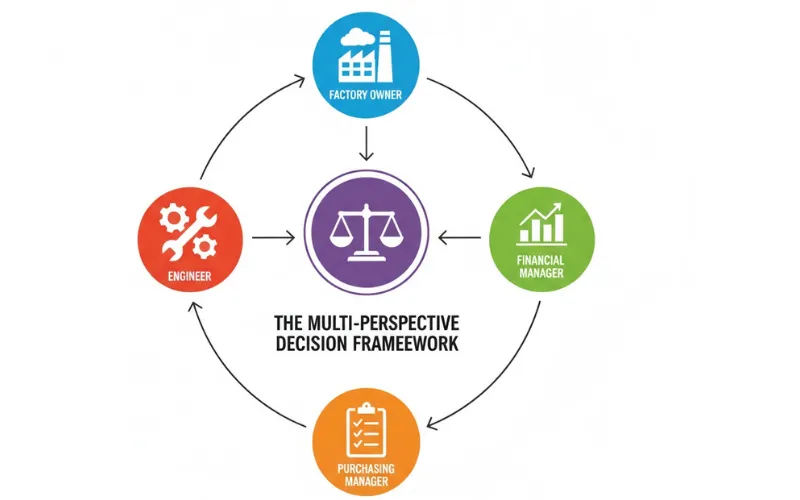
The purpose of this article is to cut through the fog. We will deeply analyze the core differences between these two classes of biscuit stacking systems from the unique perspectives of factory owners, financial managers, purchasing managers, and front-line electrical, mechanical, and maintenance engineers.
We will move beyond the superficial labels of "speed" and "flexibility" to explore Total Cost of Ownership (TCO), Return on Investment (ROI), system integration, maintenance challenges, and future-proof scalability. Our goal is to provide you with a clear, practical, and comprehensive decision-making framework.
Key Takeaways
Strategic Positioning: Mechanical stackers (Star Wheel/Penny) are "Efficiency Specialists" optimized for a single task, ideal for high-volume, low-mix production. Robotic stackers are "Versatile Platforms," built for high-flexibility, multi-product, and future-proof production.
The Financial Truth (TCO): Mechanical stackers have a low initial investment but hide high "changeover downtime costs" and "mechanical spare part costs." Robotics have a high initial investment but often win on 3-5 year TCO through labor savings, reduced breakage, and near-zero changeover time.
Flexibility is the Key: The greatest value of a robotic system lies in its "minute-level" product changeover capability. This allows a factory to rapidly respond to market demands (like variety packs or seasonal products), whereas the "hour-level" changeover of mechanical systems is their biggest pain point.
The Integration Challenge: Robotic automation is not just buying a machine; it's a complex integration project. The biggest technical difficulties and risks lie in the software, electrical (PLC communication, safety), and integration with the existing line.
The Human Factor: Shifting to robotic automation requires a parallel "skill-set upgrade." The maintenance team must evolve from traditional "mechanics" to "mechatronics technicians" who understand electrical systems and software.
II. The World of Traditional Mechanical Stackers
Definition: Traditional mechanical stackers are purpose-built machines designed for a specific stacking pattern, typically used in High-Volume, Low-Mix (HVLM) production lines. They are marvels of mechanical engineering, designed to execute a single, fixed task with extremely high speed and repeatability.
2.1 Type 1: Penny Stackers
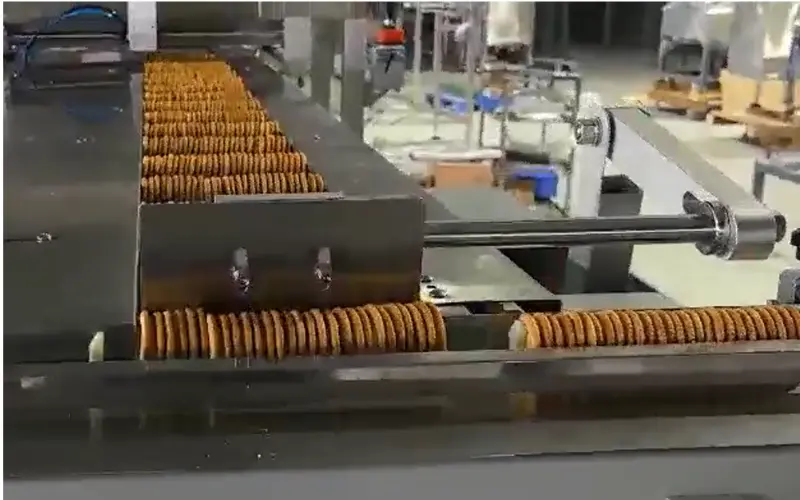
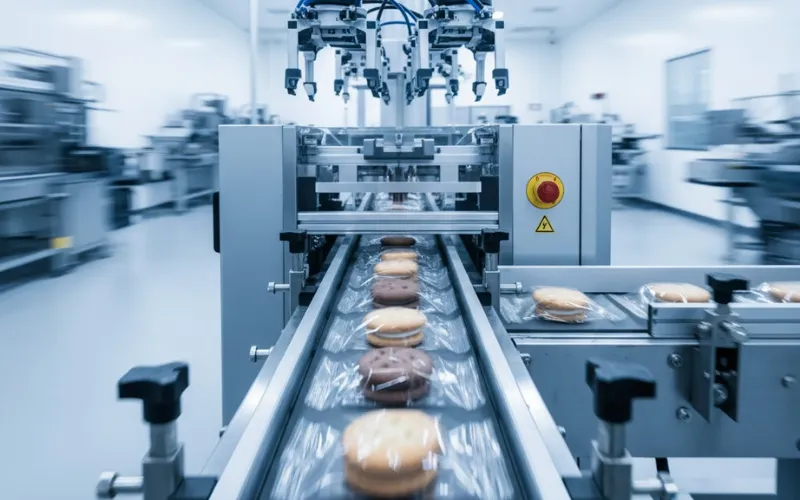
The name "Penny Stacker" vividly describes its function: like stacking a roll of pennies, it stacks biscuits in a "flat stacking" orientation into a vertical pile.
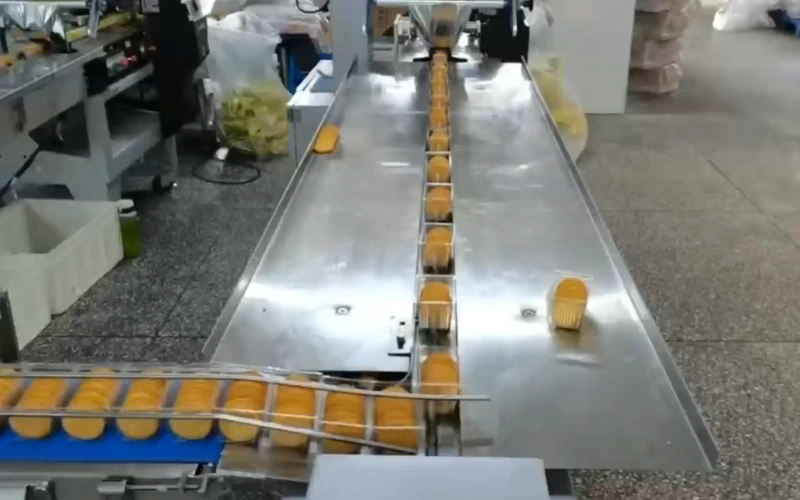
Function: To take flat-lying round or square biscuits from a cooling conveyor and create flat, vertical piles of a fixed count.
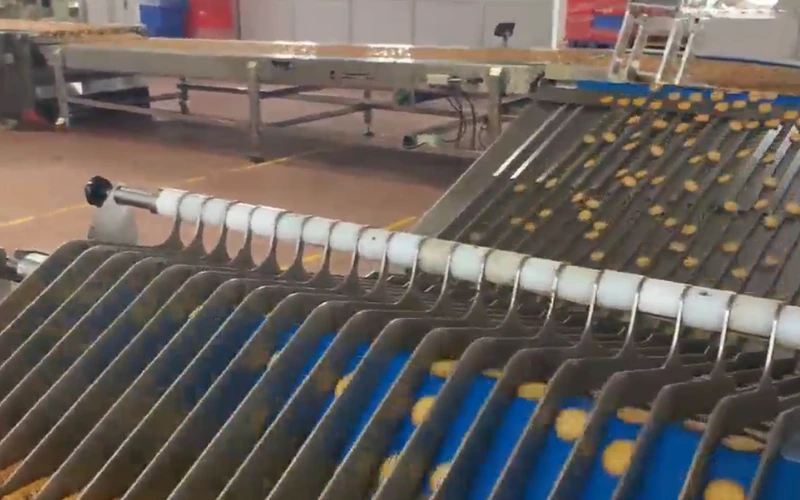
How it Works: The core principle usually combines vibration, gravity, and clever mechanical guides. Biscuits are first fed into one or more lanes.
Inside the lane, a vibratory bed or small rotating wheels gently "nudge" or "push" the biscuits, causing them to slide down one by one and stack neatly on top of the biscuit below. When the stack reaches a preset count (e.g., 6 or 8), a mechanical pusher or servo-controlled gate activates, pushing the entire pile flat onto the infeed conveyor of the packaging machine.
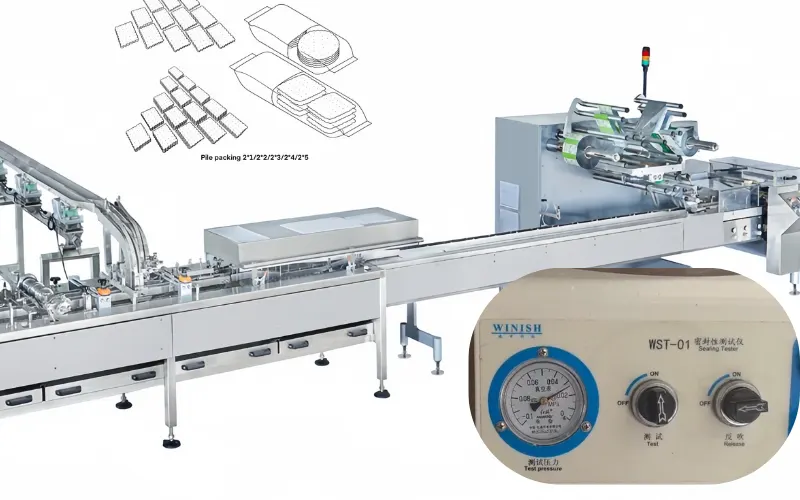
Primary Application: Exclusively suited for "pile packs"—the format you see in supermarkets where multiple biscuits are stacked flat, common for digestives, soda crackers, or butter cookies.
Advantages:
Extreme Speed: On its single, dedicated task of flat stacking, its speed is exceptional and can easily match high-speed packaging machines.
Mature Technology: Proven for decades, the technology is extremely mature and runs stably.
Cost-Effective: Compared to robotics, its initial capital expenditure (Capex) is generally lower.
Limitations:
Rigid Functionality: It is designed to do one thing: stack flat. If the market demands the same biscuit be packaged "on-edge," this machine is completely useless, offering zero flexibility.
Product Limitations: It struggles to handle irregular shapes, highly fragile products, or biscuits with sticky coatings (like jam or chocolate), which can easily cause jams or breakage.

2.2 Type 2: Star Wheel Stackers
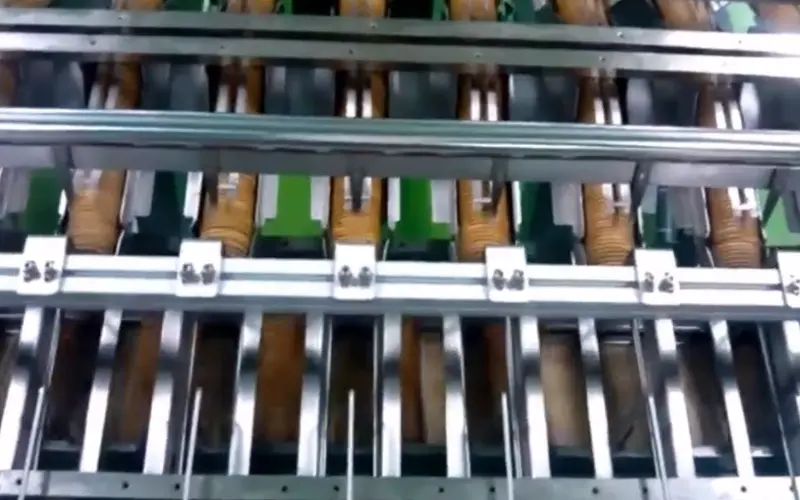
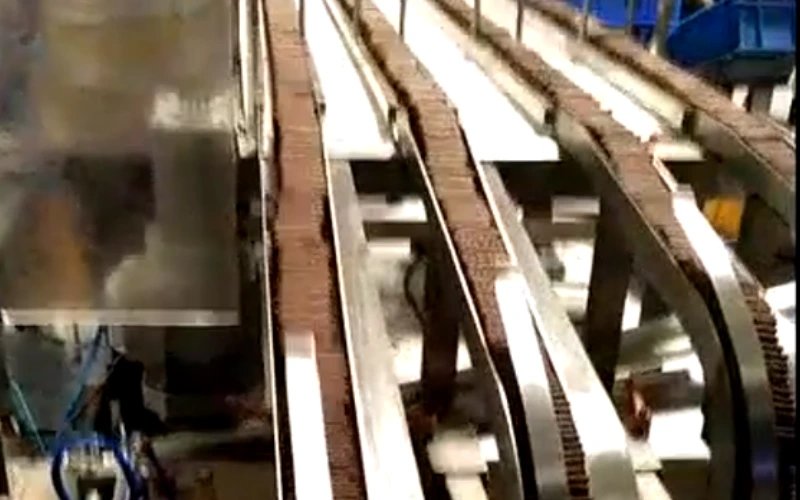
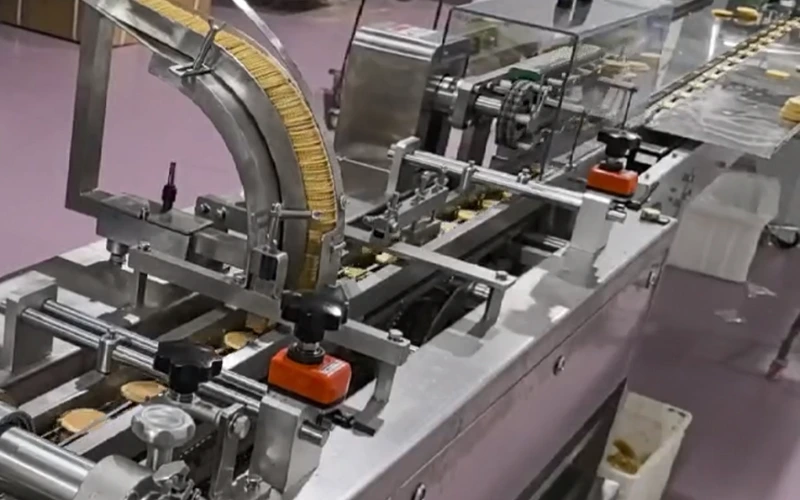
The Star Wheel Stacker is one of the most common and efficient biscuit stacking machines in the industry, designed specifically for "on-edge stacking."
Function: Its core task is to take biscuits lying flat on the cooling conveyor, precisely flip them 90 degrees so they are standing vertically (on-edge), and arrange them neatly into one or more lanes.
How it Works: This is pure, precision mechanical synchronization.
Infeed: Biscuits are first guided into a progressively narrowing channel.
Flip & Grab: The edge of the biscuit makes contact with a vertically rotating wheel that has multiple "pockets" or "slots"—this is the "Star Wheel."
On-Edge Stacking: The rotation of the star wheel "scoops" the biscuit, flips it 90 degrees, and "inserts" it into a parallel fixed guide (often called a "magazine").
Pushing: The biscuits behind continuously push the biscuits in front, forming a continuous, compact, standing "slug" (or lane) of biscuits.
Primary Application: Its sole purpose is to directly feed a horizontal flow-wrapper or roll-wrapping machine. This "slug" of biscuits is precisely cut into a fixed length (e.g., 12 biscuits) and then fed into the packaging film, forming the common "on-edge" biscuit roll.
Advantages:
Unmatched Speed: For on-edge applications, the speed of a star wheel stacker is astonishing. Its throughput can perfectly match top-tier flow-wrappers handling hundreds of packs per minute, ensuring maximum line efficiency.
High Integration: It is tightly integrated with the downstream packaging machine, forming a continuous-flow production unit.
Robust & Durable: The construction is solid, typically stainless steel, and designed for 24/7 operation.
Limitations:
Extremely Low Flexibility: The "pockets" of the star wheel are precision-molded for a specific biscuit diameter and thickness.
Disastrous Changeover Times: If the factory needs to run a different biscuit with a significant change in diameter or thickness, the maintenance engineer must stop the line. They have to remove guards, loosen bolts, swap out the entire (and often heavy) star wheel, and manually re-adjust all guide rail widths with tools (like calipers).
This process is typically measured in hours (e.g., 2 to 5 hours). From a Financial Manager's perspective, this is expensive downtime with zero output.
Note: The biggest "hidden cost" of a mechanical stacker is not maintenance; it is the production downtime caused by changeovers. Financial managers must quantify this loss when calculating TCO.
III. Modern Robotic Stacking Solutions
Definition: A robotic stacking solution represents a fundamental paradigm shift. It no longer relies on dedicated mechanical structures.
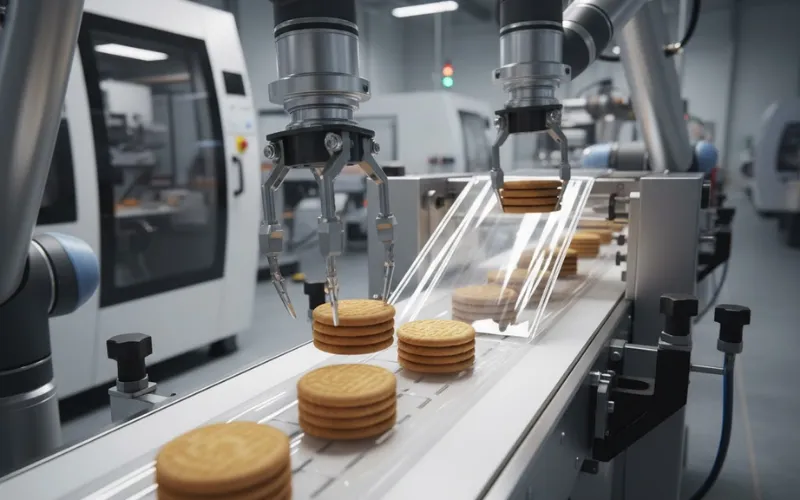
Instead, it uses programmable industrial robots (typically Delta robots), advanced vision systems, and custom end-effectors to dynamically "pick" and "place" biscuits from a moving conveyor belt.
3.1 Core Technology: The Delta Robot
The Delta Robot, known for its "spider-like" appearance, is the perfect choice for "Pick & Place" applications in the food industry.
How it Works: Unlike the 6-axis articulated robots we often see, a Delta robot uses three or four parallel, lightweight (often carbon-fiber) arms driven by servo motors.
This parallel kinematic structure gives its "wrist" (where the gripper is mounted) extremely high acceleration (up to 10-15 Gs) and incredible speed, all while maintaining high precision. It is designed specifically for high-speed grabbing of small, lightweight items from above.
Key Component 1: Vision Systems
Role: This is the robot's "eye" and the core of its flexibility. One or more high-speed industrial cameras are mounted above the conveyor, taking real-time pictures of the biscuits flowing underneath.
Advantage: The vision system enables "Dynamic Conveyor Tracking." This means:
No Positioning Needed: Biscuits can be in any position, at any angle, or even in a chaotic, jumbled state on the cooling belt.
Real-Time Identification: The vision software identifies the X, Y coordinates and rotation (Theta) of every single biscuit in milliseconds.
Quality Control: More advanced 2D or 3D vision systems can even identify broken, misshapen, unevenly coated, or out-of-spec products on the fly. It then instructs the robot not to pick them, performing quality control at the source.
Key Component 2: End-of-Arm-Tooling (EOAT)
Vacuum Suction Cups: The most common method. A vacuum generator creates suction, allowing flexible, food-grade silicone cups to "lift" the biscuit. This is very effective for flat, hard biscuits (like soda crackers).
Soft Grippers: Pneumatically-driven, flexible grippers that mimic human fingers. They can gently "pinch" irregularly shaped or coated products (like chocolate or icing) without causing damage.
Customization: The EOAT is often highly customized. It can be designed to pick 1, 4, or even 10 biscuits at a time to meet throughput demands.
Role: This is the robot's "hand," which directly contacts the product. For fragile biscuits, the design must be extremely gentle.
Types:
3.2 Application Flexibility
This is what makes the robotic biscuit stacking system revolutionary. It isn't a "stacker"; it's a "multi-function processing platform."
High-Speed Pick & Place: This is the robot's basic function. It can execute any programmed action, including (but not limited to) flat stacking, on-edge stacking, and sorting.
Tray Loading: This is a task that mechanical stackers are almost incapable of performing. The robot can precisely place delicate biscuits, cookies, or small cakes one-by-one into the specific pockets of a thermoformed plastic tray, far exceeding human speed and accuracy.
Complex Patterns & Variety Packs: This is where the highest value lies.
Scenario 1: A holiday gift box requires a mix of "4 vanilla + 3 chocolate + 2 strawberry-filled" biscuits.
Scenario 2: Biscuits need to be placed in an artistic "pinwheel" or "checkerboard" pattern in a high-end box.
For a mechanical system, this is impossible. For a robot, this is merely loading a new program, telling the vision system to identify the different types of biscuits, and placing them at new coordinates.
IV. Core Comparison: Robotic vs. Mechanical Stacking
Now, we will expand the comparison into a deep analysis that is critical for decision-makers.
Deep-Dive Analysis:
The Truth About Flexibility (Changeover Time):
For a financial manager, those 4 hours of downtime are 4 hours of "zero sales revenue" and "fixed expenses for labor and utilities."
The entire changeover time might be 10 minutes. Even swapping the EOAT is just a quick-lock action. This is a leap from "hours" to "minutes."
Robotic: "High flexibility" means "instant market response." When the marketing department wants to launch a "Christmas Limited Edition" mix, the factory simply selects the new "Recipe" on the robot's HMI (Human-Machine Interface).
Mechanical: "Low flexibility" means "high downtime costs." For a maintenance engineer, changing a star wheel is heavy manual labor and a delicate alignment job.
The Myth of Speed & Throughput:
Therefore, the robotic system's total throughput can be precisely configured to meet demand, with room to add more robots in the future.
"Mechanical is faster" is a common misconception. To be precise, a star wheel stacker's peak speed for the single task of "on-edge stacking" (e.g., 300-500 biscuits/minute) may be higher than a single robot.
A robot's speed (e.g., 120-150 picks/minute) is scalable. If a line requires 600 picks/minute, the system integrator will design a work cell with 4 or 5 robots working in coordination over the same conveyor.
The Value of Product Breakage (Yield Rate):
Mechanical stackers rely on "guiding" and "pushing." Biscuits scrape and collide in stainless steel guides. For fragile soda crackers or coated biscuits, this causes edge breakage and surface scratches.
Robotics is about "picking." The vision system actively skips biscuits that are already broken. This has two huge benefits:
It doesn't put crumbs into the final package, improving product quality.
It prevents broken pieces from entering the expensive downstream flow-wrapper, avoiding jams or failed heat-seals caused by debris. This directly improves the Overall Equipment Effectiveness (OEE) of the entire line.
Tip: By using its vision system to actively reject non-conforming products (broken, misshapen), the robot is not just a stacker. It is also a frontline "online Quality Control (QC)" station, which is vital for protecting expensive downstream packaging machines from damage.
V. Deep-Dive Financial & ROI Analysis (The Differentiator)
This is the most critical section for the Factory Owner and Financial Manager. Buying a biscuit stacker is not just a purchase; it's a financial investment.
5.1 Capex (Capital Expenditure) vs. Opex (Operating Expenditure)
Mechanical: A typical low Capex, high Opex model... or is it? This is a trap.
Its Operating Expenditure (Opex) looks low (power, lubricant), but it hides massive "changeover downtime costs" and "mechanical spare part costs" (custom star wheels, guides, etc.).
Robotic: A typical very high Capex, low Opex model. Its Opex is mainly in energy and specialized maintenance.
However, a new "Robot-as-a-Service" (RaaS) model is emerging. This allows factories to "lease" the robotic equipment for a monthly fee, turning a high Capex into a predictable Opex and dramatically lowering the barrier to adoption.
Analysis: The financial manager must evaluate cash flow. Is it better to pay $100,000 in one-time Capex, or $3,500 a month in Opex? This depends on the company's financial strategy.
5.2 Total Cost of Ownership (TCO) Comparison
TCO (Total Cost of Ownership) is the only correct way to evaluate this investment, as it looks beyond the simple "automated biscuit stacker price" tag.
Mechanical TCO (5-Year Model):
TCO = Initial Purchase Cost +
Energy Costs +
Maintenance Costs (High cost of mechanical spares + labor hours) +
(The Giant Hidden Cost) Changeover Downtime Cost (e.g., 4 hours/change * 3 changes/week * 50 weeks/year * 5 years * Value of line output/hour) +
(Hidden Cost) Product Breakage Cost (e.g., 2% breakage rate * Annual Production * Cost per product)
Robotic TCO (5-Year Model):
TCO = Initial Purchase & Integration Cost +
Energy Costs (Often lower, as it only uses high power during motion) +
Maintenance Costs (Specialized skill labor hours + Software licenses [if any]) +
(Extremely Low) Changeover Downtime Cost (e.g., 15 min/change * 3 changes/week * 50 weeks/year * 5 years * Value of line output/hour) +
(Extremely Low) Product Breakage Cost (e.g., 0.5% breakage rate)
5.3 Key Drivers of Return on Investment (ROI)
How does the high investment in robotics pay for itself?
Labor Savings (The Most Direct):
One robotic cell can often replace 2-3 workers per shift responsible for manual loading, sorting, or tray packing. On a 3-shift operation, this could be 6-9 total employees.
Calculation: (Total annual cost of 8 employees [wages + benefits]) * 5 years = The primary source of ROI. In an era of labor shortages and rising wages, this is the most urgent driver.
Reduced Changeover Time (The Most Overlooked):
Scenario: Mechanical stacker has 3 changeovers/week at 4 hours each. Robot has 3 changeovers/week at 15 minutes each.
Calculation: Weekly savings = (4 * 60 - 15) * 3 = 675 minutes = 11.25 hours.
Annual Gain: 11.25 hours/week * 50 weeks/year = 562.5 hours/year of additional production time.
Value: 562.5 * (Value of line output per hour) = Hundreds of thousands of dollars in extra revenue, per year.
Reduced Breakage Rate (Improved Yield):
Scenario: Mechanical breakage rate is 2%. Robotic rate is 0.5%.
Calculation: This saves 1.5% of all raw material, energy, and packaging costs. That money is converted directly into pure profit.
Financial Summary: The mechanical stacker is "visibly cheap, but invisibly expensive." The robotic stacker is "visibly expensive, but demonstrably profitable."
Note: For financial decision-makers, the key mental shift is to stop viewing the
biscuit stackeras a "Capital Expense (Capex)" and start seeing it as an "Investment." A mechanical machine is a depreciating asset. A robot is a revenue-generating asset, whose ROI is realized in reduced operational costs and increased production flexibility (new capacity).
VI. Implementation, Integration & Maintenance (The Differentiator)
This section is written specifically for Purchasing Managers, Mechanical Engineers, Electrical Engineers, and Maintenance Engineers to address their most pressing "go-live" concerns.
6.1 Physical Integration & Utilities (Mechanical Engineer's View)
Footprint & Mounting:
Mechanical: Floor-mounted, linear design. It must be "cut into" the existing production line, taking up valuable floor space. Installation requires precise physical alignment.
Robotic: Overhead-mounted. The robot body and its gantry (frame) are installed directly above the conveyor belt. This is a massive advantage, as it takes up almost zero floor space and can be "bridged" over existing equipment, making integration and retrofitting much easier.
Utilities:
Mechanical: Primarily requires electrical power.
Robotic: Requires not only high-quality power (servo systems are sensitive to power quality) but also a large, clean, and dry supply of compressed air (for vacuum generators and pneumatic grippers). If the factory's air quality is poor (contains water or oil), it will be a primary source of failure for the robotic system.
6.2 Software & Electrical Integration (Electrical Engineer's View)
This is often the single biggest technical challenge when integrating a robotic system.
Control Systems: This is a "conversation between two countries." The robot has its own independent controller (e.g., a FANUC R-30iB or ABB IRC5), which is a "black box."
The entire biscuit line (from oven to wrapper) is controlled by a master PLC (e.g., a Siemens S7-1500 or a Rockwell ControlLogix).
Communication Protocol:
The two must talk to each other. The electrical engineer must ensure the robot controller and the master PLC are communicating at high speed over an industrial Ethernet protocol, such as PROFINET (in a Siemens environment) or EtherNet/IP (in a Rockwell environment).
The master PLC needs to tell the robot: "Start," "Stop," "Change to Recipe A." It also needs to receive status from the robot: "Running," "Fault," "Vision system sees a bad part."
Safety Standards:
When any person hits any E-Stop button on the line, the robot must immediately stop in a "Safe Torque Off (STO)" mode, not continue moving at high speed. This is the most critical part of the integration.
Tip: For Electrical Engineers, the biggest risks in robotic integration are "communication and safety." Before the project begins, you must finalize a detailed Control Architecture diagram and communication protocol (PROFINET/EtherNet-IP) with the integrator and clarify how the safety-rated (PL/SIL) stop circuit will be implemented.
6.3 Suppliers & Purchasing (Purchasing Manager's View)
The Supplier Ecosystem:
Mechanical: Purchasing is relatively simple. You often buy it as a standard "add-on" from the flow-wrapper supplier or the turnkey line provider. There is a single point of responsibility.
Robotic: Purchasing is more complex. You typically do not buy directly from FANUC or ABB (the robot arm manufacturers). You need to find a "System Integrator."
The System Integrator is the key: They are responsible for selecting the components (robot, vision, EOAT), designing the frame, writing all the software (PLC and robot), installing, commissioning, and taking responsibility for the entire cell. Purchasing managers must rigorously vet an integrator's past case studies in the food industry.
Lead Time:
Mechanical: Standard parts. Lead time might be 8-16 weeks.
Robotic: Highly custom engineering. Design, fabrication, programming, testing... the lead time can be 20-30 weeks. This must be planned for well in advance.
Service Level Agreement (SLA):
The purchasing manager must define the SLA in the contract. When this expensive robotic system goes down, how many hours until the integrator responds? Do they have a local spare parts depot?
6.4 Long-Term Maintenance & Skill Sets (Maintenance Engineer's View)
This is the "gut-check" question from the maintenance shop: "How am I supposed to fix this new 'monster'?"
Maintenance Complexity:
Mechanical: This is the maintenance engineer's "comfort zone." It's the chains, gears, bearings, and grease they know. It's "wrench and hammer" work. The downside: high mechanical wear and a need for high-frequency preventive maintenance (greasing, adjusting chain tension).
Robotic: This is the maintenance engineer's "fear zone." It's a "black box." Maintenance becomes plugging in a laptop, reading fault codes, and checking servo loads on a teach pendant. Its mechanical maintenance cycle is very long (e.g., gearbox oil change every 5 years), but troubleshooting is a highly specialized skill.
The Skill-Set Shift:
This is the biggest challenge for the factory. The plant can no longer hire just "mechanics" and "electricians."
The factory must invest in training, upgrading existing staff into "Mechatronics Technicians"—people who understand mechanics, electrics, and a little software programming. Otherwise, the factory will be held hostage by the integrator's high-priced service calls.
Hygienic Design & Cleaning:
The bodies are smooth, with no hygienic dead zones. The overhead mounting leaves the floor underneath completely open and easy to clean.
This is an overwhelming win for robotics.
Mechanical: Full of hard-to-clean corners, crevices, chains, and lubrication points. Crumb and grease buildup create a breeding ground for microbes.
Robotic: Modern food-grade robots (often with a white coating) are designed for washdown environments. They carry IP67 (immersion-proof) or even IP6K9K (high-pressure, high-temperature washdown resistant) ratings.
VII. Conclusion: Making the Right Choice For Your Factory
The decision on which biscuit stacking machine to choose ultimately comes down to a strategic question: Are you optimizing your factory for "today" or investing for "tomorrow"?
When to Choose a Mechanical Stacker:
If your factory will produce a high volume of a single product for the next 5-10 years (e.g., you only make one size of soda cracker).
Your primary goal is the absolute maximum single-task speed and the lowest possible initial investment for that one line.
You do not anticipate frequent product changeovers, and your market demand is extremely stable.
When to Choose a Robotic Stacker:
If your production is "High-Mix, Low-Volume" (HMLV), with a wide variety of products (different sizes, shapes, coatings).
You need (or expect) frequent product changeovers to respond quickly to retailer and consumer demands.
Your product needs to be precisely placed into trays, is fragile, or requires creating variety packs.
You want to integrate quality control (vision inspection) into the stacking step and reduce your dependency on manual labor.
The New Strategic Summary (The Owner's View):
It is a "special forces operator" that can learn new skills at any time. Every piece of data the robotic system generates (production counts, reject rates, cycle times) is a valuable asset for your factory's digital transformation and OEE optimization.
The final decision is not just a technical choice; it is a business strategy.
A mechanical stacker is a tool for optimizing "today." It performs a defined task with maximum efficiency. It is an excellent "soldier," but it only knows one order.
A robotic stacker is a platform for investing in "tomorrow." It gives the factory the ability to handle market uncertainty and provides the data-gathering foundation for Industry 4.0.
VIII. Frequently Asked Questions (FAQ)
Q1: (From PPA) What is the real "automated biscuit stacker price"? Why does it vary so much?A1: The price range is enormous. A basic, Chinese-made mechanical star wheel stacker might cost only $10,000 - $20,000 USD.
A complete robotic cell with a single Delta robot, vision system, and safety guarding might start at $70,000 - $120,000 USD. A high-speed system requiring 4-5 robots, 3D vision, and complex grippers could easily exceed $500,000 USD.
The price difference is driven by: Speed (How many robots?), Flexibility (How complex is the vision system?), and Integration (How much line modification is needed?).
Q2: We are a smaller factory. Is there a small biscuit stacking machine for us?A2: Yes. For small to medium-sized enterprises (SMEs), there are two main options:
Smaller Mechanical Stackers: Many manufacturers offer simpler, slower-speed
stacker for cookiesunits designed to match medium-speed packaging machines.Cobots (Collaborative Robots): If your speed requirement is lower (e.g., 20-30 picks per minute), using a Cobot (like a UR or Aubo) with a simple vision system can be a very cost-effective entry into automation (around $30k-$50k USD), and it still provides all the flexibility of a robot.
Q3: (A real concern from Reddit engineers) "Robots look cool, but isn't it just an expensive toy? I feel like a traditional mechanical solution is cheaper, and the robot's maintenance costs must be way higher... Am I right?"A3: This is a very common and valid concern. You are correct about the initial cost, but you might be incorrect about the long-term operational cost.
Traditional Mechanical: Its maintenance cost feels "low" because your team is familiar with it. But its maintenance is high-frequency (greasing, adjustments, wear parts) and its biggest cost is "changeover downtime" (as shown in the TCO analysis).
Robotic: The type of maintenance is different. It has almost no mechanical wear parts and very long service intervals (e.g., gearbox oil change every 5 years). But it does require a "new skillset" (electrical, software).
Conclusion: The robotic system's Total Cost of Ownership (TCO) is often lower because it eliminates expensive changeover downtime and drastically reduces line stoppages from jams and breakage. It's not "more expensive"; it requires a different kind of maintenance.
Q4: (A Purchasing Manager's question) Should I buy directly from a robot manufacturer (like ABB or FANUC) or from a System Integrator?A4: You must find a System Integrator. The robot manufacturers (like FANUC) only sell the "bare robot" (the arm and the controller).
They do not build the gripper, install the vision, write the PLC program, or integrate it with your packaging machine. The System Integrator is your real partner; they deliver a complete "Turnkey Cell" that solves your "biscuit stacking" problem and takes responsibility for the final result.
Q5: (A QC question from Quora) "Why do the sandwich cookies I buy often have one side 'flipped' (chocolate side down)? Can't a mechanical stacker fix this?"A5: This is an excellent question that perfectly illustrates the fundamental difference.
Mechanical Stacker (like a Star Wheel): Cannot fix this. It is "blind." It relies on mechanical design to "assume" the biscuit is perfect. If a biscuit comes from the cooling conveyor already flipped, the star wheel will unknowingly stack it, leading to a product quality defect.
Robotic Stacker: Can fix this perfectly. The robot's "eye" (the vision system) doesn't just see the (X, Y) position; it also sees features. You can train the vision system to recognize the "top" (e.g., chocolate coating) and the "bottom."
When it detects a flipped biscuit, the system can either: 1) Tell the robot not to pick this bad part, rejecting it as waste, OR 2) (If equipped with a more advanced gripper) Pick the biscuit, flip it 180 degrees, and then place it correctly.
Q6: (An Owner's question) Can one robotic system handle several of my production lines?A6: Usually, no. A Delta robot stacking system is a high-speed, high-frequency piece of equipment that is "dedicated" to one production line (i.e., the outfeed of one cooling conveyor).
However, if you have multiple low-speed lines, you could design a single, central robot (like a 6-axis robot) to handle palletizing trays from multiple lines. But for the high-speed "stacking" step, it's one system per line.
IX. Take Action: Get Your Custom Stacking Solution Analysis
Choosing the right biscuit stacking system is a complex decision that will profoundly impact your factory's operational efficiency and competitiveness for the next decade. The data (TCO and ROI) doesn't lie, but getting the right data requires a professional analysis.
Don't let "uncertainty" stall your automation journey. Our team of experts has extensive experience in food industry automation, specializing in the integration of both mechanical and robotic systems.
Contact us today for a free, no-obligation production line evaluation. We will help you:
Analyze your current product mix and production bottlenecks.
Calculate the potential ROI and TCO savings of adopting a robotic system.
Evaluate the electrical and mechanical integration feasibility for your specific line.
Ready to start your journey toward a customized solution? Contact me directly on WhatsApp to begin the conversation.