Mastering Soft Dough: The Engineering & ROI Guide to Vacuum Cookie Cappers
Executive Summary: The Physics of the "Soft-Baked" Challenge
In the modern landscape of industrial baking, consumer preference has shifted decisively away from the "snap" of hard biscuits toward the "chew" of soft-baked goods. From artisanal macarons to moisture-rich sponge cakes, the premium segment is defined by texture.
However, for the Factory Manager, this shift presents a nightmare scenario. Soft dough products possess high moisture content and low structural rigidity, making them fundamentally incompatible with legacy automation. If you attempt to run a soft whoopie pie on a traditional pusher-style sandwiching machine, you will face catastrophic waste rates.
The Direct Answer:For soft dough applications, a Vacuum Cookie Capper is not merely an "alternative"; it is the only viable engineering solution. It abandons the brute force of mechanical pushing, utilizing fluid dynamics to handle products with "Zero Impact."
This guide serves as a ruthless technical audit, analyzing vacuum physics, porosity challenges, and the undeniable ROI of reducing waste from 8% to under 1%.
🚀 Key Takeaways
Physics Dictates Hardware: Soft dough lacks the compressive strength to withstand mechanical pushers. Vacuum is the only non-destructive method.
Porosity is the Enemy: Not all vacuum systems are equal. Sponge cakes require High-Flow Blowers, while macarons can run on standard Venturi systems.
The ROI of Integrity: By eliminating edge damage, a vacuum machine can recover $300,000+ in annual waste savings.
System Integration: Success depends on the entire line. Read our
for the full ecosystem view. Industrial Biscuit Sandwich Machine Guide
The Engineering Challenge: Why Soft Dough is a "Machine Killer"
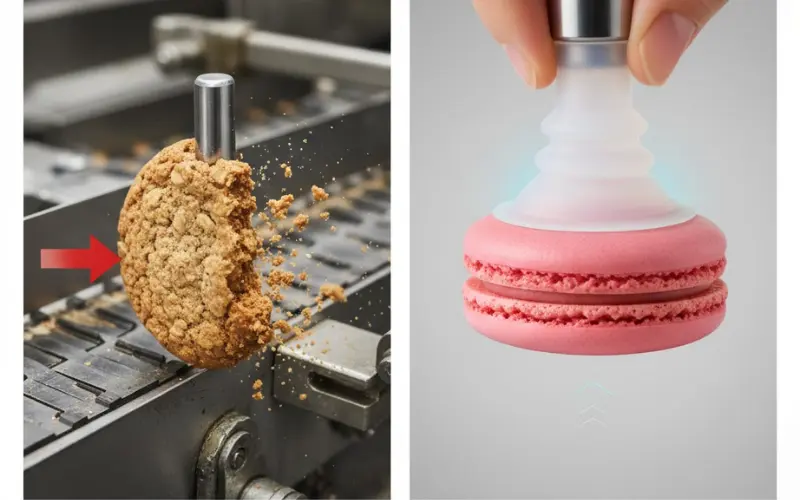
To understand why you need a cookie capper, you must first understand why your current equipment is failing. It is a failure of physics.
Structural Fragility: The Shear Stress Failure
Hard biscuits are rigid bodies. You can push them with a steel pin at high speeds, and they will slide. Soft cookies, however, are "Viscoelastic" materials.
External Resource:
(ScienceDirect) Viscoelastic Properties of Foods
When a mechanical pusher hits a soft cookie, the cookie absorbs the energy and deforms. The localized pressure exceeds the yield strength of the dough, causing the edge to crumble.
The Vacuum SolutionA vacuum cookie capper eliminates this side-impact entirely. It approaches the product from the Z-axis, lifting it against gravity. By distributing the holding force across the entire surface area, there is zero shear stress on the delicate edges.
Surface Irregularity: The Alignment Nightmare
Unlike rotary-moulded biscuits, soft cookies have an unpredictable "spread factor" during baking. Traditional machines rely on fixed-width rails, meaning a cookie 2mm wider than spec will jam.
The Fix:A robotic capper uses active centering or Vision Systems, ignoring edge irregularities.
Deep Dive: Dealing with non-round shapes? Read our
Rectangular Biscuit Alignment Guide Feeding Options: Deciding how to feed these irregular products? Compare
Magazine Feeder vs. Inline Automation
Technical Deep Dive: The Fluid Dynamics of Vacuum
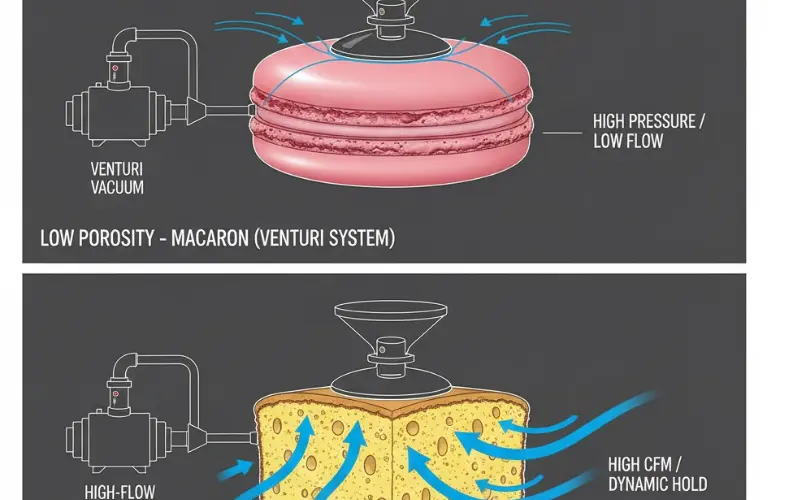
Most Engineering Managers make the wrong purchasing decision by assuming "Vacuum is Vacuum." The type of vacuum generation must match the Porosity of your product.
The Porosity Challenge: Venturi vs. High-Flow Pumps
Scenario A: The Macaron (Low Porosity)A macaron shell has a smooth, airtight skin.
The Solution: A standard Venturi Vacuum Generator. It utilizes Bernoulli's Principle to create high vacuum pressure (High Hg) with low airflow.
External Resource:
Bernoulli's Principle Explained
Scenario B: The Sponge Cake (High Porosity)A sponge cake is an open-cell structure. If you use a Venturi generator, air is sucked through the cake, breaking the seal.
The Solution: You must specify a High-Flow Regenerative Blower. This system prioritizes Airflow (CFM) over Pressure. It moves air faster than it can leak through the cake, creating a "Dynamic Hold."
G-Force Management: The Art of S-Curves
Picking up a soft cookie is easy; moving it at high speed without throwing it is hard. Standard pneumatic cylinders use "Bang-Bang" motion, generating massive G-forces.
The Servo Solution:Top-tier machines use independent servo motors programmed with an S-Curve Profile (Ease-In / Ease-Out). This gentle acceleration prevents the cookie from shearing off the cup.
Operations & Maintenance: Combating Contamination
The biggest fear with vacuum systems is clogging. "If we suck up crumbs, won't the pump burn out?"
The Vacuum Trap: Cyclonic Filtration
You cannot rely on simple paper filters.
Stage 1 (The Cyclone): Airflow spins rapidly, flinging heavy crumbs to the outer wall.
Stage 2 (Fine Mesh): Only microscopic dust reaches the secondary filter.
This design is crucial for hygienic operation. For a broader look at sanitary standards, consult our
External Standard:
EHEDG Guidelines for Food Processing Equipment
Suction Cup Material Science
Silicone Cups (Bellows): Best for smooth surfaces like Macarons.
Foam Cups: Best for rough surfaces like Oatmeal cookies.
Tooling: Ensure your machine supports fast swaps. Read our
Biscuit Machine Quick Changeover Guide
Filling Versatility: Beyond Simple Cream
Because the capping arm moves up and away, the bottom biscuit is left fully exposed, allowing for complex filling systems that wouldn't fit on a Stencil machine.
Handling "Non-Newtonian" Fluids
Soft cookies are often paired with difficult fillings: Marshmallow, Caramel, or High-Viscosity Jam.
The Challenge: These fluids "tail" and create spiderwebs.
The Fix: Equip the depositor with Servo Suck-Back or a Heated Wire-Cut mechanism.
Resource: For handling sticky jams, see our
Industrial Tart Injection Engineering Guide Resource: For complex rheology, refer to our
Biscuit Filling Viscosity Guide
The "Hybrid" Advantage
Need to run both plain and sandwiched cookies? Vacuum cappers are easily integrated into flexible lines. Learn how to design a
Financial Audit: The Waste Reduction ROI
Vacuum machines are expensive CapEx, but the OpEx savings are massive.
The Cost of Crumbs
Scenario: Producing premium soft cookies ($0.20/unit wholesale) at 600 PPM.
Legacy Pusher Machine: 8% Breakage = $576 Waste/Hour.
Vacuum Cookie Capper: <1% Breakage = $72 Waste/Hour.
The Annual Profit Impact:
Daily Savings (16 hours): $8,064
Annual Savings (300 days): $2,419,200
This calculation justifies the investment in under 3 months. For a deeper analysis of factory-wide efficiency, see our
Downstream Integration
A capper is only as good as the packaging machine behind it.
Synchronization: The capper must time delivery perfectly into the flow wrapper flights. Read
Biscuit Sandwicher & Flow Wrapper Synchronization Buffering: To prevent oven stops during micro-stoppages, install a buffer. See our
Biscuit Production Buffer Systems Guide
Conclusion: Embracing the Soft Revolution
The era of the mechanical pusher is ending for the premium biscuit market. Soft dough automation is no longer about brute force; it is about intelligent handling.
Choosing a Vacuum Cookie Capper is not just about buying a machine; it is about respecting the physics of your product.
Ready to Validate Your Process?
[Free Lab Service] Request a Porosity TestUnsure if your sponge cake needs a Venturi or a Blower? Send us samples.
[Explore the Ecosystem]Before you buy, understand how this machine fits into your total line.
Mini Biscuit Sandwich Machine Guide
Disclaimer: All engineering calculations regarding ROI are based on typical industry parameters.

Ready to start your journey toward a customized solution? Contact me directly on WhatsApp to begin the conversation.